Historically, US equities experience increased volatility and subdued returns during the first several months of a midterm election year. Once election results resolve legislative uncertainty, markets have often rebounded, and the S&P 500 has tended to post solid 12-month returns in many past cycles. However, long-term portfolio growth remains driven by underlying economic trends and corporate earnings rather than which political party wins.
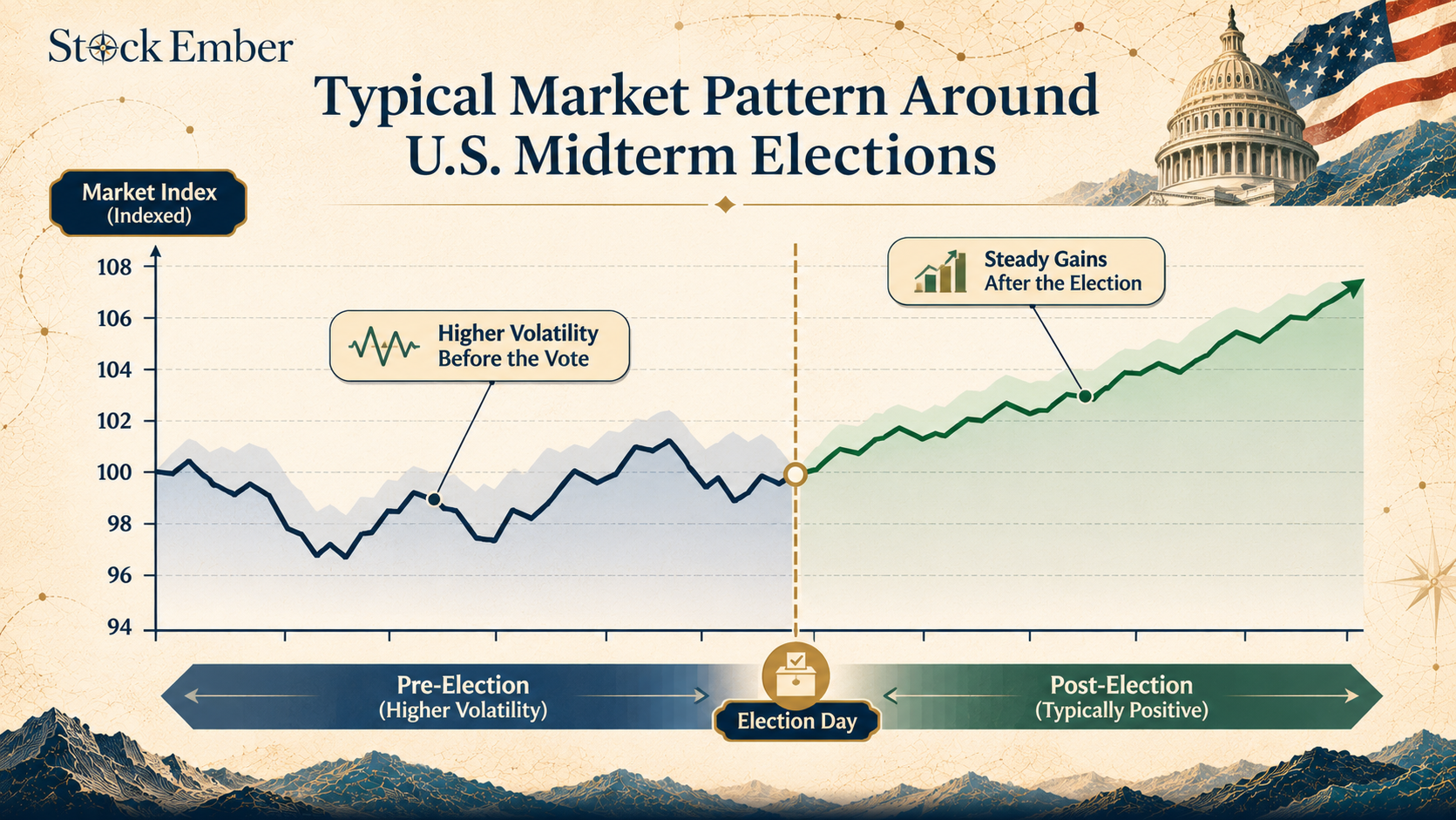
The stock market during midterm elections typically sees higher price swings before Election Day, followed by historically steadier gains once congressional power is settled.
Every 2 years, election headlines warn of major policy shifts, leaving investors unsure whether to hold their positions or move to cash. For long-term investors, political changes feel urgent, but history shows election noise matters far less than business earnings and interest rates.
This guide breaks down historical market patterns around midterms, how divided government shapes equities, and the behavioral traps to avoid.
Quick Takeaways
01The stock market during midterm elections often faces higher volatility in the first 10 months of the year before rebounding after Election Day
02Divided government, where neither party controls both the presidency and Congress, historically gives stocks a steady backdrop by preventing sudden legal overhauls.
03Fundamental economic forces like inflation, Federal Reserve interest rates, and corporate earnings drive equity growth far more than election outcomes.
04Moving to cash to avoid election swings often damages a portfolio's 10-year compounding by missing the sharpest recovery days.
What Are Midterm Elections and Why Wall Street Watches Them
Midterm elections are general elections held halfway through a president's 4-year term to decide which party controls Congress. All 435 seats in the House of Representatives and roughly one-third of the Senate seats are on the ballot. While midterms do not change the presidency, they can flip legislative control, reshaping federal policy for the next 2 years.
Wall Street watches closely because Congress writes laws that touch corporate earnings. Congressional committees set corporate tax rates, approve federal spending, and oversee industry regulation. Approaching elections with unknown outcomes makes estimating future business profits difficult.
For anyone investing in stocks, this policy ambiguity introduces systematic equity risk. Investors dislike uncertainty around tax codes and regulatory burdens. Consequently, many market participants pause capital commitments until ballots are counted. Once the vote concludes, policy fog clears, allowing businesses to plan with known rules.
How Midterm Years Play Out: From Pre-Election Dips to Post-Vote Relief
Midterm election years historically show a 2-part pattern: choppy trading leading up to November, followed by a relief rally once voters decide the outcome. Historical studies suggest the second year of a presidential term may be the weakest of the 4-year cycle, with intra-year pullbacks that have tended to run deeper than in other years.
Chart showing stock market volatility before midterm elections and market recovery after the vote
This pre-election weakness reflects a repricing of political uncertainty as investors price in worst-case scenarios for new levies or rules.
Once the election passes, the trend often flips. Historical data suggest the S&P 500 has tended to post positive 12-month returns after midterm elections, with average gains above typical yearly returns.
Yet, past performance is never a guarantee of future outcomes. This pattern is an empirical observation from about 19 midterm cycles since 1950, not an unbending financial law. External economic shocks can and do override seasonal tendencies.
Midterm Elections Stock Market Impact: The Divided Government Effect
The midterm elections stock market impact often shows up in how legislative power is divided between the White House and Capitol Hill. Voters frequently use midterm elections to check the sitting president's party, flipping one or both chambers of Congress to the opposing party. This creates divided government, or legislative gridlock.
While gridlock sounds unproductive in politics, financial markets often welcome it. When power is split, passing major tax hikes, sweeping regulatory shifts, or large spending packages becomes difficult. For businesses and long-term equity holders, political stalemate can mean greater policy stability. Companies can invest capital into research, hiring, and facilities without worrying that a single party will rewrite the rules.
Government Setup
Legislative Environment
Historical Market Reaction
Divided Congress
Major statutory overhauls stall
Historically solid; regulatory stability
Divided Government
Executive orders replace legislation
Historically positive; low tax change risk
Unified Government
Fast lawmaking; high policy shift risk
Mixed; higher policy uncertainty
Studies of past cycles suggest stocks have tended to rise under different government setups, and divided government has not reliably outperformed unified government, with relative results depending on the period studied. Still, gridlock is not a magic shield. If the broader economy enters a recession, a gridlocked Congress may struggle to pass timely fiscal relief, showing that political arrangements alone do not drive market health.
Why Macro Fundamentals Matter More Than Election Headlines
Macro fundamentals like interest rates, inflation, and corporate earnings drive stock prices far more over time than the party in power. While election night makes for dramatic television, corporate shares represent ownership stakes in real businesses. Over time, a company's share price tracks its ability to grow revenue, expand cash margins, and return capital to shareholders.
These 2 historical examples suggest that macroeconomic conditions can outweigh election cycles:
The 1974 Midterm Election: The S&P 500 dropped sharply in 1974 despite the election cycle, as the global oil embargo, stagflation, and aggressive Federal Reserve rate hikes deepened a bear market that began in 1973.
The 2022 Midterm Election: Equities struggled throughout 2022 because inflation surged to 40-year highs, forcing the Federal Reserve to implement rapid rate hikes. Even so, the S&P 500 still finished higher in the 12 months after the November 2022 vote, although the path along the way was uneven.
As financial education guidance from Investor.gov points out, investors with longer time horizons have the room to ride out short-term market swings rather than reacting to temporary headlines. Over long horizons, Federal Reserve monetary policy, labor productivity, and corporate profitability are likely to matter more to your portfolio than which party controls Capitol Hill.
3 Traps to Avoid When Elections Rattle the Market
Election seasons tempt investors into 3 costly mistakes: letting political bias dictate asset allocation, running to cash to avoid short-term drops, and chasing speculative policy bets.
1. Letting Political Bias Dictate Your Portfolio Investors frequently view the economy through a partisan lens. Many people appear to feel more optimistic about the economy when their preferred party holds the White House, and less so when the opposing party wins. Translating this bias into portfolio decisions is dangerous.
The US economy and stock market have grown under both Democratic and Republican administrations. Selling equities simply because you dislike the election outcome usually means missing out on long-term compound growth.
2. Moving to Cash to Wait for Clarity When pre-election market swings pick up, stepping to cash feels safe. Yet trying to time market swings around political events rarely works. The market's strongest days frequently occur right after deep drawdowns or immediately following election night clarity.
J.P. Morgan Asset Management research, based on historical S&P 500 data, found that missing just the 10 best trading days over a 20-year period roughly halved the ending value of a $10,000 investment. Market timing creates friction and lost compounding that takes years to repair.
3. Making Big Bets on Policy Winners and Losers Every election cycle brings headlines claiming certain sectors will thrive under a specific party. Conventional wisdom assumes traditional energy and defense stocks win under one party, while clean energy and healthcare win under another. In reality, actual market performance regularly defies these easy narratives due to global supply chains and commodity prices. Betting your capital on speculative policy outcomes is a gamble, not an investment strategy.
In practice, many long-term investors find that turning off financial cable news during October of a midterm year helps them avoid reactive trades. Reviewing your asset allocation once a year based on your personal financial goals often works better than checking the polls every day.
Conclusion: Stock Market During Midterm Elections
The stock market during midterm elections often experiences temporary swings, but political cycles rarely alter the multi-year trajectory of business earnings. Pre-election pullbacks have historically given way to market recoveries once legislative clarity returns, particularly when voters produce divided government. Rather than trying to outsmart election headlines or moving into cash, many long-term investors may be better served by staying disciplined with a well-diversified plan.
When you want to evaluate the platforms and accounts that support your long-term strategy, our broker reviews provide a practical place to compare your options. Keep in mind that all investing involves the risk of loss, and past historical patterns do not promise future returns, so use this guide as an educational starting point rather than personal financial advice.
FAQ
5 questions
Is the stock market open on Election Day?
Yes, major United States stock exchanges, including the New York Stock Exchange and Nasdaq, remain open for normal trading hours on Election Day. Federal elections always take place on the Tuesday following the first Monday in November, but Election Day is not a federal banking holiday. Market participants trade shares as usual while voting takes place nationwide.
Which political party is historically better for the stock market?
Historical data shows that broad equity markets have posted positive annualized compounding under both Democratic and Republican administrations. Market returns correlate far more closely with business cycles, corporate profit growth, and monetary policy than the party controlling the federal government. Portfolios built around partisan expectations tend to underperform balanced, long-term buy-and-hold strategies.
What happens to stock prices if election results are delayed or contested?
When election results remain undecided or face recounts, market volatility often lingers longer as investors price in continued policy ambiguity. During past contested elections, such as the 2000 presidential vote, equities traded lower or sideways until legal resolutions provided a clear winner. Once certainty returns, markets typically shift attention back to economic indicators.
How do midterm election outcomes affect Federal Reserve interest rate policy?
Midterm elections have no direct influence on Federal Reserve interest rate policy. The Federal Reserve operates as an independent central bank with a congressional mandate to pursue maximum employment and price stability. Policymakers adjust interest rates based on macroeconomic data such as consumer price inflation and employment reports, rather than changes in congressional leadership.
Do international stock markets react to US midterm elections?
Global stock markets frequently mirror US equity movements around midterm elections because American fiscal, trade, and regulatory policies influence global commerce. Export-heavy international markets pay close attention to potential changes in corporate tariffs, trade agreements, and federal spending. However, foreign stocks ultimately follow their domestic monetary conditions and local economic fundamentals over long holding periods.
Disclaimer
This guide was written with AI assistance and reviewed by the StockEmber editorial team for accuracy. StockEmber provides independent education, not personal financial advice. Investing puts your capital at risk: the value of investments can go down as well as up, you may get back less than you invest, and past performance doesn’t guarantee future results. Some links may support our work at no additional cost to you.
The StockEmber Team is our in-house desk of independent research writers. We test brokerage platforms, read the fine print on fees and custody, and cover ETFs and long-horizon investing for people who plan to hold for decades — not days.