The NYSE minimum stock price rule requires listed companies to maintain a closing price of at least $0.25 per share under Section 802.01C. If a security closes below this threshold on a single trading day, the exchange immediately initiates trading suspension and delisting proceedings with zero cure period.
The NYSE minimum stock price rule requires listed companies to maintain a closing price of at least $0.25 per share to avoid immediate trading suspension and delisting proceedings. Under Section 802.01C of the New York Stock Exchange Listed Company Manual, falling below this price on a single trading day triggers swift exchange action with no cure period.
For investors holding shares in micro-cap or distressed companies, a sudden exchange removal can create severe liquidity problems overnight. Knowing how this threshold works helps long-horizon investors evaluate portfolio risks, understand corporate remedies like reverse stock splits, and make informed choices when managing low-priced equity holdings.
Quick Takeaways
01A single closing price below $0.25 on the NYSE triggers immediate trading suspension and administrative delisting without a cure period, effective July 1, 2027.
02Micro-cap equities and distressed companies trading near $1.00 face the highest exposure to fast-track delisting risks.
03Corporations typically attempt reverse stock splits to raise their share price, though this accounting change does not alter fundamental business value.
04Delisted stocks move to over-the-counter (OTC) marketplaces, where lower liquidity and wider bid-ask spreads increase trading costs.
05Evaluating underlying business solvency rather than relying on low share prices protects portfolios from long-term capital loss.
What Is the NYSE Minimum Stock Price Rule?
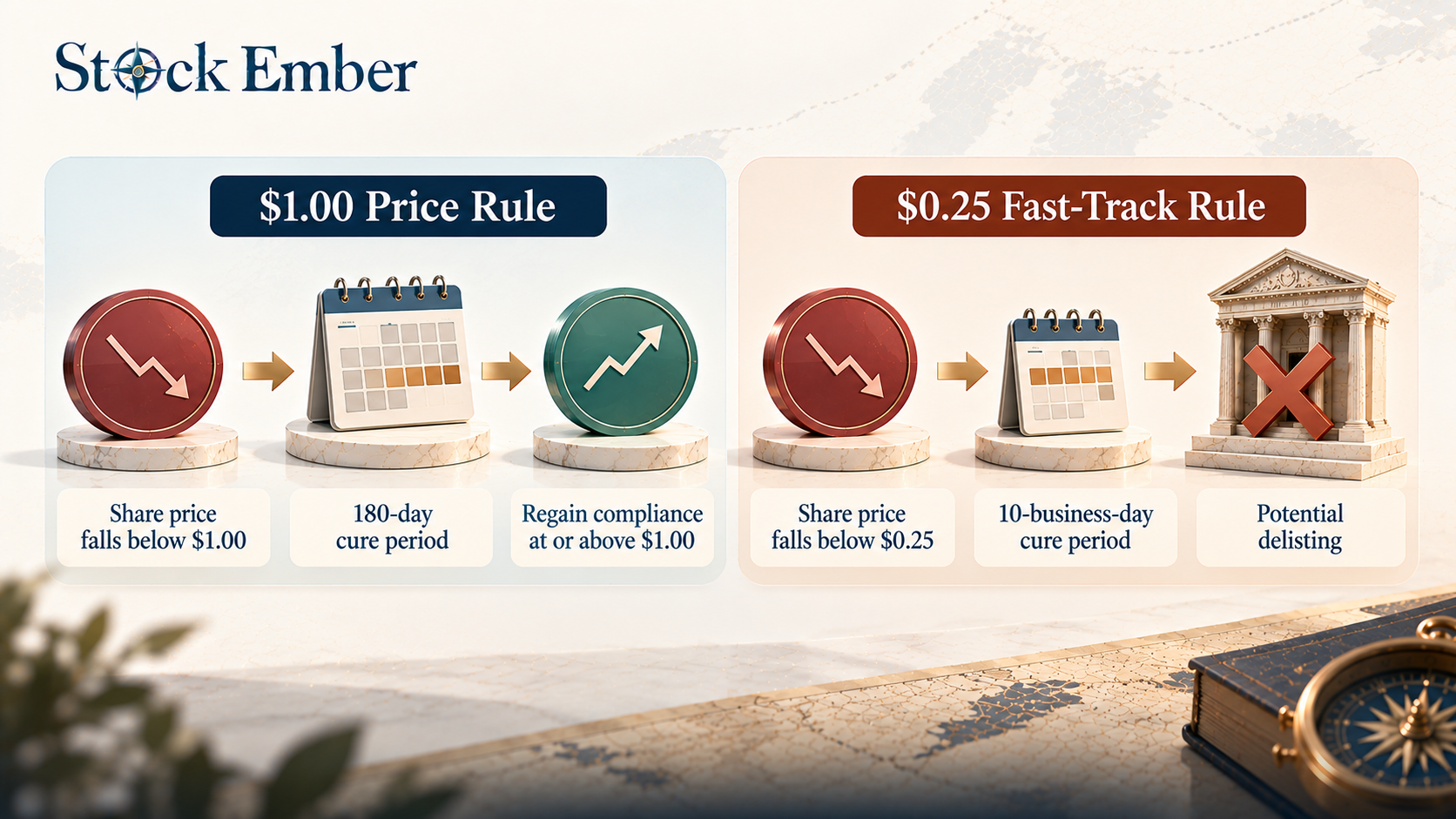
The NYSE minimum stock price rule is a listing standard that establishes the floor trading price required for securities to remain listed on the exchange. Historically, the New York Stock Exchange enforced a primary low-price standard based on an average closing price below $1.00 over a continuous 30 trading-day period. When a stock falls below that $1.00 mark, the exchange issues a non-compliance notice, granting the issuing firm a six-month cure period to restore its share price.
However, regulatory updates under Section 802.01C established a strict secondary floor. Under this standard, if a security closes below $0.25 on any single trading day, the exchange immediately initiates suspension and delisting proceedings.
The standard six-month grace period does not apply to shares crossing below $0.25. This structural change eliminates time for distressed issuers to rely on gradual market recovery, making compliance a daily operational priority for low-priced companies.
Comparison diagram of stock exchange $1.00 compliance cure period versus $0.25 immediate suspension threshold
How Immediate Suspension Triggers Work
An immediate suspension trigger activates the moment official market close data confirms a security traded below the $0.25 floor on the NYSE or NYSE American. Before the next trading session opens, the exchange halts trading in the affected ticker symbol. The exchange then issues a public notice and files regulatory forms with the U.S. SEC to formally begin removing the security from the main board.
Once suspended, shares can no longer execute trades through the exchange’s central order book. Instead, secondary trading moves down to unlisted over-the-counter (OTC) markets, such as the OTC Bulletin Board or Pink Open Market.
In practice, many long-term investors find that the sudden loss of main-exchange listing status causes an immediate contraction in order depth (the volume of buy and sell orders waiting at each price level), as automated market makers withdraw liquidity standards on national exchanges.
While investors retain legal ownership of their equity, buying or selling delisted shares becomes significantly more difficult.
Market Impact: Who Is Most Exposed?
Companies most exposed to the $0.25 threshold are early-stage growth firms, micro-cap equities, and financially distressed businesses trading under $1.00 per share. Businesses in capital-intensive sectors, such as biotech research, junior mining, or early clean technology, frequently issue equity to fund operations before generating consistent profits. When market sentiment turns or cash burn accelerates, these shares can drop into penny stock territory.
Large-cap companies rarely face this rule because their institutional ownership, diversified revenue streams, and broader equity base keep individual share prices well above single-digit dollars. For smaller enterprises, however, dropping into sub-dollar territory triggers a self-reinforcing downward cycle.
Many institutional funds operate under internal mandates prohibiting them from holding equities priced under $1.00 or traded off main exchanges. Forced institutional selling accelerates downward price momentum, pushing vulnerable companies closer to the $0.25 line.
Feature
Standard $1.00 Threshold
Fast-Track $0.25 Floor
Trigger Condition
30-day average close below $1.00
Single daily close below $0.25
Cure Period
6 months
None
Action Taken
Compliance warning letter
Immediate trading suspension
Target Exchange
NYSE / NYSE American
NYSE / NYSE American
The Wave of Reverse Stock Splits
To prevent sudden exchange removal, corporate directors frequently propose reverse stock splits at annual general meetings. A reverse stock split consolidates existing shares into a smaller number of higher-priced shares. For example, in a 1-for-10 reverse split, an investor holding 1,000 shares priced at $0.30 each receives 100 shares priced at $3.00 each.
New Share Price = Old Share Price * Split Ratio Consolidation Factor
While this mathematical change moves the share price above regulatory minimums, it leaves total company valuation unchanged.
Pre-Split Position: 1,000 shares * $0.30 = $300 total value
Post-Split Position: 100 shares * $3.00 = $300 total value
Exchange rules also discourage repeated split cycles. Under Section 802.01C, a company loses eligibility for the cure period if it has completed a reverse split within the prior year, or reverse splits with a cumulative ratio of 200-to-1 or more over the prior two years. In either case, the company faces immediate suspension and delisting proceedings.
Furthermore, a reverse split does not resolve underlying cash flow shortages or operational deficits. Without fundamental business recovery, market forces often pull post-split share prices lower over subsequent quarters.
Effect on Investors Holding Low-Priced Shares
Holding low-priced shares near listing boundaries exposes investor portfolios to operational and behavioral risks. When a stock moves to over-the-counter markets, trading volume drops sharply while bid-ask spreads widen.
A wider bid-ask spread means a larger gap between what buyers offer and what sellers demand. On OTC markets, this gap can meaningfully erode a trade's total value the moment an order executes, creating an immediate drag on capital.
Low share prices also invite lottery-ticket bias, a psychological tendency where investors view cheap stocks as asymmetrical upside bets regardless of business quality. In reality, a stock trading at $0.30 is not inherently cheap; its low price reflects the market's assessment of financial distress or equity dilution. Understanding this reality helps investors judge assets based on earnings and cash flow rather than unit share cost.
What Companies Can Do Instead
Beyond reverse splits, management teams have limited structural alternatives to maintain main board compliance. Some companies attempt strategic capital restructurings, securing new equity investment or converting outstanding debt into common equity to strengthen their balance sheets. Others focus on operational cost cuts or asset sales to restore positive cash flow and rebuild investor confidence.
If turnaround efforts fail, a company may voluntarily transfer its listing to lower-tier exchanges before triggering an abrupt trading halt. While voluntary transfer does not prevent share price declines, it gives shareholders a predictable transition timeline rather than an unannounced suspension notice.
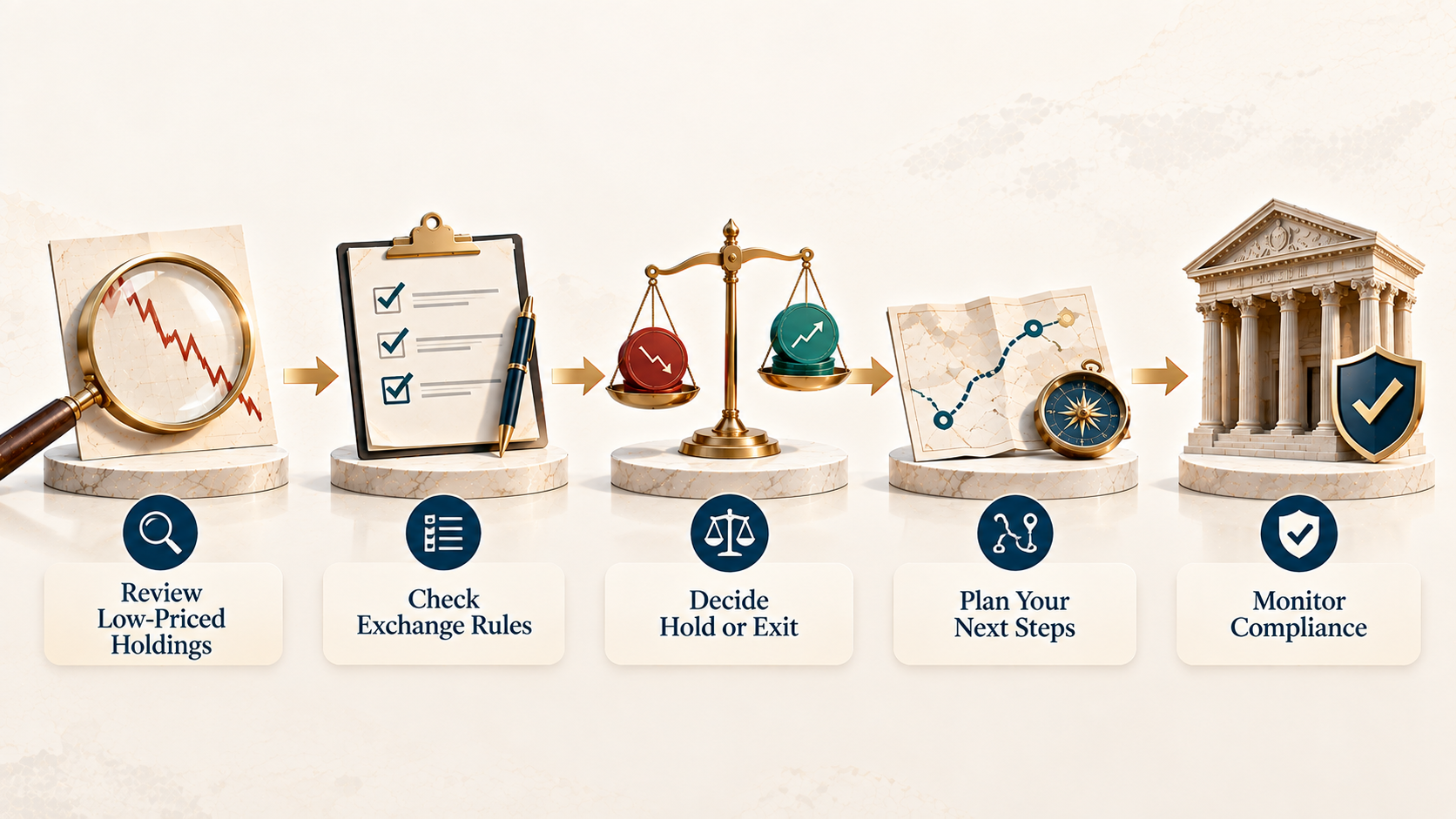
Graphic showing portfolio risk review steps for monitoring low-priced stocks
Investor Checklist: What to Review in Your Portfolio
When managing exposure to low-priced equities, evaluating listing health requires systematic quarterly checks.
Monitor Share Price Trajectories: Check whether any holding in your portfolio trades under $1.00 or approaches $0.25.
Read Proxy Ballot Proposals: Watch for corporate proxy statements requesting authorization for reverse stock splits, which signals management anxiety over listing compliance.
Assess Cash Runway: Examine balance sheet liquid reserves against monthly cash burn to verify if the business can operate without dilutive share issuances.
Review Institutional Ownership: Check whether institutional funds are reducing exposure, as declining institutional backing often precedes liquidity drops.
Seasoned portfolio managers often find that strict, rule-based position limits on micro-cap equities keep individual listing disruptions from derailing broader compounding goals.
Focusing on underlying business performance rather than short-term price movements remains the most effective defense against delisting surprises.
Conclusion
Understanding the nyse minimum stock price rules clarifies how exchange standards influence low-priced shares and market liquidity. The $0.25 immediate suspension rule removes grace periods for severely distressed companies, forcing management teams toward prompt structural adjustments like reverse splits. While consolidation changes share count numbers, long-term portfolio stability depends entirely on fundamental corporate earnings, balance sheet strength, and operational cash generation.
When you are ready to evaluate broader market assets for your long-term portfolio, exploring individual stocks provides a clear foundation for building a research strategy. Evaluating fundamental quality over nominal share price ensures your capital remains focused on durable compounding. Investing always puts your money at risk and past returns never promise future results, so treat this analysis as an educational resource rather than financial advice.
FAQ
5 questions
Which stocks will be affected by the NYSE $0.25 rule?
Early-stage growth companies, micro-cap equities, and financially distressed businesses trading near or below $1.00 per share face the highest exposure. These firms often experience low liquidity and cash burn, making them vulnerable to falling below listing price thresholds.
Will the NYSE minimum price rule cause more reverse stock splits?
Yes, corporate boards frequently use reverse stock splits to consolidate outstanding shares and elevate trading prices above listing thresholds. However, a reverse split alters share count and price proportionately without changing the underlying business valuation.
What happens to shares if a stock is delisted from the NYSE?
When a stock is delisted, trading moves to unlisted over-the-counter (OTC) marketplaces like the Pink Open Market. Shares usually suffer from significantly lower trading volume, wider bid-ask spreads, and reduced institutional interest.
Does the NYSE minimum stock price rule affect large-cap companies?
Large-cap companies are rarely affected because their broader institutional backing, substantial equity base, and diversified revenue streams keep unit share prices well above single-digit dollars.
When does the NYSE minimum price rule start?
The fast-track immediate suspension standard under Section 802.01C was approved by regulators with full market enforcement effective July 1, 2027.
Disclaimer
This guide was written with AI assistance and reviewed by the StockEmber editorial team for accuracy. StockEmber provides independent education, not personal financial advice. Investing puts your capital at risk: the value of investments can go down as well as up, you may get back less than you invest, and past performance doesn’t guarantee future results. Some links may support our work at no additional cost to you.
The StockEmber Team is our in-house desk of independent research writers. We test brokerage platforms, read the fine print on fees and custody, and cover ETFs and long-horizon investing for people who plan to hold for decades — not days.