A negative P/E ratio occurs when a company operates at a net financial loss, resulting in negative earnings per share (EPS). Because dividing a positive stock price by negative earnings creates misleading mathematical comparisons, financial platforms usually display the metric as "N/A" or "NE". Investors evaluating unprofitable companies rely instead on metrics like Price-to-Sales (P/S) and cash burn rate.
A negative P/E ratio occurs when a company's earnings per share (EPS) fall below zero, indicating that the business operated at a net financial loss over a given reporting period.
When evaluating potential stock investments, encountering a missing or negative price-to-earnings figure can be confusing. While traditional valuation metrics work well for profitable businesses, unprofitable companies require a different analytical framework. This simple guide explains why financial portals display negative P/E ratios as "N/A", how to distinguish between temporary growth losses and troubled companies, and which alternative metrics to evaluate instead.
Quick Takeaways
01A negative price-to-earnings (P/E) ratio means a company reported negative earnings per share (EPS) over the trailing twelve months.
02Financial websites usually display "N/A" or "NE" instead of a negative number to prevent mathematical confusion when comparing stocks.
03A negative P/E is common in early-stage growth companies reinvesting heavily, but it can also signal financial distress in mature firms.
04Investors evaluating unprofitable stocks should look at alternative valuation metrics like Price-to-Sales (P/S) and cash burn rate.
What Is a Negative P/E Ratio?
The negative P/E ratio meaning stems from basic financial accounting: the price-to-earnings ratio is calculated by dividing a company's current stock price by its earnings per share (EPS).
Price-to-Earnings Ratio = Share Price / Earnings Per Share
When asking what is a negative P/E ratio, the answer lies entirely in the denominator. If a company posts a net loss on its income statement over the past four quarters, its EPS becomes a negative number. Dividing a positive share price by a negative EPS produces a mathematically negative ratio.
So, what does a negative P/E ratio mean in practical terms? Put simply, what does a negative P/E ratio mean for shareholders is that the underlying business lost money during the reporting period. The company spent more money on operating expenses, interest, and production than it generated in revenue.
According to investor disclosure resources from the U.S. SEC, the P/E ratio measures how much investors are paying for each dollar of a company's earnings. When earnings disappear, the standard ratio loses its ability to measure relative value.
Why Financial Portals Display "N/A" Instead of Negative Numbers
If you search for an unprofitable company on major financial news portals, you will rarely see a negative number in the P/E field. Instead, most platforms, including Yahoo Finance and Bloomberg, show "N/A" (Not Applicable), "NE" (No Earnings), or a blank dash.
Financial websites suppress negative P/E ratios because the math creates misleading comparisons. In positive financial land, a lower P/E ratio generally indicates a cheaper stock relative to its earnings. A P/E of 10 suggests a lower valuation than a P/E of 30.
However, when earnings fall below zero, this mathematical logic breaks completely:
Stock A has a share price of $20 and an EPS of -$2.00, resulting in a P/E of -10.
Stock B has a share price of $20 and an EPS of -$1.00, resulting in a P/E of -20.
Mathematically, -20 is a lower number than -10. But Stock B actually lost less money per share than Stock A. Displaying negative P/E numbers would make Stock B look like a "cheaper" investment than Stock A, when in reality Stock B has healthier financial performance. Suppressing the metric prevents investors from mistaking negative earnings for a bargain valuation.
Is a Negative P/E Ratio Good or Bad?
When determining if a negative P/E ratio is good, the short answer is that a negative P/E is neither inherently good nor bad on its own, it depends entirely on why the company is losing money.
Unprofitable companies generally fall into two distinct categories:
1. Productive Growth Losses Young technology, biotechnology, and green energy firms often report negative earnings intentionally. These companies spend heavily on research, product development, and customer acquisition to build market share. In these cases, a negative P/E ratio represents early-stage growth reinvestment rather than business failure.
2. Destructive Structural Losses Mature companies that previously generated steady profits can fall into a negative P/E status due to declining sales, inefficient operations, or heavy debt interest payments. These losses signal operational trouble or a dying business model.
When building a portfolio and learning the basics of investing in stocks, distinguishing between these two categories requires looking beyond a single accounting period to examine revenue trends and management strategy.
Evaluating Unprofitable Stocks: Alternative Metrics
Because traditional price-to-earnings metrics fail when net income drops below zero, fundamental analysts rely on alternative valuation metrics to assess unprofitable companies.
Alternative Metric
Formula
What It Measures
Best Used For
Price-to-Sales (P/S)
Market Cap / Total Revenue
Value relative to annual sales
High-growth startups with rapid revenue
EV-to-Sales
Enterprise Value / Revenue
Valuation including debt and cash
Comparing capital structures across peers
Price-to-Free-Cash-Flow
Market Cap / Free Cash Flow
Cash generation before non-cash charges
Companies with heavy depreciation charges
Comparing enterprise value vs market cap is particularly useful for loss-making companies. Enterprise value accounts for a company's cash reserves and debt, showing the true takeover cost of the business regardless of temporary accounting losses.
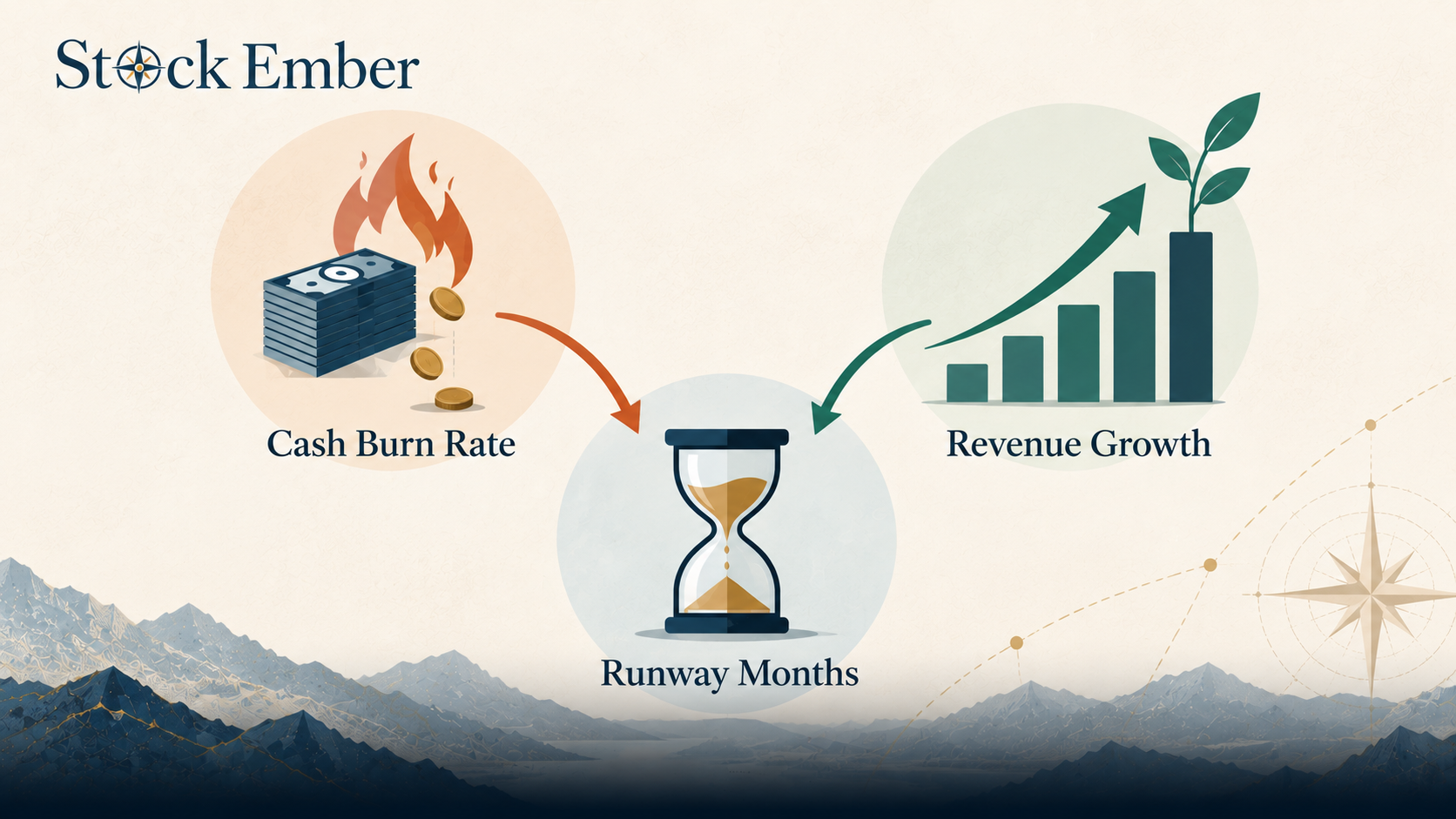
Additionally, investors must analyze the cash burn rate, how quickly a company uses up its cash balance each month. A loss-making business with a strong balance sheet can survive for years, whereas a company with rapid cash burn and high debt faces severe financial risk.
Risk Factors for Unprofitable Companies
Investing in companies with negative earnings carries significant capital risk that every long-term investor must understand before buying shares.
Equity Dilution Risk: Unprofitable companies constantly need cash to fund ongoing operations. If cash reserves run low, management may issue new shares of stock. While this brings in needed capital, it dilutes existing shareholders by shrinking their percentage ownership.
Insolvency Risk: Companies that burn cash without a clear path to profitability eventually risk running out of money. If debt maturities arrive and credit markets tighten, unprofitable firms face restructuring or bankruptcy.
Price Volatility: Stocks with negative earnings rely heavily on investor expectations about future growth rather than current cash flows. Any negative news or missed revenue target can trigger sharp share price drops.
Diagram illustrating cash burn rate and financial runway for evaluating unprofitable stocks.
In practice, many long-term investors find that holding individual unprofitable stocks requires constant monitoring of quarterly cash burn, whereas diversified index funds automatically manage this risk.
Conclusion
A negative P/E ratio indicates that a company is currently operating at a net financial loss, which leads most financial platforms to display the metric as "N/A" to prevent mathematical confusion. While negative earnings are common among early-stage growth companies reinvesting in their operations, they can also signal operational trouble in mature businesses.
For buy-and-hold investors focusing on broad index funds or diversified portfolios, individual accounting losses in single stocks carry far less risk, as index funds automatically spread capital across hundreds of profitable market leaders.
When evaluating trading software or research platforms to analyze company balance sheets, our broker reviews can help you find tools with detailed fundamental data. Investing always carries risk of capital loss and past performance does not guarantee future results, so treat this guide as educational context for your overall strategy.
FAQ
5 questions
What does a negative P/E ratio mean?
A negative P/E ratio means that a company generated a net loss over the trailing twelve months, causing its earnings per share (EPS) to fall below zero. It indicates the business spent more on operating costs, debt, and production than it earned in revenue.
Is a negative P/E ratio good?
A negative P/E ratio is neither good nor bad on its own. For early-stage growth companies, net losses often reflect productive reinvestment in expanding market share. However, for mature companies, negative earnings frequently signal declining revenue, high debt burdens, or operational distress.
What is a negative P/E ratio definition?
A negative P/E ratio definition describes a financial valuation metric where a stock's current market price is divided by a negative earnings per share figure. Because the resulting negative ratio distorts relative valuation comparisons, data providers typically classify the metric as Not Applicable (N/A).
Why do financial websites show N/A instead of a negative P/E?
Financial platforms display "N/A" or "NE" because negative P/E ratios create inverted mathematical logic. A company losing $2 per share yields a P/E of -10, while one losing $1 per share yields -20. Displaying -20 would wrongly suggest the larger loss is a "cheaper" stock.
What alternative metrics should you use when P/E is negative?
When P/E is negative, investors evaluate Price-to-Sales (P/S) to measure valuation relative to revenue, Enterprise Value-to-Sales (EV/Sales) to account for debt and cash, and the monthly cash burn rate to determine how long the company can operate before needing additional capital.
Disclaimer
This guide was written with AI assistance and reviewed by the StockEmber editorial team for accuracy. StockEmber provides independent education, not personal financial advice. Investing puts your capital at risk: the value of investments can go down as well as up, you may get back less than you invest, and past performance doesn’t guarantee future results. Some links may support our work at no additional cost to you.
The StockEmber Team is our in-house desk of independent research writers. We test brokerage platforms, read the fine print on fees and custody, and cover ETFs and long-horizon investing for people who plan to hold for decades — not days.