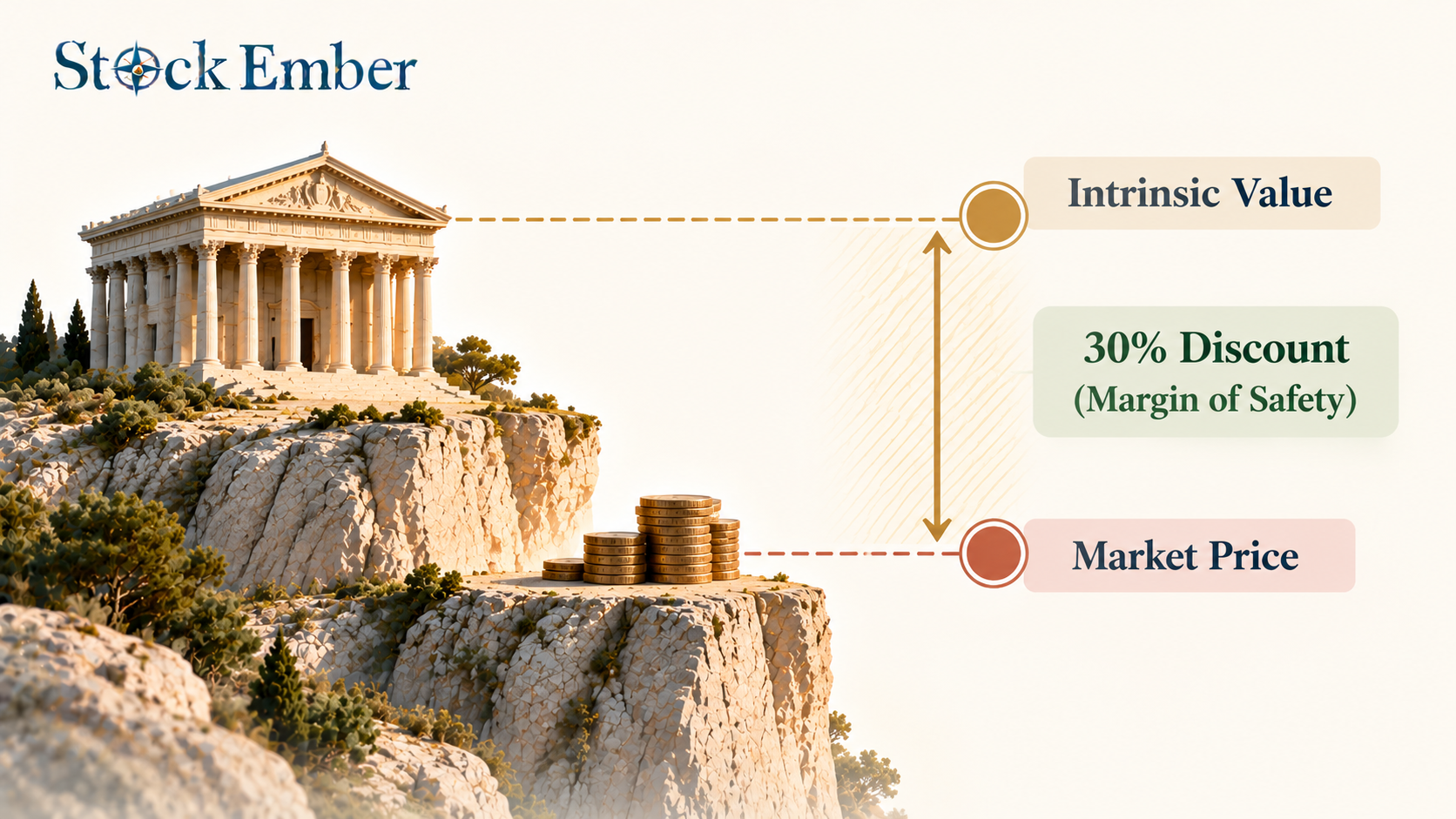
A margin of safety is the discount between a stock's market price and its estimated intrinsic value. Purchasing an asset below its calculated worth provides a financial cushion against estimation errors, bad luck, or temporary business downturns. It helps protect long-term capital while allowing future compounding to work effectively.
When stock market prices swing wildly, telling the market price apart from what a company is actually worth becomes tricky. Buying shares at a discount does not ensure you will never suffer a loss, but it creates a buffer that helps protect your long-term portfolio when business conditions change.
This guide explains how this valuation buffer works, how to calculate it, and why understanding it helps when investing in stocks.
Quick Takeaways
01A valuation cushion is the gap between a stock's market price and its estimated true underlying value.
02Calculating a valuation buffer protects your capital against human calculation errors and unexpected economic changes.
03Buying cheap businesses with failing operations creates a value trap rather than a genuine bargain.
04A valuation buffer may support 10-year compounding by reducing the impact of early portfolio drawdowns, though it cannot prevent losses.
What Is Margin of Safety?
It is a valuation principle based on buying an asset only when its market price sits significantly below its estimated true value. The concept was pioneered by Benjamin Graham and popularized by Warren Buffett as a core element of value investing.
To understand what is margin of safety, you must first separate market price from underlying business value. Market price is what you pay today on an exchange, driven by daily trading volume and sentiment. Intrinsic value is an estimate of what the underlying business is worth based on its cash flows, balance sheet strength, and competitive position.
The margin of safety meaning rests on accepting that any valuation model relies on estimates about the future. Because no investor can predict earnings or interest rates with complete certainty, buying at a clear discount creates room for error. When margin of safety is explained in everyday terms, it acts like building a bridge capable of holding 10,000 pounds but only driving 6,000-pound trucks across it.
How Margin of Safety Works: Calculating the Valuation Buffer
Calculating the buffer requires comparing your estimate of a company's intrinsic value against its current trading price.
Margin of Safety = (Intrinsic Value − Market Price) / Intrinsic Value
For example, if your financial analysis estimates that a company's intrinsic value is $100 per share and the stock currently trades at $70 per share, the calculation is:
($100 − $70) / $100 = 0.30 or 30%
In this scenario, you have a 30% discount to protect your investment. If the company's real value turns out to be $85 instead of $100 due to lower earnings, your purchase price of $70 still leaves you with a positive buffer.
Diagram comparing estimated intrinsic value to market price to illustrate a 30% margin of safety.
It is important to separate equity valuation from managerial cost accounting. In corporate accounting, breakeven analysis calculates the sales volume needed to cover fixed costs. In equity investing, the valuation buffer measures how far a stock's price sits below its estimated fundamental worth.
In practice, many long-term investors find that setting a fixed required discount, such as 20% for stable businesses and 30% for higher-risk industries, helps remove emotional pressure when deciding when to enter a position.
Why Margin of Safety Matters for Long-Term Investors
Buying assets at a discount can help protect your capital during broader market downturns. When market expectations drop, stocks trading near or above their full value often suffer deep price drops, whereas discounted stocks may experience less downside because much of the bad news is already priced in.
Over a 10-year holding period, avoiding deep initial price drops makes a significant difference to your total returns. Consider a $10,000 investment:
Scenario A (No Discount): You buy an overvalued stock at $100. Over the first two years, reality sets in and the stock drops 30% to its fair value of $70. To get back to your original $10,000 baseline, the stock must gain about 43% just to break even.
Scenario B (With a Discount): You wait and buy the same stock at $70. Because you avoided the initial 30% loss, every dollar of business growth over the next 10 years compounds directly on your principal.
In this hypothetical example, that starting difference could add up to thousands of dollars in extra compounded growth over 10 years, assuming the business grows as expected. Actual results will vary, and the stock could still fall further after purchase.
Over ten years, that starting difference in capital preservation can result in thousands of dollars in extra compounded growth. Durable competitive advantages, often called economic moats, help protect this fundamental value from being eroded by competitors over time.
Margin of Safety vs. Value Traps
A low stock price alone does not mean a company offers real value protection. A company trading at a deep discount relative to its historical price or book value (its assets minus its liabilities) can easily be a value trap if its business model is fundamentally breaking down.
Feature
Genuine Discount
Value Trap
Business Fundamentals
Stable cash flow and manageable debt
Shrinking revenue and rising debt
Competitive Position
Strong moat protects market share
Losing market share to competitors
Primary Driver
Temporary market pessimism
Permanent structural decline
A business with declining revenues, high debt, and loss of market share may see its true value drop faster than its stock price. In that situation, a stock that looks cheap at $50 might actually only be worth $30, turning your expected discount into a trap. Assessing qualitative factors like management quality and balance sheet strength is just as critical as performing numerical math.
Common Pitfalls When Applying a Valuation Buffer
While the concept of a valuation buffer is straightforward, applying it in real markets comes with practical challenges:
Overestimating Intrinsic Value: If your sales growth or profit margin forecasts are overly optimistic, your calculated value will be too high. A stock that appears to offer a 30% discount may actually be trading at fair value or even an overvaluation.
Missing Quality Businesses: High-quality companies with strong competitive advantages rarely trade at deep discounts. Strictly waiting for a 30% discount might cause you to miss great businesses that compound wealth over decades, a common trade-off when choosing between traditional value strategies and growth investing.
Assuming It Prevents All Losses: A valuation buffer reduces downside risk, but it does not eliminate market volatility or operational failures. Unforeseen regulatory changes, macroeconomic shocks, or management missteps can still cause permanent capital losses.
Conclusion
Understanding the margin of safety helps investors focus on business value rather than short-term price movements. By estimating intrinsic value and demanding a clear discount before purchasing, you create a buffer that protects capital and improves long-term compounding potential.
Keep in mind that calculating intrinsic value is an imprecise exercise that relies on assumptions about future business performance. Stock prices can remain below estimated value for long periods, and no valuation buffer removes the risk of market loss. Treating this buffer as a risk management filter, rather than a guarantee, allows you to build a resilient long-term portfolio.
When you are ready to evaluate platforms for managing your long-term portfolio, our broker reviews offer a clear starting point.
FAQ
5 questions
What is a margin of safety in simple terms?
In simple terms, it means buying an asset for less than its estimated true value. If a stock's underlying analysis indicates a worth of $100 per share and you purchase it at $70, the $30 difference represents your valuation buffer.
What is a good margin of safety percentage for stocks?
Value investors typically look for a discount of 20% to 30%. Stable companies with predictable earnings may warrant a 20% buffer, while higher-risk or cyclical businesses often require a 30% to 50% discount to account for unexpected operational challenges.
Can you still lose money after buying at a discount?
Yes. Calculating intrinsic value requires making assumptions about a company's future growth and cash flows. If those assumptions prove wrong, or if a company suffers a permanent decline in its competitive position, its market price can fall well below your discounted purchase price.
What is the difference between intrinsic value and market price?
Market price is what you pay today on a public stock exchange, influenced by daily investor sentiment and trading volume. Intrinsic value is an estimated calculation of what the underlying business is fundamentally worth based on its earnings, balance sheet, and competitive moat.
How does this concept apply to index fund investors?
Passive index fund investors do not need to calculate individual margins of safety because broad exchange-traded funds (ETFs) spread risk across hundreds of stocks. Instead of seeking individual valuation discounts, index investors typically manage timing risk through long holding periods and dollar-cost averaging, which means investing a fixed amount at regular intervals.
Disclaimer
This guide was written with AI assistance and reviewed by the StockEmber editorial team for accuracy. StockEmber provides independent education, not personal financial advice. Investing puts your capital at risk: the value of investments can go down as well as up, you may get back less than you invest, and past performance doesn’t guarantee future results. Some links may support our work at no additional cost to you.
The StockEmber Team is our in-house desk of independent research writers. We test brokerage platforms, read the fine print on fees and custody, and cover ETFs and long-horizon investing for people who plan to hold for decades — not days.