This tax is a statutory fee charged on the purchase or sale of financial assets like stocks, bonds, or derivatives. Unlike profit-based income taxes, this levy applies directly to the gross monetary value of a trade at execution regardless of whether the transaction yields a gain or loss.
This levy is placed on the purchase or sale of specific financial instruments. Governments charge this tax as a percentage of a trade's gross total value at execution.
When evaluating trade friction, many investors look closely at broker commissions and exchange spreads while overlooking trade-level taxes. However, transaction taxes can steadily erode investment capital over extended holding periods. This guide breaks down how these taxes work, how they differ from capital gains taxes, and how long-term buy-and-hold investors can minimize their impact.
Quick Takeaways
01This tax applies instantly when buying or selling a security, regardless of whether the trade earns a profit.
02Unlike capital gains taxes, transaction taxes use total trade value rather than net capital gains as their tax base.
03Frequent portfolio turnover exposes an investor's capital to repeated transaction tax friction over time.
04Low-turnover, buy-and-hold index strategies naturally reduce exposure to transaction levies.
What Is a Financial Transaction Tax?
It is a fixed percentage fee imposed by a government on trade executions involving financial assets like stocks, bonds, or derivatives. Unlike profit-based income taxes, this charge applies to the gross monetary amount of every qualifying transaction.
Regulatory authorities often create transaction taxes to raise public revenue or reduce rapid short-term trading speculation. The levy attaches directly to the transaction itself, meaning you pay it whether your trade ultimately makes money or loses money. While individual trade tax percentages might look small, their cumulative presence adds friction to trading activity.
How Financial Transaction Taxes Work
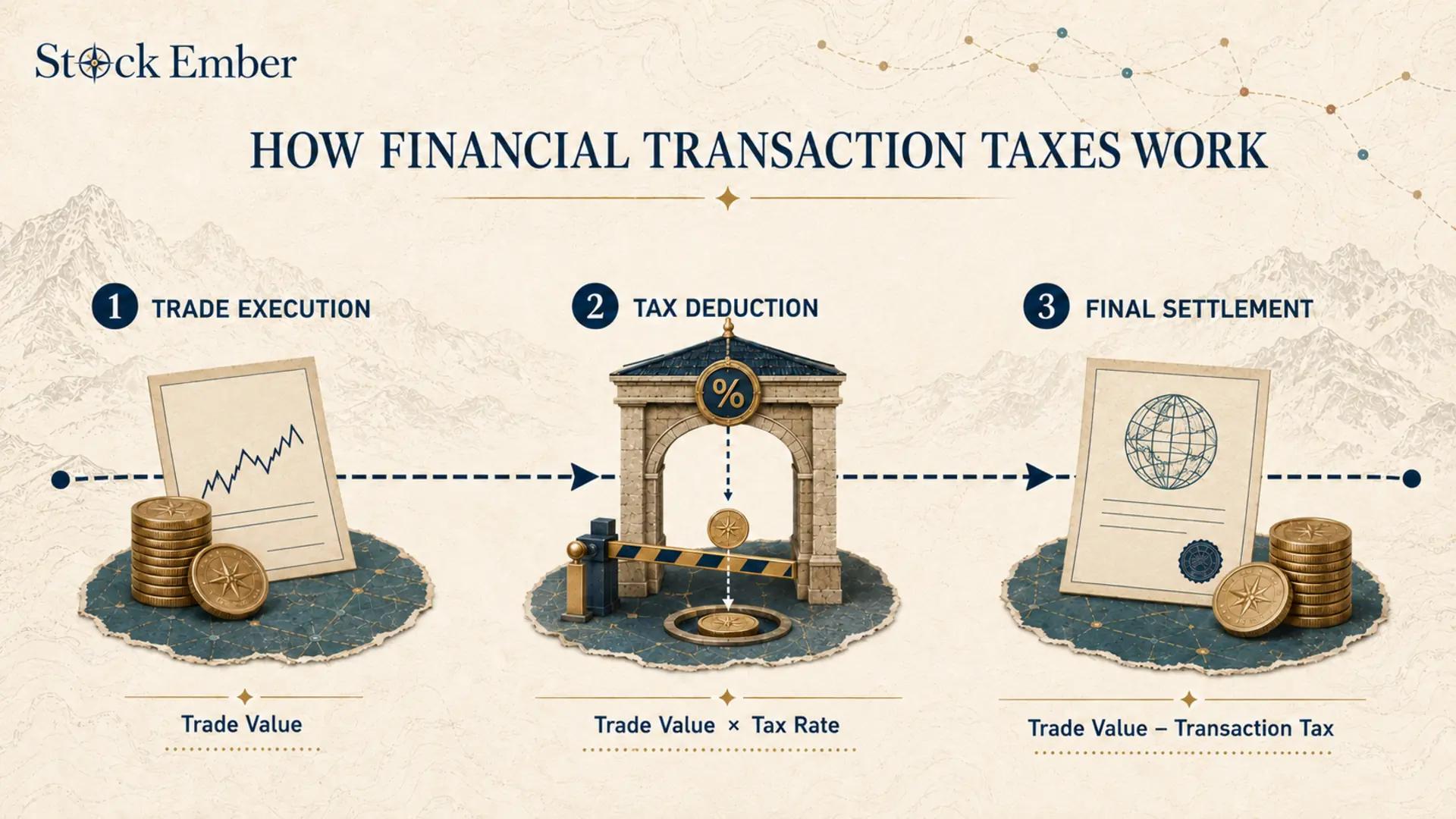
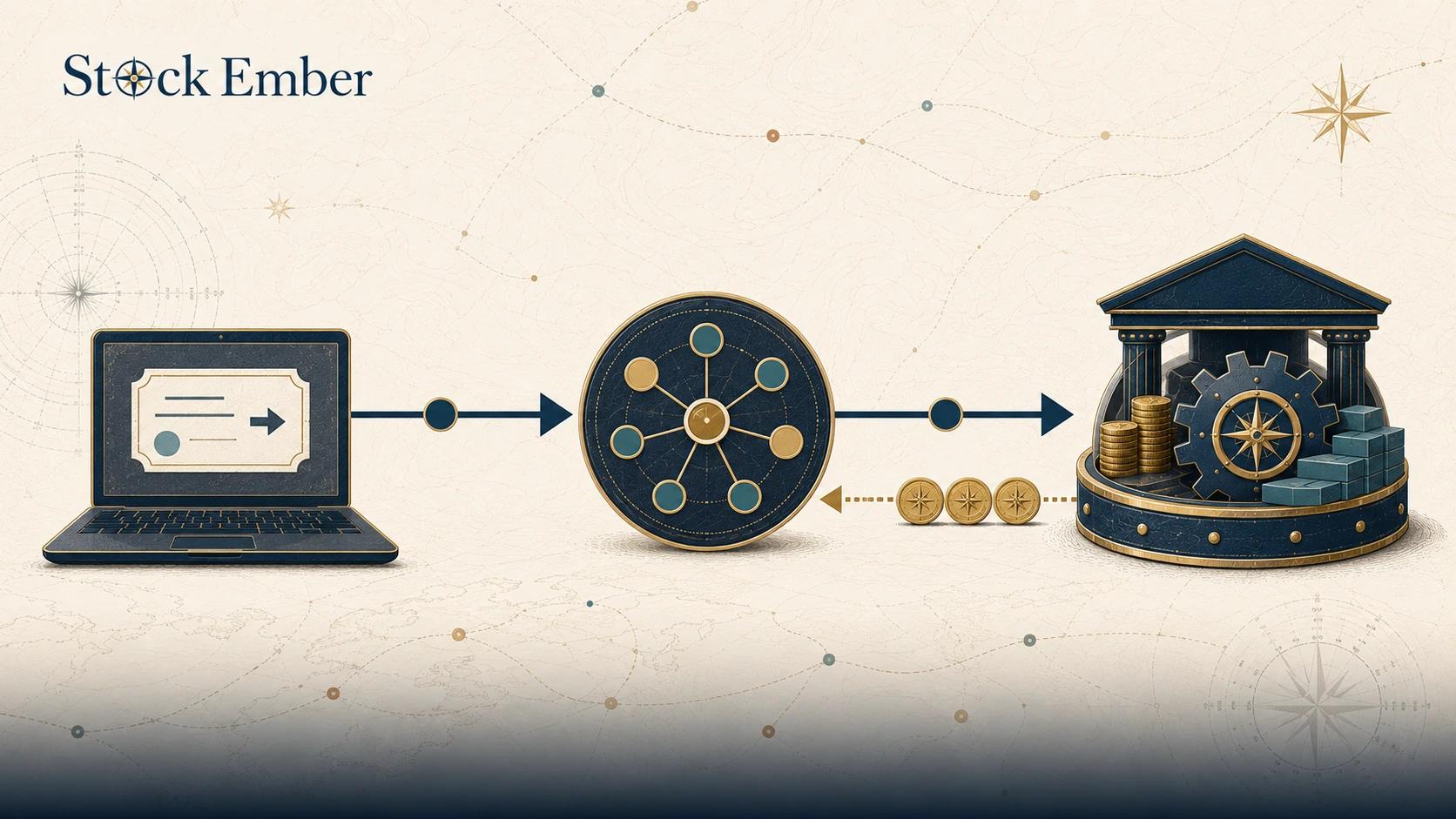
These taxes work by taking a direct cut of the total value of an asset purchase or sale at the moment of trade execution. Brokers automatically calculate and deduct this tax from your account balance when filling an order.
Diagram showing how a transaction tax is deducted during a trade
To calculate the levy, multiply the gross nominal value of the trade by the statutory tax percentage:
For example, if you buy $10,000 worth of shares in a country with a 0.1% transaction tax, your broker automatically collects $10 in tax at execution. If you sell those same shares later for $12,000, another $12 tax applies. The levy taxes total transaction value rather than net growth. How long-term buy-and-hold investors can minimize their impact. This guide refers to a financial transaction tax as an FTT throughout.
FTT vs. Capital Gains Tax vs. Stamp Duty
An FTT differs fundamentally from capital gains tax because it applies to total trade volume rather than investment profits. While capital gains taxes trigger only when you sell a winning investment at a profit, transaction taxes charge both purchases and sales regardless of trade performance.
Tax Type
Trigger Event
Tax Base
Profit Required?
FTT
Asset purchase or sale
Gross nominal trade value
No
Capital Gains Tax (CGT)
Asset sale only
Net realized profit
Yes
Stamp Duty / Reserve Tax
Transfer of asset ownership
Gross purchase value
No
Regional transfer taxes often share similar mechanics with general transaction taxes. For instance, the UK charges a 0.5% Stamp Duty Reserve Tax on electronic stock purchases (per HM Revenue & Customs), while France charges an equivalent 0.3% levy on purchases of large domestic public companies (per France's Direction Générale des Finances Publiques). Both mechanisms function as trade-level transaction levies that increase the cost of investing.
Why FTT Matters for Long-Term Investors (The 10-Year Cost Drag)
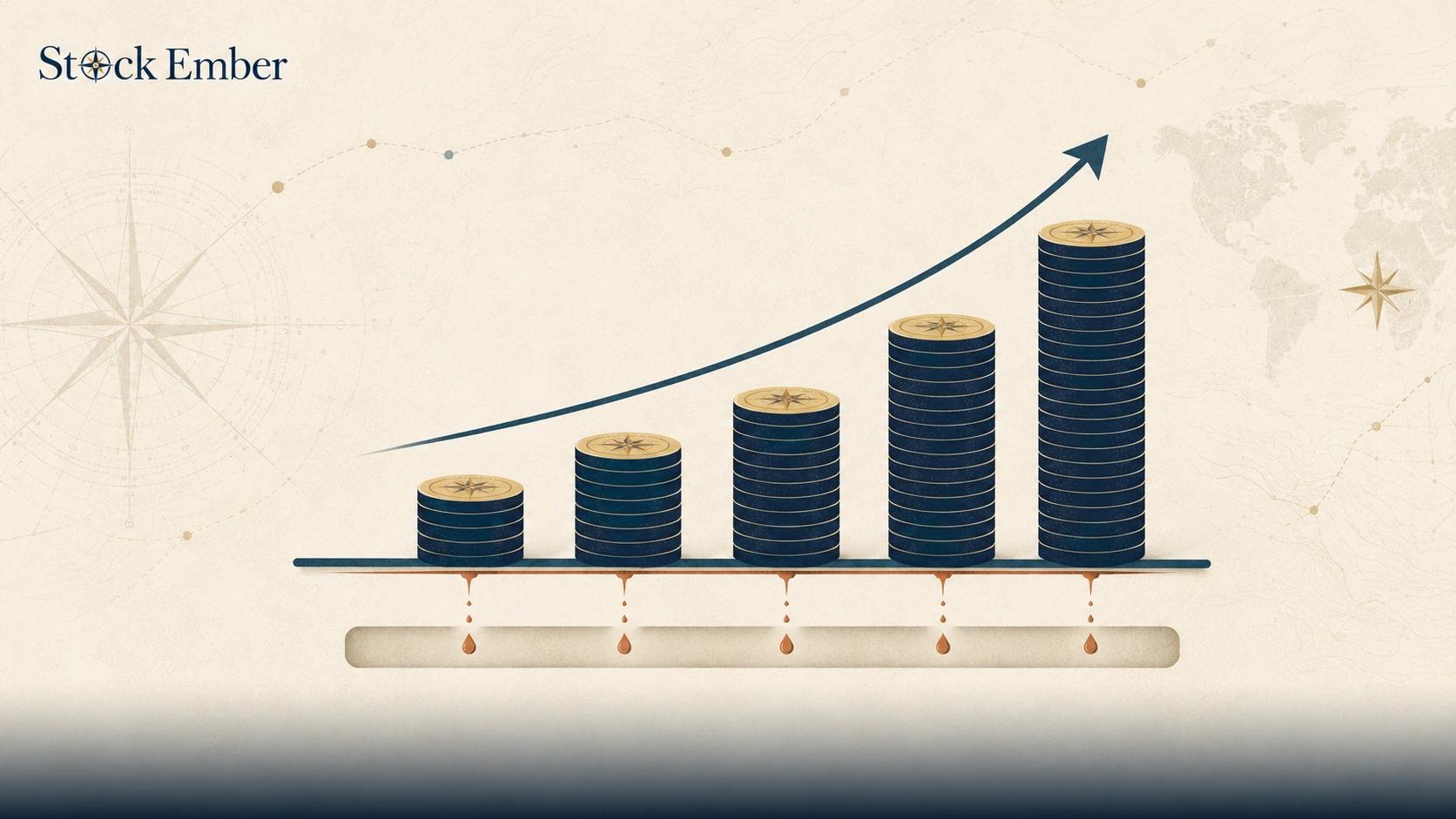
FTT matters for long-term investors because portfolio turnover turns small individual tax levies into significant compounding cost drag over time. Each time a portfolio manager or investor buys or sells assets, transaction taxes skim off capital that could otherwise remain invested and growing.
Consider two distinct $100,000 portfolios operating under a 0.2% transaction tax environment over ten years:
Active Trading Portfolio (100% Annual Turnover): Buying and selling $100,000 in assets each year incurs $400 in direct transaction taxes annually (0.2% on $100,000 bought plus 0.2% on $100,000 sold). Over ten years, direct tax costs alone wipe out $4,000, plus thousands more in lost compound growth on that removed cash.
Buy-and-Hold Portfolio (5% Annual Turnover): Rebalancing just $5,000 of the portfolio annually generates only $20 in annual transaction tax friction ($200 total over ten years).
In addition to direct taxes, high trading activity triggers operational execution drag, such as slippage, which further widens bid-ask spreads (the gap between buy and sell prices).
Common Financial Transaction Tax Misconceptions
A common misconception about this tax is that it only affects large institutional banks or high-frequency hedge funds. Because brokers collect the tax at execution, retail investors end up paying the fee directly on qualifying international exchanges.
Another common mistake is confusing transaction taxes with exchange trading spreads or broker commission fees. Commissions go to your brokerage for execution services, whereas transaction taxes go directly to national tax authorities.
Finally, some investors assume they can easily avoid transaction taxes by trading foreign stocks through a local domestic brokerage. However, international market rules generally tax trades based on where the underlying company or exchange is legally registered, regardless of where the investor resides. The U.S. Securities and Exchange Commission (SEC) regulates public exchange fees differently than foreign transaction levies, but local venue tax rules still apply to foreign cross-border executions.
Financial Transaction Taxes and Your Portfolio
Understanding how this levy impacts trade execution helps you build a more cost-efficient investment approach. While trade taxes remain outside your control, controlling your trading frequency is entirely within your hands. By focusing on low-turnover index funds and long holding periods, buy-and-hold investors naturally isolate their portfolios from repeated transaction costs.
When you are ready to evaluate how fees and taxes influence your long-term wealth, our portfolio calculators can help model your total cost of ownership. Tax laws, exchange fees, and market conditions change over time, and past tax structures do not guarantee future investment performance. Treat this guide as educational information rather than personal tax or financial advice, and consider checking local venue rules or consulting a qualified tax professional before trading foreign securities.
FAQ
5 questions
What is a financial transaction tax and how does it work?
It is a fixed percentage fee imposed by a government on trade executions involving financial assets such as equities, fixed income, or derivatives. Brokers automatically calculate and collect the tax directly from your account balance based on the total nominal value of the transaction at execution.
How is an FTT different from capital gains tax?
It applies to the total trade value at the moment of purchase or sale, regardless of profitability. In contrast, capital gains tax only triggers when you sell an asset for a profit, applying specifically to the net realized gain rather than the total transaction amount.
Who pays the FTT on stock trades?
The buyer or seller of the security pays the transaction tax. While governments assess these levies on exchange operations or brokerage platforms, market intermediaries automatically pass the cost directly to retail and institutional traders when fulfilling order transactions.
What are real-world examples of this tax?
Common international examples include the UK Stamp Duty Reserve Tax on electronic stock purchases, the French equivalent on public shares of large domestic companies, and a similar levy in Italy assessed on equity trades and derivatives.
How does an FTT affect long-term investors?
Long-term buy-and-hold investors experience minimal impact from this tax because low portfolio turnover generates very few taxable trade events. Conversely, active trading strategies incur frequent transaction taxes that compound into significant cost drag over time.
Disclaimer
This guide was written with AI assistance and reviewed by the StockEmber editorial team for accuracy. StockEmber provides independent education, not personal financial advice. Some links may support our work at no additional cost to you.
The StockEmber Team is our in-house desk of independent research writers. We test brokerage platforms, read the fine print on fees and custody, and cover ETFs and long-horizon investing for people who plan to hold for decades — not days.