A contingent deferred sales charge is a back-end sales fee assessed when an investor redeems mutual fund shares before a specified multi-year holding period expires. The fee percentage typically declines each year until it reaches zero, but funds with these charges often carry higher ongoing operating expense ratios.
A contingent deferred sales charge is an exit fee assessed by some mutual funds when an investor redeems share holdings before a specified minimum holding period expires.
Investors often choose deferred fee funds to avoid upfront commissions, assuming their money goes straight to work. However, paying a back-end load can restrict your flexibility and hide higher ongoing operating costs. This guide explains how back-end fee schedules operate, how share classes differ, and how exit penalties impact your total portfolio value over time.
Quick Takeaways
01A contingent deferred sales charge (CDSC) applies only if you sell mutual fund shares before a set time window ends.
02The fee percentage scales down annually, eventually dropping to zero after several years of ownership.
03Funds with deferred exit charges often carry higher ongoing operating expense ratios that quietly drag down long-term returns.
04Automatic share conversions frequently transfer Class B shares into lower-fee Class A shares once the penalty schedule expires.
How Mutual Fund Back-End Loads Function
A contingent deferred sales charge (CDSC) is a back-end sales load charged when you sell shares of a mutual fund within a pre-determined timeframe.
Fund management companies use this mechanism to recover upfront distributor commissions paid to financial advisers. Instead of deducting a fee on day one, the fund agrees to waive the exit charge if you keep your principal invested for a set duration, often ranging from five to seven years.
Understanding how back-end loads fit into broader mutual fund fees is essential for long-term planning. Rules established by the US Securities and Exchange Commission require funds to detail these schedules clearly in their prospectus. If you redeem your investment early, the fund company deducts the fee directly from your payout. If you hold your investment past the agreement window, the charge expires completely, allowing you to exit without a direct redemption penalty.
How a CDSC Schedule Works Over Time
A CDSC schedule works on a sliding scale that reduces your exit fee percentage for every full year you remain invested in the fund.
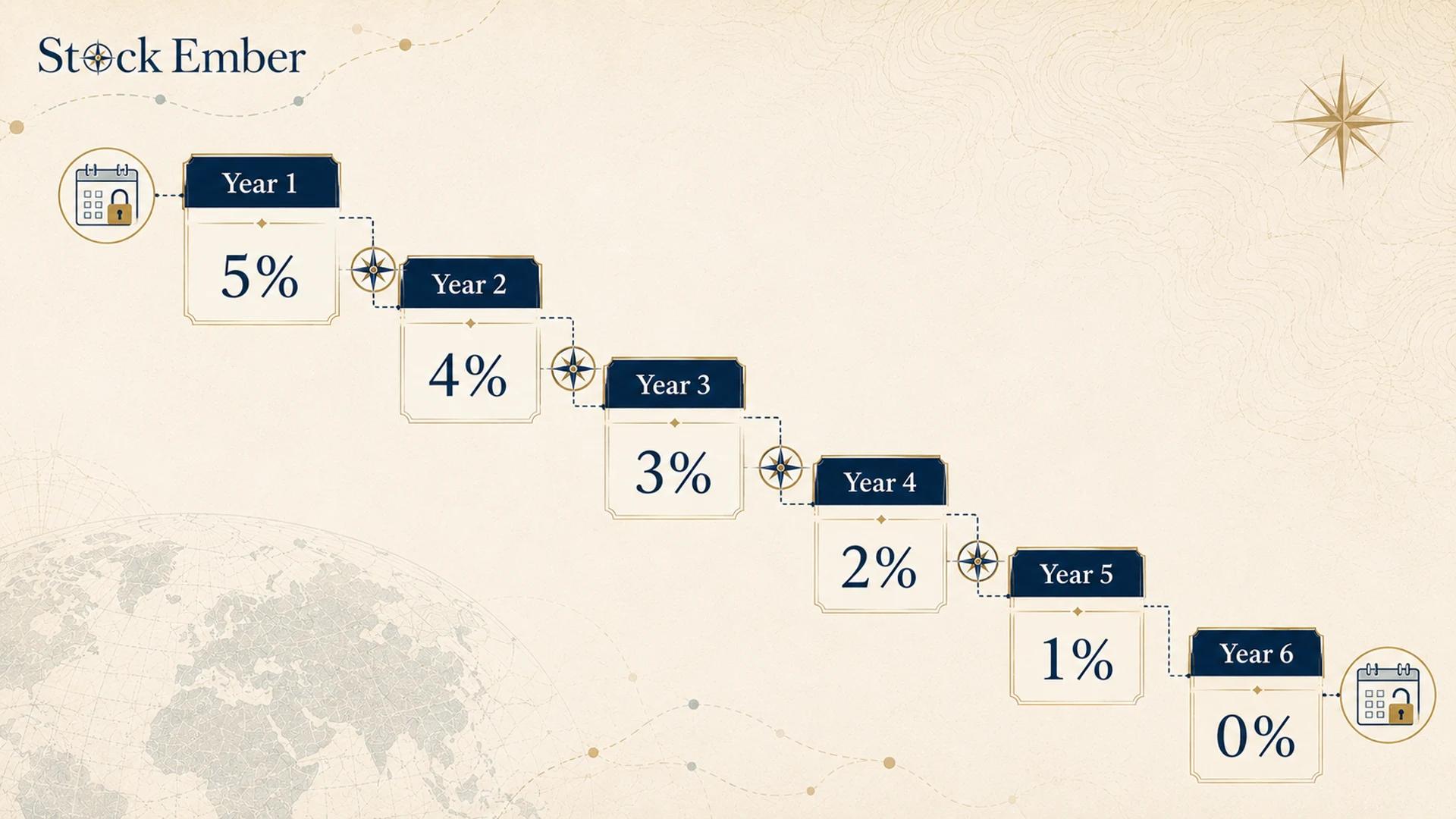
Step-down diagram showing a declining mutual fund exit charge over five years.
When you buy shares subject to a deferred charge, the prospectus outlines a specific schedule. In year one, the fee is highest, then decreases by one percentage point each year after that until reaching zero:
Year 1 redemption: 5% exit charge
Year 2 redemption: 4% exit charge
Year 3 redemption: 3% exit charge
Year 4 redemption: 2% exit charge
Year 5 redemption: 1% exit charge
Year 6 and beyond: 0% exit charge
Depending on specific fund terms, the fee percentage applies to either your original purchase value or the current market value at redemption, whichever is lower.
Class A, Class B, and Class C Share Differences
Mutual fund share classes differ primarily in how and when sales commissions and ongoing annual operating expenses are charged to investors.
Class A Shares: Feature a front-end load paid at purchase. While you pay a charge immediately, these shares carry lower annual marketing fees and lower ongoing expense ratios.
Class B Shares: Feature no upfront charge, but carry a declining CDSC that lasts five to seven years. They also charge higher annual operating expenses during the lock-in period.
Class C Shares: Feature a low initial or 1-year CDSC alongside a level annual fee structure, making them costly for holding periods beyond a few years.
Choosing Class B shares to avoid paying upfront commission feels convenient initially. However, the higher annual operating expenses built into Class B shares remain active every single year you own the fund.
The 10-Year Cost and Liquidity Lock-In
Over a 10-year holding period, higher annual operating fees in back-end load funds often cost significantly more than an initial front-end sales charge.
Consider a hypothetical $10,000 investment held for ten years. If you select a fund with a 0.50% higher annual expense ratio to avoid a 5% upfront fee, that extra 0.50% fee compounds every year against your growing balance. Over ten years, that annual fee difference takes roughly $800 to $1,000 out of your portfolio through lost compounding.
By contrast, fee structures like an advisory wrap fee bundle investment management and transaction costs into a single annual percentage, eliminating exit penalties entirely.
Common CDSC Pitfalls and How to Avoid Them
The most common CDSC pitfall is holding onto an underperforming mutual fund simply to avoid paying an exit penalty.
Loss Aversion Trap: Investors often keep money in poor-performing funds because they refuse to realize a 2% or 3% redemption fee. Allowing fear of a fee to override portfolio quality can lead to much larger investment losses.
Unnoticed Conversions: Most Class B shares automatically convert into lower-expense Class A shares once the fee schedule hits zero. Failing to confirm this conversion can leave you paying higher annual expense fees unnecessarily.
Fee Waivers: Fund prospectuses frequently waive exit charges during major life events, including investor death, permanent disability, or mandatory retirement distributions.
Conclusion
While a contingent deferred sales charge provides a way to enter a mutual fund without upfront fees, it comes at the price of reduced portfolio liquidity and higher annual operating costs. For true buy-and-hold investors, prioritizing low ongoing expense ratios is far more important than avoiding initial transaction fees. Before purchasing back-end load shares, review the fund prospectus carefully to understand total ongoing friction across your planned holding period. When you are ready to evaluate how different fee models affect your wealth growth over time, our financial calculators can help you model your long-term results. Investing always carries risk of capital loss and past returns do not guarantee future results, so evaluate fee schedules carefully as part of your broader research.
FAQ
5 questions
What is a contingent deferred sales charge (CDSC)?
A contingent deferred sales charge is an exit fee charged by certain mutual funds when an investor redeems shares before a designated holding period ends. Designed to recover upfront distributor commissions, the fee percentage scales down annually until it reaches zero.
How does a CDSC schedule work over time?
A CDSC schedule uses a sliding scale that reduces the exit fee percentage for each full year you remain invested. For example, a fund might charge 5% in year one, 4% in year two, and decrease by 1% each subsequent year until no fee applies after year six.
How do Class A, Class B, and Class C shares differ regarding sales charges?
Class A shares charge a front-end sales fee at purchase with lower ongoing expense ratios. Class B shares feature no upfront sales fee but carry a declining CDSC and higher ongoing operating expenses. Class C shares usually feature a low 1-year CDSC alongside higher ongoing annual fees.
What happens when a Class B share’s CDSC schedule reaches zero?
Once the contingent deferred sales charge schedule expires and drops to zero, most Class B mutual fund shares automatically convert into Class A shares, which reduces your ongoing annual expense ratio for the remainder of your investment.
Can you avoid paying a contingent deferred sales charge?
You can avoid paying a CDSC by holding your mutual fund shares until the specified fee window expires. Many funds also offer fee waivers for specific events, such as investor death, permanent disability, or required minimum retirement distributions.
Disclaimer
This guide was written with AI assistance and reviewed by the StockEmber editorial team for accuracy. StockEmber provides independent education, not personal financial advice. Some links may support our work at no additional cost to you.
The StockEmber Team is our in-house desk of independent research writers. We test brokerage platforms, read the fine print on fees and custody, and cover ETFs and long-horizon investing for people who plan to hold for decades — not days.