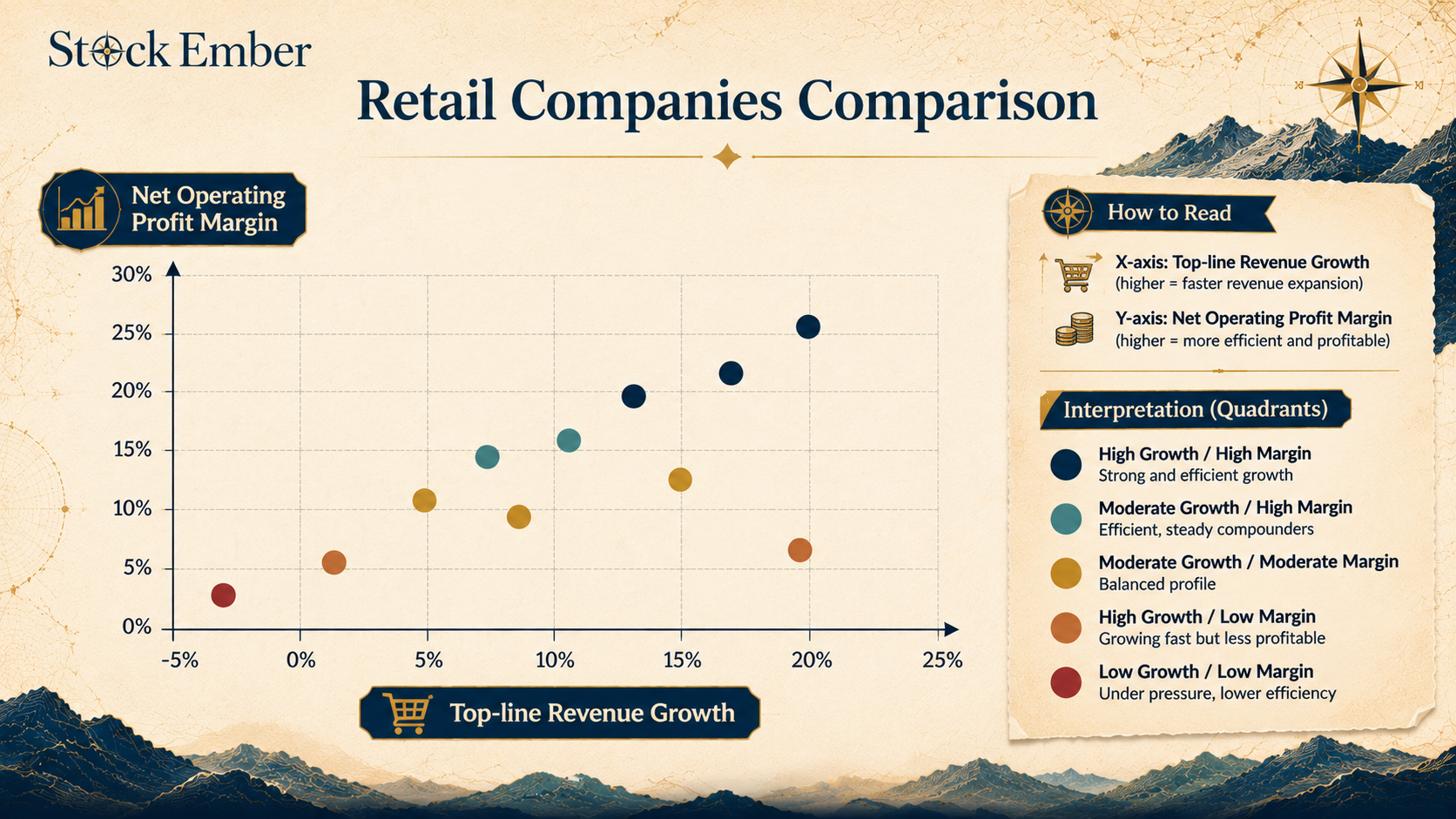
Retail stocks around Black Friday 2026 represent publicly traded consumer and e-commerce companies during the peak holiday shopping season. Despite large sales totals over the 4-day shopping weekend, equity prices rarely surge on holiday turnover alone because seasonal spending patterns are already priced in, and deep promotional discounts often compress net profit margins.
Retail stocks around Black Friday 2026 reflect public companies that sell consumer goods during the late-November shopping holiday. While the weekend generates large spending headlines, seasonal shopping spikes rarely drive sustained share price gains on their own.
Investors often watch news footage of packed stores or record online checkouts and assume retail shares must climb next. In practice, public markets anticipate these shopping patterns months ahead, while heavy price discounts can quietly squeeze business earnings.
This guide examines how forward expectations shape retail share prices, why net profit matters more than gross receipts, and how patient investors evaluate the holiday quarter.
Quick Takeaways
01Strong Black Friday sales volumes rarely trigger automatic rallies for retail stocks because equity markets price in seasonal forecasts well in advance.
02Gross weekend revenue does not equal profit; deep promotional discounting often increases transaction volume while eroding net operating margins.
03Share prices move on unexpected deviations from analyst consensus rather than the absolute dollar size of shopping headlines.
04Fourth-quarter corporate earnings reports, which most large retailers release between mid-February and mid-March, provide the true financial verdict on holiday performance.
05Patient investors focus on business competitive advantages and multi-year cash flows rather than trading short-term seasonal spending spikes.
Do Record Black Friday Sales Mean Higher Retail Stock Prices?
Strong Black Friday sales numbers do not automatically cause retail stock prices to rise. Financial news channels regularly highlight record checkout totals and surging foot traffic during the Thanksgiving shopping weekend. Yet retail shares may produce mixed or muted reactions once the registers close.
For anyone learning the basics of investing in stocks, separating promotional noise from business performance is a valuable habit. A common behavioral bias known as the availability heuristic leads people to believe that visible retail activity translates into immediate corporate wealth. Seeing crowded aisles makes consumer demand feel unprecedented. However, equity prices reflect corporate cash flows discounted over many years, not the cash collected over a single 4-day weekend.
Broad retail indexes do not always outperform the wider market during November and December. When a retailer announces that holiday weekend sales grew by 4%, that news rarely surprises the market. Institutional investors already built that exact growth rate into their models during the summer. Unless the reported spending total departs sharply from prior forecasts, the share price tends to stay flat or drift lower as short-term traders take profits.
Market Expectations: Why the Holiday Rush Is Already Priced In
Share prices move based on unexpected financial surprises rather than predictable calendar events. Every market participant knows that Black Friday arrives in late November and that consumer spending peaks during the final 2 months of the year. Because this shopping rush happens every 12 months, equity analysts spend months building detailed models of foot traffic, online shopping cart values, and credit card usage.
Based on U.S. Census Bureau data compiled by the National Retail Federation, sales in November and December have averaged about 19% of annual retail sales over the past 5 years, according to NRF's 2026 holiday FAQ. Because this volume is predictable, fund managers do not wait for holiday receipts to buy shares. They adjust their positions weeks before Thanksgiving based on consensus estimates, the average sales forecast published by Wall Street analysts.
This dynamic reflects the core principle of market efficiency: asset prices rapidly incorporate publicly available forecasts, meaning that share prices move only when new information breaks away from what analysts already anticipated. If a major department store is expected to generate $10 billion in holiday revenue and delivers exactly $10 billion, the stock price has little reason to jump. The good news was already in the price. If the market expected $12 billion, a record-setting $10 billion holiday result could actually push the stock lower.
Sales vs. Profit Margins: The Real Cost of Holiday Discounts
Gross sales volume measures incoming cash receipts, whereas equity valuations depend on net operating income. News reports routinely emphasize gross merchandise volume, which is the total dollar amount spent by consumers. However, retailers often generate those eye-catching numbers by offering deep price cuts, free express shipping, and generous product return terms.
Investors who spend time reading financial statementslook past top-line transaction records to see how much cash the business actually keeps after paying suppliers, marketing teams, and store staff. When a store slashes prices by 40% to clear shelves, it must sell significantly more items just to match its normal profit. Higher shipping overhead, temporary warehouse labor, and return processing fees eat away at earnings.
The relationship between sales and operating income is captured by a basic financial measure:
Operating Margin = Operating Income / Total Revenue
Operating margin is the percentage of revenue left after paying everyday business costs. If total revenue climbs 15% while operating margin drops from 8% to 3%, the company earns less real profit despite setting a shopping record.
In practice, many long-term investors find that tracking retail foot traffic or opening-weekend checkout volume provides very little actionable signal for equity returns. Public companies that offer the steepest doorbuster promotions often end up with inventory clearance rather than high-margin growth.
Diagram comparing gross retail revenue against net profit margins after discounts
How Different Retail Sectors React: E-Commerce, Big-Box, and Payments
Different segments of the retail industry experience holiday shopping volume in distinct ways. The retail sector is not a single uniform group of companies. Broadline discount retailers, dedicated online platforms, and digital payment networks operate with distinct business models and expense structures.
Omnichannel big-box retailers, businesses that sell through both physical storefronts and digital websites, often use doorbuster discounts on electronics or toys to draw shoppers into stores. They hope consumers will also buy higher-margin groceries and household items. Pure-play e-commerce platforms process heavy order volumes over Cyber Monday, but they absorb steep parcel delivery fees and higher return rates on clothing. Meanwhile, payment networks charge small percentage fees on every transaction without taking on inventory risk.
Retail Sector
Primary Revenue Driver
Primary Margin Risk
Big-Box Retailers
Store foot traffic and high-margin add-on purchases
Heavy store staffing and clearance price markdowns
E-Commerce Platforms
Digital order volume and holiday membership signups
High delivery expenses and customer return processing
Payment Networks
Total transaction volume and consumer credit usage
Rising customer credit defaults and fee disputes
Because each sector faces different cost pressures, an overall surge in consumer spending produces uneven corporate profits across the market.
What to Watch After the Weekend: Inventory, Guidance, and Q4 Earnings
Long-term business fundamentals appear in full-year financial disclosures rather than promotional weekend press releases. The immediate sales estimates published on the Saturday after Black Friday are unofficial estimates compiled by trade groups, payment networks, and analytics firms. Patient investors wait for audited disclosures.
The primary operational detail to examine after the holiday season is inventory overhang, unsold stock that sits in warehouses. If retailers overordered goods ahead of the fourth quarter, they may be forced to carry heavy discounts into January, eroding winter profit margins. Conversely, lean inventory levels allow companies to sell new spring merchandise at full price.
In addition, management guidance provides a clearer forward signal than weekend sales. Corporate leadership updates its forward earnings outlook when reporting third-quarter results in November or alongside interim holiday sales updates. Ultimately, fourth-quarter earnings reports, which most large public retailers release between mid-February and mid-March, deliver the only definitive verdict on whether holiday shopping translated into durable earnings per share.
Common Pitfalls: Why Long-Term Investors Avoid Holiday Hype
Trading seasonal retail headlines introduces unnecessary portfolio friction and behavioral bias. Retail investors frequently make the mistake of attempting to time short-term price swings around Thanksgiving. They buy retail shares on Friday morning hoping to sell for a profit on Monday afternoon, falling victim to herd behavior and market noise.
Attempting to trade seasonal events also creates compounding investment costs. A 1% annual drag from trading commissions, bid-ask spreads, and taxable churn may seem small across a single weekend, but over a 10-year holding period, a 1% annual cost quietly removes roughly 10% of a portfolio's total wealth that could have continued compounding.
In practice, experienced investors avoid rebuilding a portfolio around seasonal events. Holding low-cost, broad-market index funds captures the long-term earnings of high-quality retailers alongside the rest of the economy without requiring you to guess short-term consumer sentiment.
Conclusion
Retail stocks around Black Friday 2026 illustrate why market expectations and operating profit matter far more than headline sales volume. Record consumer spending may not lift share prices when revenue is heavily discounted or already reflected in market prices. Long-term wealth is built by owning resilient businesses with steady cash flows and durable competitive advantages, not by reacting to holiday shopping news.
When you want to evaluate balance sheets, compare operating metrics, or track portfolio diversification across sectors, our investing tools provide a practical place to start. Investing in individual equities or sector funds always carries the risk of capital loss, and past market reactions never guarantee future returns, so use this analysis as an educational foundation for your own research rather than personal financial advice.
FAQ
5 questions
When do retailers report their holiday quarter earnings?
Large public retailers typically report their fourth-quarter financial results between mid-February and mid-March. Because the retail fiscal year often runs through late January or early February to account for post-holiday gift card redemptions and merchandise returns, companies require several weeks to close and audit their figures. These quarterly earnings releases provide the first audited look at whether holiday sales generated actual operating profit.
How do customer product returns impact retail stocks after Black Friday?
Customer returns significantly reduce holiday profitability, particularly for apparel and online retail segments, where return rates can run higher than in other categories. Processing returned merchandise incurs reverse logistics expenses, restocking labor, and inventory markdowns. If post-holiday returns exceed historical averages, retailers face unexpected margin compression when reporting their final fourth-quarter financial statements.
Are e-commerce stocks better holiday investments than brick-and-mortar stores?
E-commerce platforms capture substantial digital order volume during Cyber Week, but they also bear steep shipping carrier surcharges, packaging expenses, and high return rates. Brick-and-mortar stores with omnichannel fulfillment can use physical locations as local distribution hubs and generate high-margin add-on sales from foot traffic. Neither business model is universally superior; profitability depends on operating efficiency and inventory control.
Why do retail stocks sometimes fall after reporting record Black Friday sales?
Retail share prices often drop following record sales announcements because financial markets trade on expectations rather than absolute revenue numbers. If analysts had projected even higher sales figures, or if high transaction volumes were achieved through deep price discounts that squeeze margins, the headline numbers can disappoint institutional investors and may prompt a sell-off.
Should long-term investors adjust their portfolios before Black Friday?
Long-term investors generally avoid altering their portfolio allocations around seasonal retail holidays. Attempting to time seasonal retail swings introduces trading fees, bid-ask spreads, and potential tax liabilities without improving risk-adjusted returns. Holding diversified, broad-market index funds captures the durable earnings of resilient retail leaders across the entire year without the risk of guessing short-term consumer behavior.
Disclaimer
This guide was written with AI assistance and reviewed by the StockEmber editorial team for accuracy. StockEmber provides independent education, not personal financial advice. Investing puts your capital at risk: the value of investments can go down as well as up, you may get back less than you invest, and past performance doesn’t guarantee future results. Some links may support our work at no additional cost to you.
The StockEmber Team is our in-house desk of independent research writers. We test brokerage platforms, read the fine print on fees and custody, and cover ETFs and long-horizon investing for people who plan to hold for decades — not days.