The FTSE All-World Index is a market-capitalization-weighted equity benchmark that measures the performance of large and mid-cap companies globally. Maintained by FTSE Russell, it covers roughly 90–95% of the investable global market capitalization across both developed and emerging markets. Individual investors access this benchmark through index funds and exchange-traded funds (ETFs) engineered to track its constituent weightings.
The FTSE All-World Index is a market-capitalization-weighted equity index that tracks large and mid-cap stocks across both developed and emerging markets worldwide, capturing roughly 90–95% of the investable global market cap.
If you want to own the global economy without picking individual stocks, this index serves as a foundational benchmark. Instead of betting on a single country or region, holding a fund that mirrors this benchmark gives you exposure to thousands of companies across dozens of nations in a single bucket. Here is how the benchmark works, how it compares to peers, and why it matters for long-term investors.
Quick Takeaways
01The FTSE All-World Index tracks over 4,000 large and mid-cap stocks across approximately 49 developed and emerging market countries.
02It uses free-float market-capitalization weighting, meaning larger companies naturally command a greater share of the index.
03It excludes small-cap stocks, covering roughly 90–95% of global market capitalization, unlike broader all-cap benchmarks.
04Investors cannot buy an index directly, but can gain low-cost exposure through index funds and exchange-traded funds (ETFs) that track it.
What Is the FTSE All-World Index and How Does It Work?
The FTSE All-World Index measures global stock market performance by weighting member companies according to their free-float market capitalization. Managed by FTSE Russell, a subsidiary of the London Stock Exchange Group, the benchmark includes roughly 4,000 constituent stocks spanning 49 countries.
Market-capitalization weighting means a company’s weight in the index is proportional to the total market value of its outstanding shares. FTSE Russell applies a "free-float" adjustment, which means only shares available for public trading are factored into the calculation. Government-held stakes, strategic holdings, and insider-locked shares are excluded. This prevents illiquid shares from distorting the index.
Because direct investment in a mathematical benchmark is impossible, retail investors access this market segment through an index fund or exchange-traded fund. Understanding what is an etf helps clarify how these pooled funds replicate the benchmark by purchasing the underlying stocks in proportion to their index weights.
The index undergoes semi-annual reviews in March and September, alongside quarterly rebalancing, to ensure constituent weights reflect changing market values and floating share counts without causing unnecessary turnover.
FTSE All-World vs. MSCI ACWI vs. FTSE Global All Cap
The primary difference between global equity indices lies in their constituent coverage and market classification rules rather than their long-term performance trajectory.
To select the right core benchmark, you need to understand how major index providers define the global stock universe. FTSE Russell and MSCI are the two primary benchmark providers for international equity funds.
Index Feature
FTSE All-World Index
MSCI ACWI
FTSE Global All Cap
Index Provider
FTSE Russell
MSCI
FTSE Russell
Market Segments
Large & Mid Cap
Large & Mid Cap
Large, Mid & Small Cap
Constituent Count
~4,000
~2,800
~10,000
Market Cap Coverage
~90–95%
~85–90%
~98%
Emerging Markets
Included
Included
Included
Small-Cap Exposure
Excluded
Excluded
Included (~10% weight)
The FTSE All-World Index and MSCI All Country World Index (ACWI) cover nearly identical economic ground, but they differ in country classification. For example, FTSE classifies South Korea as a Developed market, whereas MSCI classifies it as an Emerging market. This distinction leads to slight variations in regional exposures.
Conversely, the FTSE Global All Cap Index expands coverage further by including small-cap stocks, bringing its constituent count to nearly 10,000 companies. While small-cap stocks add additional diversification, large and mid-cap stocks drive the vast majority of global market returns due to market-cap weighting.
Why the FTSE All-World Index Matters for Long-Term Investors
The FTSE All-World Index offers long-term investors an automated, self-cleansing core portfolio strategy that adjusts dynamically as global markets shift over time.
Because the index is weighted by market capitalization, capital naturally flows toward growing companies and expanding economies. If a country's stock market shrinks relative to the rest of the world, its index weight declines automatically. You do not need to forecast economic winners, reallocate geographic weights manually, or pay an active manager to adjust holdings.
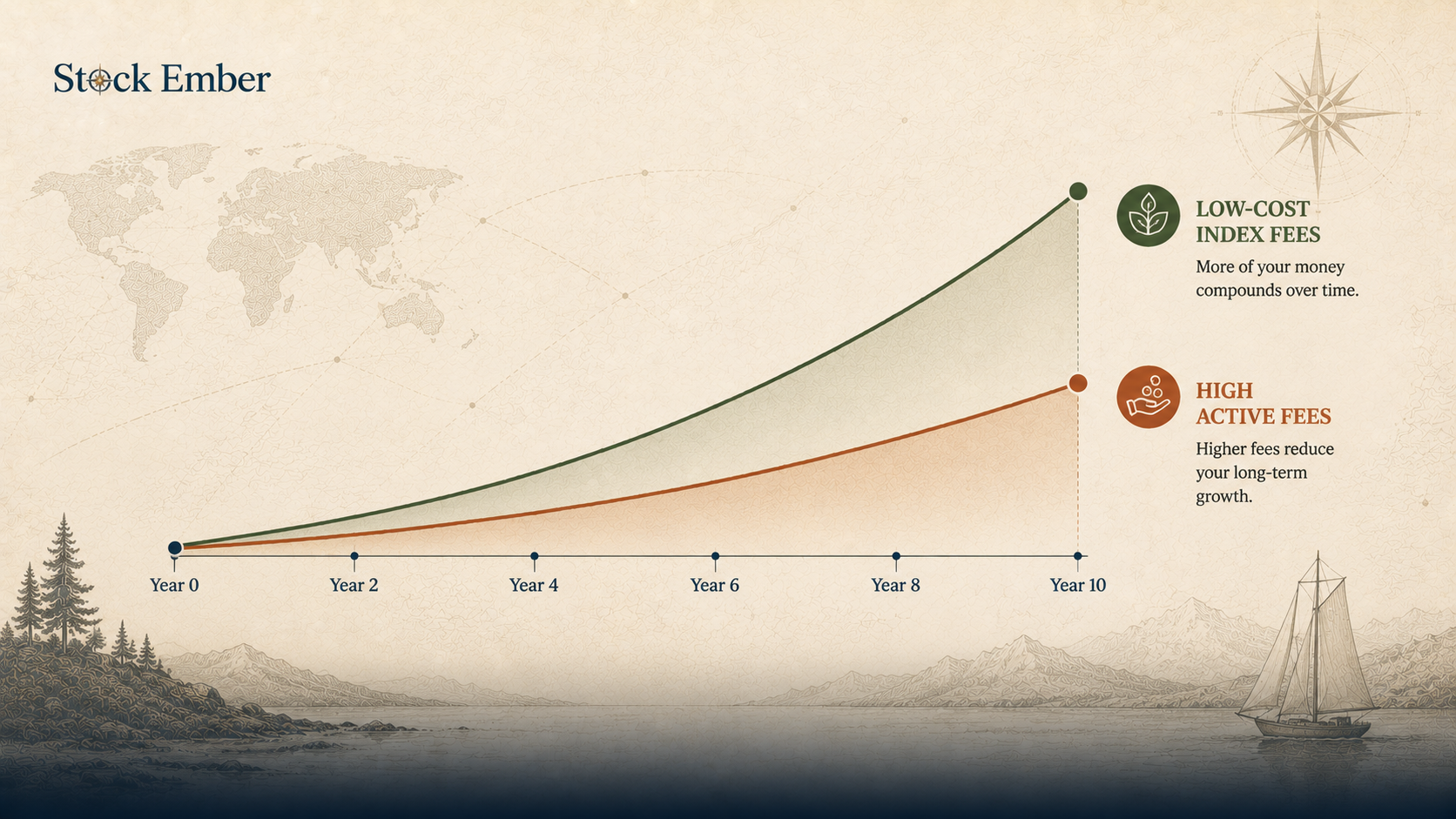
A ten-year investment comparison chart illustrating the impact of index fund fees on long-term portfolio returns
The primary structural benefit of using a passive global benchmark is cost control. Over long horizons, fee drag compounds heavily against your investment returns. Consider an illustrative $50,000 portfolio held over ten years:
Low-Cost Global ETF (0.15% Fee): A 0.15% annual expense ratio costs approximately $75 per year initially, leaving the vast majority of your capital to compound over a decade.
Active Global Fund (0.85% Fee): An 0.85% annual expense ratio costs roughly $425 per year initially. Over 10 years, that extra 0.70% annual fee quietly erodes thousands of dollars in potential wealth through lost compound growth.
In practice, long-term portfolio builders often discover that trying to manually rebalance individual country funds every quarter introduces trading friction, tax complexity, and behavioral bias that a single global benchmark eliminates.
What to Watch Out For: Portfolio Risks & Realities
Investing in the FTSE All-World Index involves significant concentration in US equities and potential exposure to foreign currency fluctuations despite its global label.
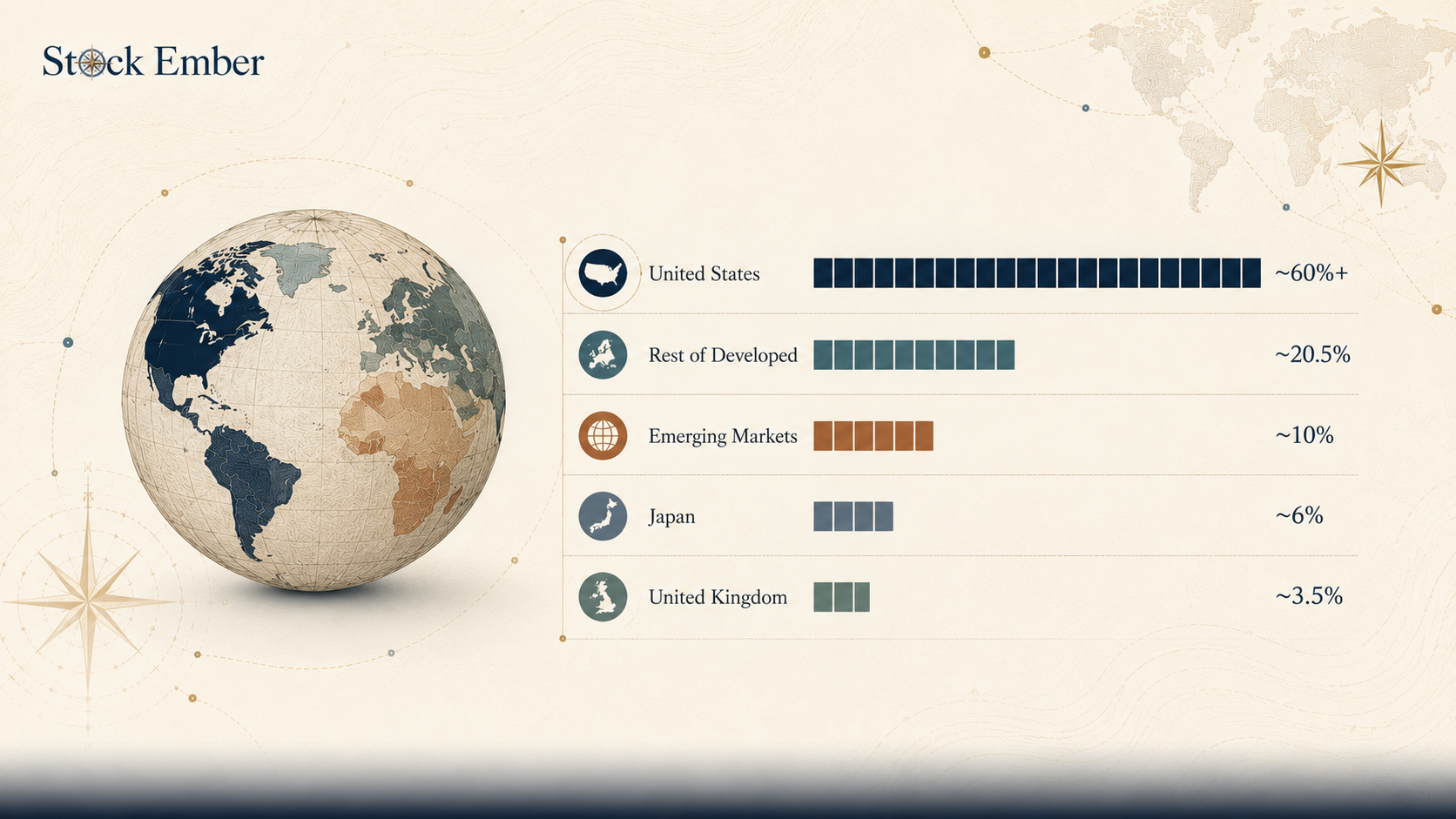
While the benchmark spans nearly 50 countries, US corporate dominance means American stocks make up roughly 60%+ of the total index weight. If you hold a separate US equity fund, such as one tracking the CRSP US Total Market Index, pairing it with a FTSE All-World fund will create substantial US equity overlap.
Horizontal bar chart showing the approximate geographic allocation of the FTSE All-World Index, with the United States representing over 60% of the index, followed by the rest of the developed world, emerging markets, Japan, and the United Kingdom.
Other risk factors to consider include:
Currency Risk: The underlying assets are denominated in foreign currencies (Euros, Yen, Pounds, Yuan). Shifts in exchange rates impact unhedged fund returns when converted back to your local currency.
Emerging Market Volatility: Approximately 10% of the index is allocated to emerging economies. These markets carry higher geopolitical, regulatory, and economic risks than developed economies.
Real-World Fund Drag: Index metrics reflect theoretical gross returns. Real-world ETFs incur small operational costs, cash drag, tracking error, and withholding taxes on international dividends.
Conclusion
The FTSE All-World Index provides a straightforward, highly diversified foundation for long-horizon equity investors. By capturing the vast majority of global public enterprise in a single market-cap-weighted structure, it eliminates the need to predict which country or sector will outperform next.
When you are ready to evaluate specific investment vehicles that track global benchmarks, exploring our ETF reviews is a natural next step.
FAQ
5 questions
What is the difference between the FTSE All-World and MSCI ACWI?
The FTSE All-World Index and MSCI ACWI (All Country World Index) both track global large and mid-cap equities with nearly identical market cap coverage. The primary distinction lies in country classification rules defined by their respective providers. For example, FTSE classifies South Korea as a Developed market, whereas MSCI categorizes it as an Emerging market, leading to slight structural variations in country weightings.
Does the FTSE All-World Index include small-cap stocks?
No, the FTSE All-World Index specifically excludes small-cap equities, focusing exclusively on large and mid-cap companies. Together, these segments represent approximately 90–95% of total global market capitalization. Investors seeking inclusion of international small-cap companies usually look to broader market benchmarks such as the FTSE Global All Cap Index, which incorporates small-cap stocks across global markets.
Does the FTSE All-World Index include emerging markets?
Yes, the FTSE All-World Index includes both Developed and Emerging market equities. Emerging market economies, such as China, India, Taiwan, and Brazil, make up roughly 10% of the total index weighting. This inclusion allows investors to capture growth in expanding global economies while maintaining heavy exposure to established developed equity markets.
How can individual investors buy the FTSE All-World Index?
Individual investors cannot purchase a financial index directly because it is a theoretical mathematical benchmark. However, you can gain exposure by purchasing shares of an index fund or exchange-traded fund (ETF) engineered to track the FTSE All-World Index. These funds hold the underlying constituent stocks in proportion to the benchmark's market-cap weights.
How often is the FTSE All-World Index rebalanced?
FTSE Russell conducts semi-annual index reviews for the FTSE All-World Index every March and September to evaluate constituent eligibility and float adjustments. Additionally, quarterly rebalancing occur in June and December. This periodic schedule ensures the index accurately reflects global equity markets without causing excessive turnover for tracking funds.
Disclaimer
This guide was written with AI assistance and reviewed by the StockEmber editorial team for accuracy. StockEmber provides independent education, not personal financial advice. Some links may support our work at no additional cost to you.
The StockEmber Team is our in-house desk of independent research writers. We test brokerage platforms, read the fine print on fees and custody, and cover ETFs and long-horizon investing for people who plan to hold for decades — not days.