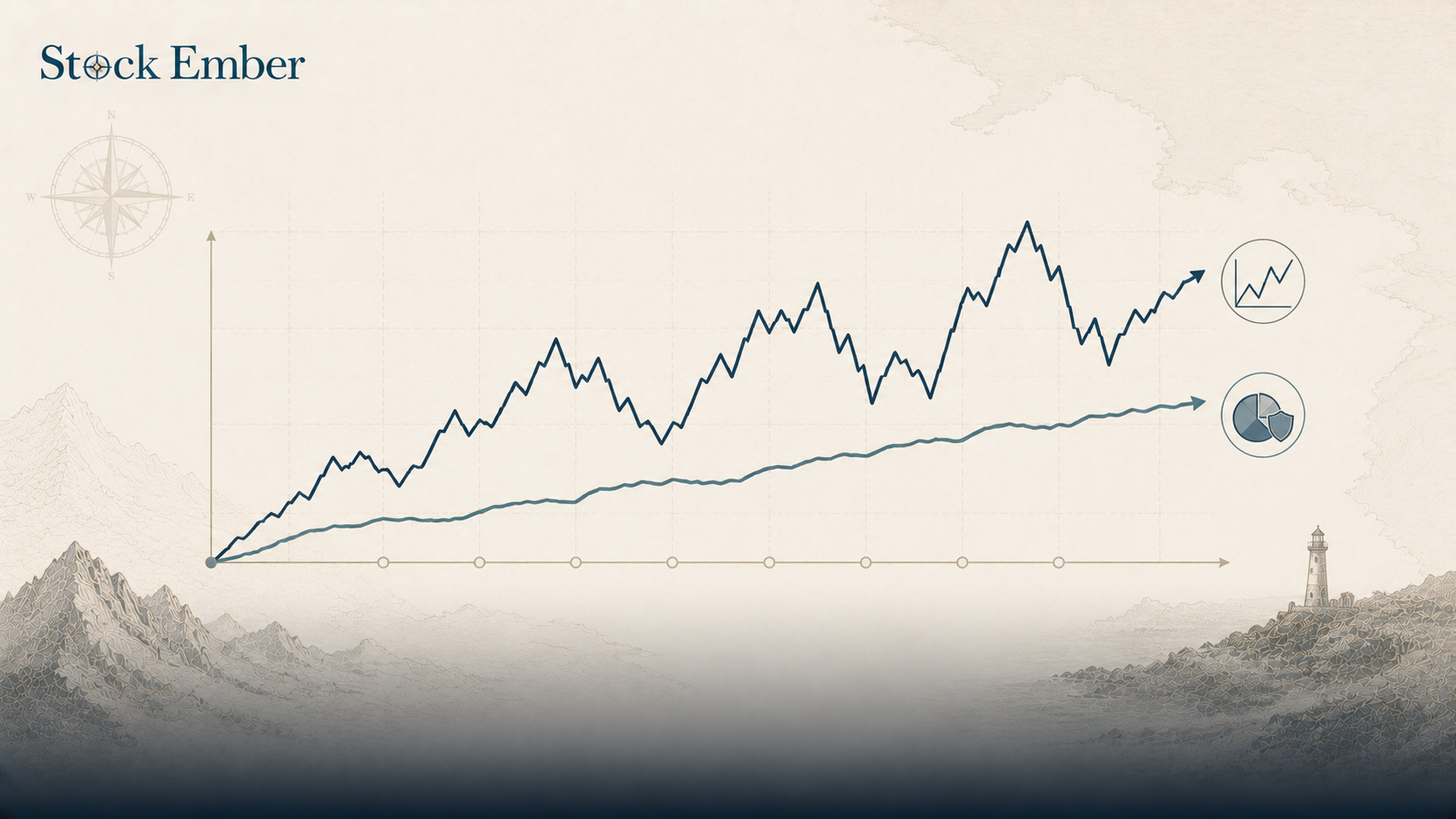
The answer to "what is portfolio diversification?" starts with one idea: spreading investments across different asset classes, market sectors, and geographic regions to reduce company-specific risk without sacrificing expected market-level returns. By holding non-correlated assets, investors smooth out portfolio volatility and protect long-term compound growth.
Put simply, diversification keeps any single company, industry, or country from deciding the fate of your entire portfolio.
Concentrating your money in a single stock or industry leaves your wealth exposed to steep losses if that specific company or sector struggles. By spreading capital across non-correlated assets, diversification dampens overall portfolio volatility and smooths out paper drawdowns over multi-decade horizons. This guide breaks down how diversification works, how asset correlation protects capital, and how to build instant global exposure.
Quick Takeaways
01Portfolio diversification spreads capital across non-correlated assets to eliminate company-specific risk while retaining broad market return potential.
02The core meaning of diversification centers on minimizing portfolio volatility through strategic allocation across asset classes, market caps, and geographic regions.
03Combining assets with low or negative correlation can help offset downturns in one market segment with stability in another, though this relationship is not guaranteed.
04Holding broad-market index ETFs provides instant, multi-thousand-asset diversification at near-zero expense ratios.
What Is Portfolio Diversification?
Portfolio diversification is a core risk-management technique designed to reduce individual asset volatility by allocating capital across multiple investments that react differently to economic events.
When beginners ask what diversification is or seek a clear diversification meaning, the simplest explanation is the classic rule of not keeping all your financial eggs in a single basket. If you invest 100% of your capital into a single company, your financial future relies entirely on that single firm's corporate earnings, management decisions, and industry conditions.
If that company fails, your capital is permanently lost. Spreading investments across dozens of industries, market capitalizations, and countries ensures that the failure of any single entity has a minimal impact on your total wealth.
How Portfolio Diversification Works: Risk Types and Asset Correlation
Portfolio diversification works by mathematically isolating and reducing unsystematic risk while managing asset correlation across economic cycles.
To understand why spreading investments works, long-term investors must distinguish between two fundamental types of financial risk:
Unsystematic Risk (Specific Risk): The risk tied directly to an individual company or industry, such as a product recall, executive mismanagement, or sector regulation. According to the U.S. SEC, a stock portfolio generally needs at least a dozen carefully selected individual stocks to be truly diversified, and spreading holdings across many companies and sectors can substantially reduce this company-specific risk.
Systematic Risk (Market Risk): The inherent risk of participating in the broader economy, such as inflation, interest rate hikes, or global recessions. Systematic market risk affects nearly all assets at the same time and cannot be eliminated by diversification alone.
The mechanical engine powering diversification is asset correlation, measured on a scale from -1.0 to +1.0. A correlation of +1.0 means two assets move in perfect tandem, while a correlation near 0.0 means their prices move largely independently. When correlation is negative (below 0.0), one asset tends to rise or hold steady while the other falls.
For example, pairing broad equity index holdings with high-quality government bonds has historically tended to stabilize portfolio returns during equity sell-offs, though correlations can shift during severe liquidity shocks or periods of high inflation.
Line chart showing how portfolio diversification reduces volatility compared to a single stock.
Portfolio Diversification vs. Strategic Asset Allocation
Strategic asset allocation sets the macro percentage split between major asset classes, whereas portfolio diversification dictates how capital is spread within and across those specific asset buckets.
While investors frequently confuse the two concepts, they serve distinct operational roles in portfolio construction. Determining that your baseline policy should consist of 70% equities and 30% fixed income is an exercise in what is strategic asset allocation.
Once those macro asset buckets are established, portfolio diversification determines how those buckets are populated. Within your 70% stock allocation, true diversification means allocating capital across large-cap, mid-cap, and small-cap stocks, covering technology, healthcare, and industrial sectors, and spanning US, international developed, and emerging markets.
Building Instant Diversification with Low-Cost Passive Indexing
Low-cost passive indexing provides instant, multi-thousand-asset diversification through a single investment vehicle without the need for active stock selection or high management fees.
Historically, achieving complete global diversification required purchasing dozens of individual stocks and bonds, incurring significant trading commissions and administrative complexity. Adopting the principles of what is passive investing completely solves this barrier.
By purchasing a single total market index ETF, an investor instantly owns a proportional share of thousands of underlying companies across dozens of countries.
Consider the 10-year cost impact of achieving diversification through active management versus passive index ETFs on a $10,000 portfolio:
Scenario
Expense Ratio
Net Annual Return (Illustrative)
Value of $10,000 After 10 Years
No fees (gross benchmark)
0.00%
7.00%
$19,672
Passive Broad Market Index ETF
0.08%
6.92%
$19,525
Active Multi-Asset Fund
0.75%
6.25%
$18,335
In this hypothetical example, the lower-cost fund preserves about $1,190 more per $10,000 invested over a decade. These figures assume a constant 7.0% gross annual return, exclude taxes and trading costs, and are not a forecast; actual returns will vary, and you can lose money.
Passive index funds deliver comprehensive global diversification while preserving $1,190 more of your capital per $10,000 invested over a single decade.
Common Pitfalls in Portfolio Diversification
Common diversification pitfalls include over-diversifying into overlapping assets ("diworsification"), mistaking asset quantity for true correlation, and expecting diversification to eliminate broad market bear runs.
Avoiding these structural traps keeps your investment strategy efficient and focused:
Over-Diversification ("Diworsification")
Adding dozens of funds or holdings that track the exact same underlying companies creates administrative clutter without lowering portfolio risk. Holding five different US large-cap ETFs simply duplicates holdings while adding fee friction, capping your return potential without delivering additional risk-reduction benefits.
Confusing Quantity with True Correlation
Buying 50 individual stocks within the technology sector is not diversification; it is concentration risk in disguise. If regulatory changes or supply chain disruptions hit the tech sector, all 50 holdings will drop simultaneously regardless of how many individual company names you hold.
Expecting Diversification to Eliminate Systematic Market Losses
Diversification manages portfolio volatility and eliminates company-specific collapse risks, but it cannot insulate a portfolio from broad market corrections. During severe global bear markets, almost all equity categories drop together. Recognizing that paper drawdowns are a normal cost of long-term equity growth prevents panic selling.
In practice, many long-term investors realize that effective diversification does not require owning hundreds of individual positions or complex niche funds. Holding two or three total-market index ETFs covers thousands of global companies and bonds, giving you broad diversification while keeping trading costs and portfolio maintenance low.
Conclusion
Ultimately, the answer to "what is portfolio diversification?" comes down to one foundational risk-management mechanism that eliminates company-specific failure risk and smooths out multi-decade market swings. By combining low-correlated asset classes across global markets, you can reduce the impact of severe losses from any single holding while still participating in broad economic growth.
Executing your strategy through broad-market index ETFs can provide wide diversification at a relatively low operating cost. When you are ready to explore broad-market index funds that offer instant global diversification, reviewing our ETF reviews is a natural next step.
FAQ
5 questions
What is the primary purpose of portfolio diversification?
The main purpose of portfolio diversification is to reduce unsystematic (company-specific or sector-specific) risk. Spreading capital across non-correlated assets prevents a single business failure or industry downturn from causing outsized damage to your total portfolio.
What is the difference between diversification and asset allocation?
Asset allocation is the macro policy decision determining your overall portfolio split (such as 70% stocks and 30% bonds). Diversification is the practice of populating those asset buckets across various market sectors, company capitalizations, and global regions to minimize concentration risk.
Can portfolio diversification prevent losses during a market crash?
No, diversification cannot eliminate systematic (market-wide) risk. During severe economic panics or global bear markets, broad equity markets tend to decline together. However, diversification limits downside severity and prevents permanent capital loss from individual company bankruptcies.
What is "diworsification" or over-diversification?
Over-diversification occurs when an investor holds dozens of overlapping, highly correlated funds or holdings that duplicate underlying asset exposure. This adds unnecessary fee drag and complexity without providing any additional risk-reduction benefit.
How do low-cost index ETFs achieve instant diversification?
A broad-market index ETF holds hundreds or thousands of individual stocks or bonds within a single fund structure. Purchasing a single share of a total market index ETF grants instant proportional ownership across global industries at a near-zero expense ratio.
Disclaimer
This guide was written with AI assistance and reviewed by the StockEmber editorial team for accuracy. StockEmber provides independent education, not personal financial advice. Investing puts your capital at risk: the value of investments can go down as well as up, you may get back less than you invest, and past performance doesn’t guarantee future results. Some links may support our work at no additional cost to you.
The StockEmber Team is our in-house desk of independent research writers. We test brokerage platforms, read the fine print on fees and custody, and cover ETFs and long-horizon investing for people who plan to hold for decades — not days.