Corporate bonds are debt contracts issued by companies to borrow capital directly from investors. The issuing corporation agrees to pay regular fixed interest across the life of the loan and return the original face value on a specified maturity date. In exchange for steady income, investors take on credit risk based on the financial health of the issuing company.
Corporate bonds are debt securities issued by companies to raise money from investors, promising regular interest payments and returning the principal at maturity.
When a company needs capital to build factories or refinance debt, borrowing directly from investors is often cheaper than taking bank loans. For patient portfolios, corporate debt offers steady income between volatile equities and lower-yielding government paper. Understanding this market helps you allocate capital with clarity.
This guide explains how corporate bonds function, how credit ratings work, and how defaults affect long-term returns.
Quick Takeaways
01Corporate bondholders are creditors with legal priority over stockholders in bankruptcy.
02Bond prices move inversely to interest rates: rising rates push bond values down.
04Most investors access corporate debt through low-cost index funds to avoid high dealer markups.
What Are Corporate Bonds?
Corporate bonds are debt obligations that turn an investor into a lender rather than a part-owner of a business. When you buy a corporate bond, you receive no voting rights or claim on earnings growth. Instead, you enter a formal agreement where the issuing firm pledges to pay periodic interest and return your original principal on a set date.
Understanding corporate bonds’ meaning for your portfolio comes down to your place on the balance sheet. In bankruptcy, bondholders are creditors. Shareholders are paid only after creditors’ claims are satisfied, and bondholders generally have priority over shareholders. In exchange for capping upside, you gain a higher legal claim on the company’s assets, although the exact priority depends on the bond’s terms.
Investor education guidance from the U.S. SEC explains that a corporate bond is issued under a contract called an indenture, which often includes covenants designed to limit credit risk, and that a trustee monitors the issuer’s compliance.
Priority does not eliminate risk. If a firm runs out of money, bondholders can face payment delays or steep restructuring haircuts through court proceedings. Corporate debt represents a legal contract, not an absolute guarantee.
How Corporate Bonds Work: Coupons, Par, and Maturity
A corporate bond operates on 4 core mechanics: par value, coupon rate, maturity date, and yield to maturity.
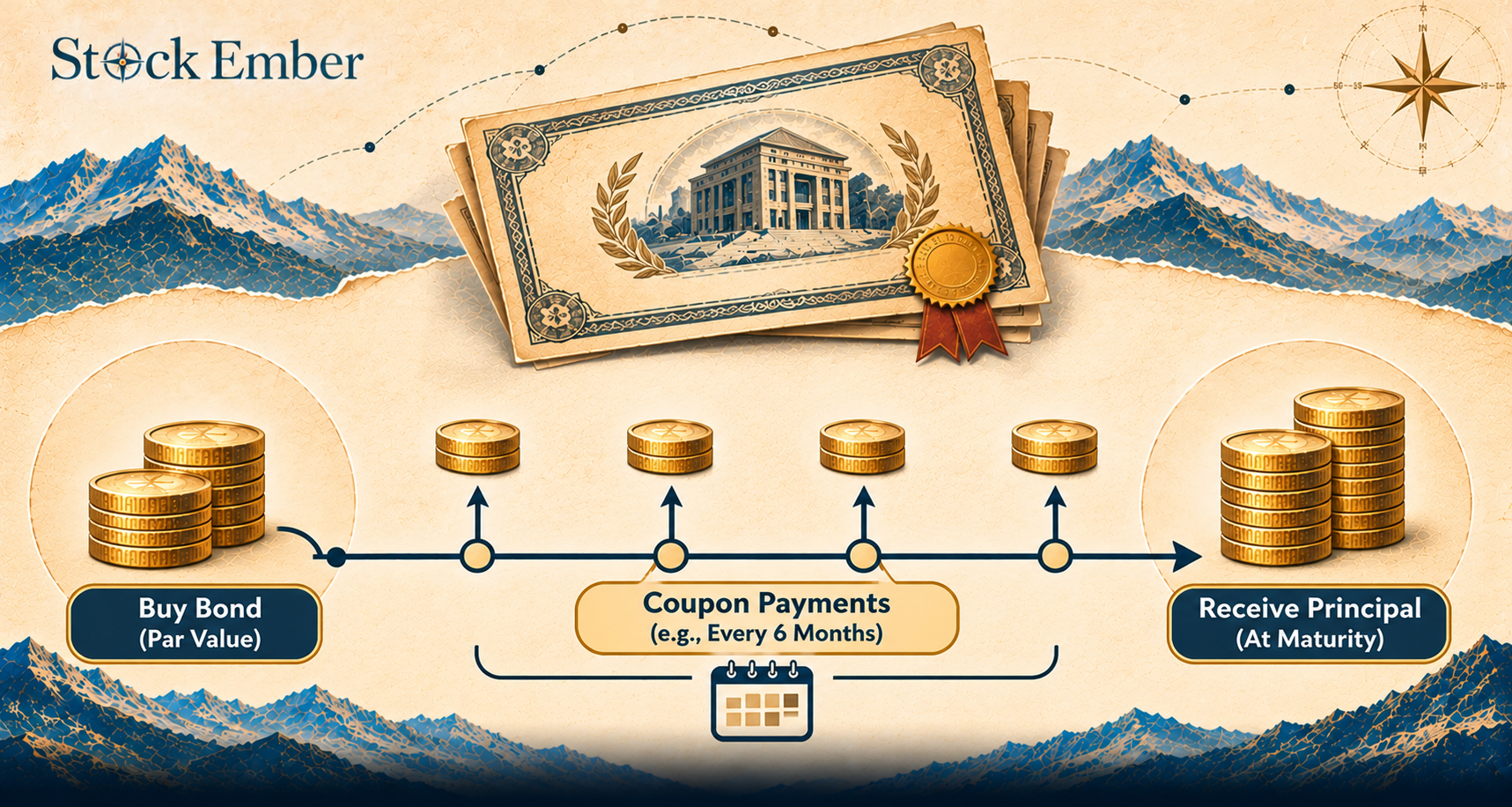
The par value (or face value) is the borrowed amount, typically $1,000 per bond. The coupon rate is the annual interest rate the company pays, usually in semiannual installments. For instance, a bond with a $1,000 par value and a 5% coupon pays $50 yearly, or $25 every 6 months. The maturity date marks when the company returns the full $1,000 principal.
Having corporate bonds explained clearly also requires understanding secondary market prices. After issuance, bonds trade between investors at prices driven by interest rates:
Bond Price Direction = Opposite of Market Interest Rate Moves
When central banks raise rates, new bonds offer higher coupons. Older bonds paying lower rates drop in market value below par (a discount). On the other hand, falling interest rates lift existing bond prices above par (a premium).
The annual rate of return you would earn by buying a bond at its market price and holding it to maturity, assuming all payments arrive as scheduled, is its yield to maturity (YTM). YTM accounts for both regular coupon payments and the difference between your purchase price and par.
Diagram showing a $1,000 corporate bond paying semiannual coupons until maturity
The Role of Corporate Debt in a Long-Term Portfolio
Corporate debt can give long-term portfolios relatively predictable cash flow and added diversification. Unlike dividend-paying stocks, which can trim payouts during difficult quarters, bond issuers must make interest payments on schedule or enter legal default.
In asset allocation, corporate debt pays higher yields than sovereign debt. This gap is the credit spread, the extra return required to compensate investors for company default risk. Comparing corporate debt against other types of bonds helps balance credit risk against interest rate sensitivity. Government bonds have historically tended to hold up better during market panics but usually pay lower yields, while corporate debt increases cash flow at the cost of corporate credit exposure.
In practice, many long-term investors find that corporate bonds cushion portfolio volatility during mild slowdowns. However, during severe liquidity panics, corporate bond prices often slide alongside equities as credit spreads widen.
Investment Grade vs. High Yield: The 10-Year Default Drag
Credit rating agencies divide corporate debt into 2 primary tiers: investment grade and high yield (often called speculative or junk debt).
Investment-grade bonds (rated AAA through BBB- by S&P and Fitch, or Aaa through Baa3 by Moody's) come from stable firms with modest default risk. High-yield bonds (rated BB+ or Ba1 and below) come from indebted businesses with cyclical cash flows. Companies can also issue hybrid securities like the convertible bond, which lets creditors swap debt into equity under specific conditions.
Credit Rating Tier
Typical Profile
10-Year Cumulative Default Rate
AAA to A
Pristine balance sheets, low debt
Roughly 1% or less
BBB
Moderate debt, stable cash flows
Roughly 3% to 4%
BB to B (High Yield)
High debt, sensitive to cycles
Roughly 10% to 22%
CCC to C
Distressed, imminent default danger
Around 50%
Source: S&P Global Ratings long-term corporate default studies; figures are approximate historical averages based on data available as of this article’s publication.
Over a 10-year horizon, credit defaults erode headline yields. Suppose you buy a high-yield portfolio yielding 8% yearly, while investment-grade debt pays 5%. That 3% spread looks compelling.
Yet over 10 years, default studies from rating agencies such as Moody's and S&P show that speculative-grade default losses have historically averaged roughly 1.5% to 2% yearly after debt recoveries. These figures reflect long-run data available as of this article’s publication. Factor in a 0.40% fund expense ratio, and your net yield advantage can fall from 3% to roughly 1% or less.
In this hypothetical example, on a $100,000 portfolio held for 10 years, an expected $30,000 income bonus can shrink to roughly $10,000 or less after default losses. Chasing headline yield without factoring in 10-year credit drag can be an expensive mistake.
Common Mistakes When Investing in Corporate Debt
Investors often make 3 mistakes when adding corporate debt to a portfolio.
First, treating high-yield debt as a cash substitute is dangerous. Speculative corporate debt correlates closely with equities. In recessions, junk bonds fall alongside stocks, offering little defense when portfolios need stability most.
Second, investors overlook interest rate duration. A bond with a 10-year maturity and a 3% coupon loses roughly 8% of its market price if interest rates rise by 1 percentage point. Selling before maturity during rate hikes locks in steep capital losses.
Third, buying individual corporate bonds through retail brokers brings heavy friction. Secondary corporate bonds trade over-the-counter across dealer networks rather than centralized public exchanges. Retail buyers may pay wide bid-ask spreads and dealer markups that can noticeably reduce their principal, especially on small orders. Be cautious of anyone offering bonds with unusually high “guaranteed” yields or pressing you to buy quickly, and check the background of any broker or adviser through the SEC’s Investor.gov before you invest.
Conclusion
Corporate bonds can be an effective way to earn relatively steady income, provided you balance credit spreads against default probabilities. Investment-grade debt tends to offer relatively dependable cash flow with a yield premium over government securities, while high-yield debt requires careful attention to default drag across a full business cycle. Choosing low-cost, broadly diversified funds can limit trading friction and reduce the impact that any single company’s bankruptcy has on your savings.
When you are ready to evaluate diversified bond funds for your portfolio, our ETF reviews are a practical place to start. Every investment carries risk of loss and past returns never guarantee future results, so use this guide as an educational foundation for your asset allocation decisions.
FAQ
5 questions
Can you lose money on a corporate bond?
Yes, you can lose money on these bonds in 2 primary ways. If the issuing company faces severe financial distress or enters bankruptcy, it may default on interest payments or fail to return your principal. Additionally, if you sell a bond on the secondary market before its maturity date after interest rates have increased, its market price will have fallen, resulting in a capital loss.
What is the main difference between a government bond and a corporate bond?
The main difference lies in credit risk and yield. Government bonds issued by developed nations that borrow in their own currency are generally considered to carry very low credit default risk, because those governments can raise taxes or create currency. Even so, these bonds still carry interest rate and inflation risk. Corporate bonds are issued by private businesses that can fail, so companies must offer a higher yield, known as a credit spread, to compensate investors for taking on repayment risk.
How often do corporate bonds pay interest?
Most of them pay interest twice a year in semiannual installments, though some international or floating-rate issues pay quarterly or annually. The annual coupon payment is divided equally across the scheduled dates. For example, a bond with a 6% coupon and a $1,000 face value pays $60 per year, delivered as 2 separate $30 payments every 6 months until the bond matures.
What happens to corporate bondholders if a company goes bankrupt?
When a corporation enters bankruptcy, legal proceedings pause regular operations to reorganize debt or liquidate assets. Corporate bondholders hold statutory priority over equity shareholders, meaning they must be settled before common stockholders receive anything. However, bondholders rarely recover the full face value in bankruptcy, often receiving reduced cash payouts, restructured debt terms, or newly issued equity shares at a discount.
How are corporate bonds taxed for individual investors?
In the United States, the coupon payments you receive from corporate bonds are generally taxed as ordinary income at your marginal rate, rather than at the lower rates that can apply to qualified stock dividends. Tax rules differ in other countries, so check the guidance where you live. If you trade them on the secondary market and sell them for more than you paid, the resulting profit is subject to capital gains tax.
Disclaimer
This guide was written with AI assistance and reviewed by the StockEmber editorial team for accuracy. StockEmber provides independent education, not personal financial advice. Investing puts your capital at risk: the value of investments can go down as well as up, you may get back less than you invest, and past performance doesn’t guarantee future results. Some links may support our work at no additional cost to you.
The StockEmber Team is our in-house desk of independent research writers. We test brokerage platforms, read the fine print on fees and custody, and cover ETFs and long-horizon investing for people who plan to hold for decades — not days.