A money market fund is a type of mutual fund that pools investor cash to buy high-quality, short-term debt securities such as Treasury bills and commercial paper. While retail funds aim to maintain a steady $1.00 share price and pay variable dividends, they are investment securities rather than bank deposits and carry no government deposit insurance.
A money market fund is a mutual fund that invests in high-quality, short-term debt to generate modest income while keeping your cash easy to access.
When interest rates rise, parking spare cash in a money market fund can look just like using a high-yield bank account, yet the 2 products operate under very different rules and protections.
This guide explains the money market fund meaning, how shares and yields behave, and what 10-year fees and inflation mean for your long-term portfolio.
Quick Takeaways
01A money market fund is an investment product regulated as a mutual fund, not a bank deposit backed by government deposit insurance.
02Most retail and government funds aim to keep a steady $1.00 share price, though that price is a goal rather than a promise.
03Over 10 years, an annual expense ratio quietly reduces your net yield, especially when short-term interest rates fall.
04Holding excess cash in a money market fund for multi-year goals can lose purchasing power to inflation compared with long-term assets.
What Is a Money Market Fund?
A money market fund is a type of mutual fund (an investment pool that combines money from many investors to buy securities) that holds short-term, low-volatility debt. In practical terms, the money market fund meaning comes down to cash management: giving investors a liquid place to hold money while earning interest tied to short-term rates.
Rather than buying stocks or long-term bonds, fund managers buy debt that matures quickly, often within days or months. Common holdings include Treasury bills (short-term debt issued by the U.S. government), commercial paper (short-term IOUs issued by large corporations), and certificates of deposit.
In the United States, money market funds are regulated by the SEC, but they carry no government deposit insurance and can lose value. Under SEC rules, non-government funds can also charge a liquidity fee on withdrawals during periods of market stress.
How a Money Market Fund Works
A money market fund earns interest from its short-term debt holdings and pays that income to shareholders as regular dividends, usually paid monthly. To see a money market fund explained in daily operation, look at 2 moving parts: its share price and its yield.
Most retail and government money market funds aim to maintain a stable net asset value (NAV), meaning the fund’s per-share price, of $1.00 per share. Rather than rising in price like a stock, the fund distributes earnings through fractional shares or cash dividends, while its 7-day yield (an annualized snapshot of income over the past week) moves with market interest rates.
Money market funds fall into 3 main groups:
Government and Treasury funds: Invest almost entirely in U.S. government securities and repurchase agreements (short-term loans backed by government securities), making them the most conservative choice.
Prime funds: Hold corporate commercial paper and bank debt alongside government notes, often offering slightly higher yields with added credit risk; institutional prime funds use a floating share price rather than a $1.00 target.
Municipal funds: Invest in short-term debt issued by state and local governments.
How Money Market Funds Differ from Bank Accounts
A money market fund is an investment security held at a brokerage or fund firm, whereas a bank deposit account is a cash balance held at an insured bank. Unlike a bank money market account, a money market fund carries no government deposit insurance if its holdings lose value.
Feature
Money Market Fund
Bank Money Market Account
Product type
Mutual fund (investment security)
Bank deposit account
Deposit insurance
None (no Federal Deposit Insurance Corporation, or FDIC, coverage)
Insured up to statutory limits
Return structure
Variable dividend yield
Bank-set interest rate
Because money market funds invest directly in short-term debt markets, their yields often adjust faster when central banks move rates. The trade-off is that your principal rests on the fund's debt holdings rather than deposit insurance.
The Role of a Money Market Fund in a Long-Term Portfolio
A money market fund works best for money you plan to spend within a few years, such as an emergency fund, a tax bill, or cash awaiting investment, rather than long-term wealth building.
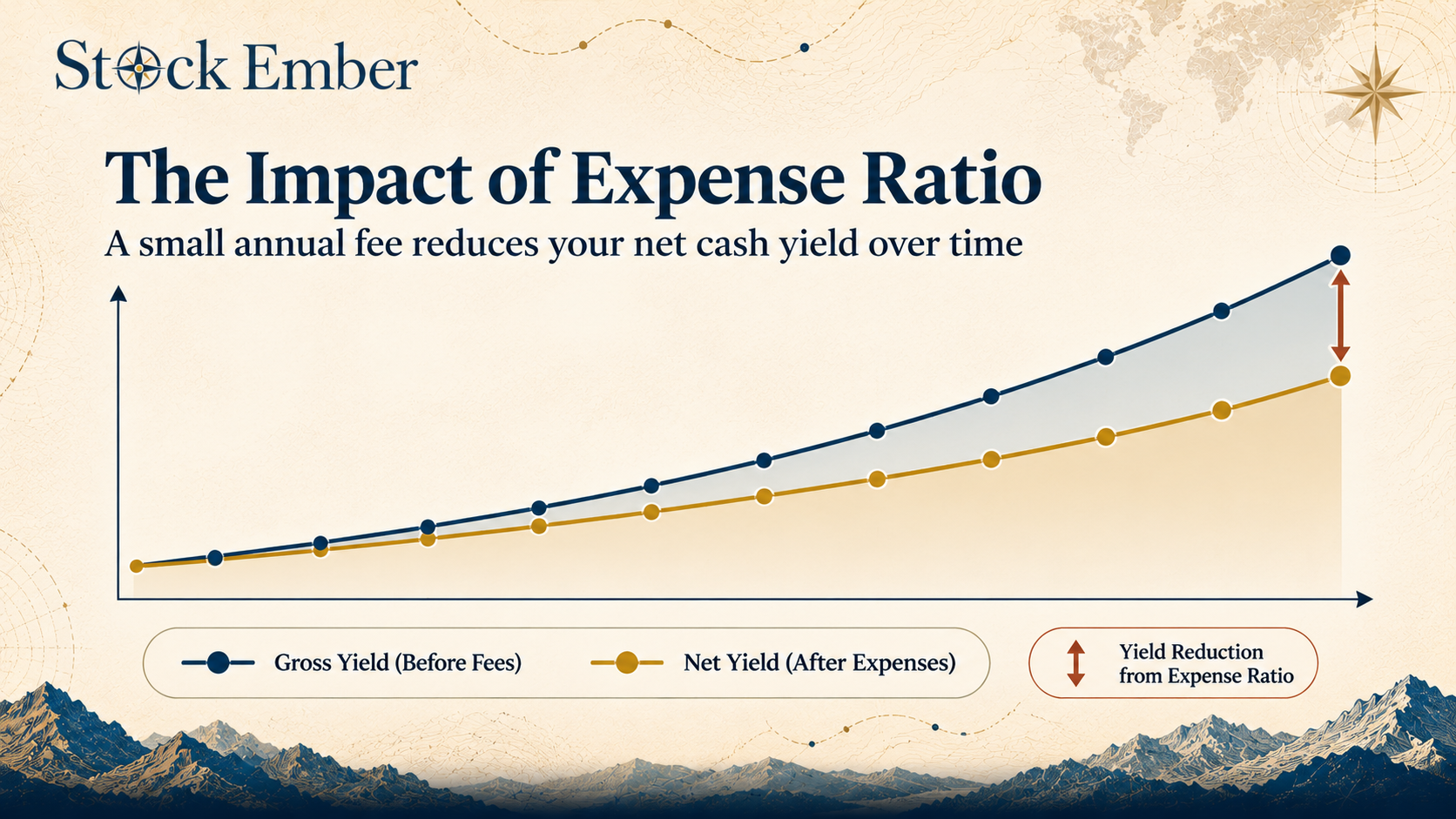
Chart showing how an annual expense ratio reduces net money market fund income over 10 years
Costs still matter in conservative cash funds. Suppose you hold $20,000 in a money market fund charging an illustrative 0.50% annual expense ratio (the annual percentage fee a fund charges to cover operating costs). Over 10 years, that fee takes roughly $1,000 out of your return, and if short-term rates drop to 1.5%, a 0.50% fee consumes one-third of your gross yield each year.
In practice, many long-term investors find that separating near-term cash in a low-cost money market fund from long-term investments makes it easier to leave stock and bond funds untouched during market downturns.
Over multi-year horizons, holding excess cash also creates inflation drag: after taxes and inflation, money market yields struggle to grow real purchasing power compared with long-term passive investing in diversified stocks and bonds.
Common Mistakes When Using Money Market Funds
The most common mistake investors make with money market funds is treating a $1.00 share price as a binding promise rather than an accounting goal. In rare periods of severe market stress, a fund's share price can dip below $1.00, an event known as breaking the buck, causing a loss of principal.
Watch out for 3 pitfalls before parking large balances in a money market fund:
Assuming deposit insurance applies: Holding a money market fund in a brokerage account does not provide FDIC protection against losses in the fund's holdings.
Ignoring expense ratios in low-rate periods: When interest rates fall near zero, a high annual fee can wipe out nearly all dividend income.
Letting fear turn short-term cash into a 10-year holding: Moving retirement money into a money market fund to avoid stock swings can expose it to inflation erosion if it stays there for years.
Conclusion
A money market fund offers liquidity, modest variable income, and low price swings for short-term cash needs, yet it lacks bank deposit insurance and can lose purchasing power to inflation over time. Watching expense ratios and keeping growth money invested in diversified assets helps prevent cash drag from weakening your 10-year plan.
When you are ready to compare diversified funds for long-term portfolio building, explore our ETF reviews as your next step. All investing puts your capital at risk and past yields never promise future returns, so treat this guide as educational background rather than investment advice.
FAQ
6 questions
Are money market funds FDIC insured?
No, money market funds are investment securities regulated as mutual funds, so they do not carry Federal Deposit Insurance Corporation (FDIC) coverage. Unlike a bank savings or money market account backed by government deposit insurance, a money market fund relies on the short-term debt instruments inside its portfolio to preserve shareholder value.
Can you lose money in a money market fund?
Yes, although money market funds hold short-term, high-quality debt to keep share prices steady, they can lose value during severe financial stress. If a fund's net asset value falls below $1.00 per share, known as breaking the buck, investors can lose principal, and inflation can also erode purchasing power over time.
What is the 7-day yield on a money market fund?
The 7-day yield measures the annualized income a money market fund generated over the previous week, after deducting operating expenses. Because short-term debt matures quickly and gets replaced at prevailing market rates, the 7-day yield moves up and down regularly rather than locking in at a fixed rate.
What are the 3 main types of money market funds?
Money market funds generally fall into 3 categories: government funds, prime funds, and municipal funds. Government funds hold U.S. Treasury bills and government-backed agreements, prime funds invest in corporate commercial paper and bank debt, and municipal funds hold short-term debt issued by state and local governments.
What is a good expense ratio for a money market fund?
Lower expense ratios leave more of the fund's short-term interest in your pocket, especially when market interest rates fall. Because money market yields are modest compared with stocks, an annual fee of 0.50% or more can consume a large share of your dividend income over a 10-year period.
Are money market funds good for long-term retirement investing?
Money market funds work well for near-term cash reserves and emergency savings, yet they are rarely built for multi-decade wealth growth. Over 10 or 20 years, after taxes and inflation, short-term cash yields often lag behind diversified passive stock and bond funds, which have historically earned higher long-term returns but can fall sharply in any given year.
Disclaimer
This guide was written with AI assistance and reviewed by the StockEmber editorial team for accuracy. StockEmber provides independent education, not personal financial advice. Investing puts your capital at risk: the value of investments can go down as well as up, you may get back less than you invest, and past performance doesn’t guarantee future results. Some links may support our work at no additional cost to you.
The StockEmber Team is our in-house desk of independent research writers. We test brokerage platforms, read the fine print on fees and custody, and cover ETFs and long-horizon investing for people who plan to hold for decades — not days.