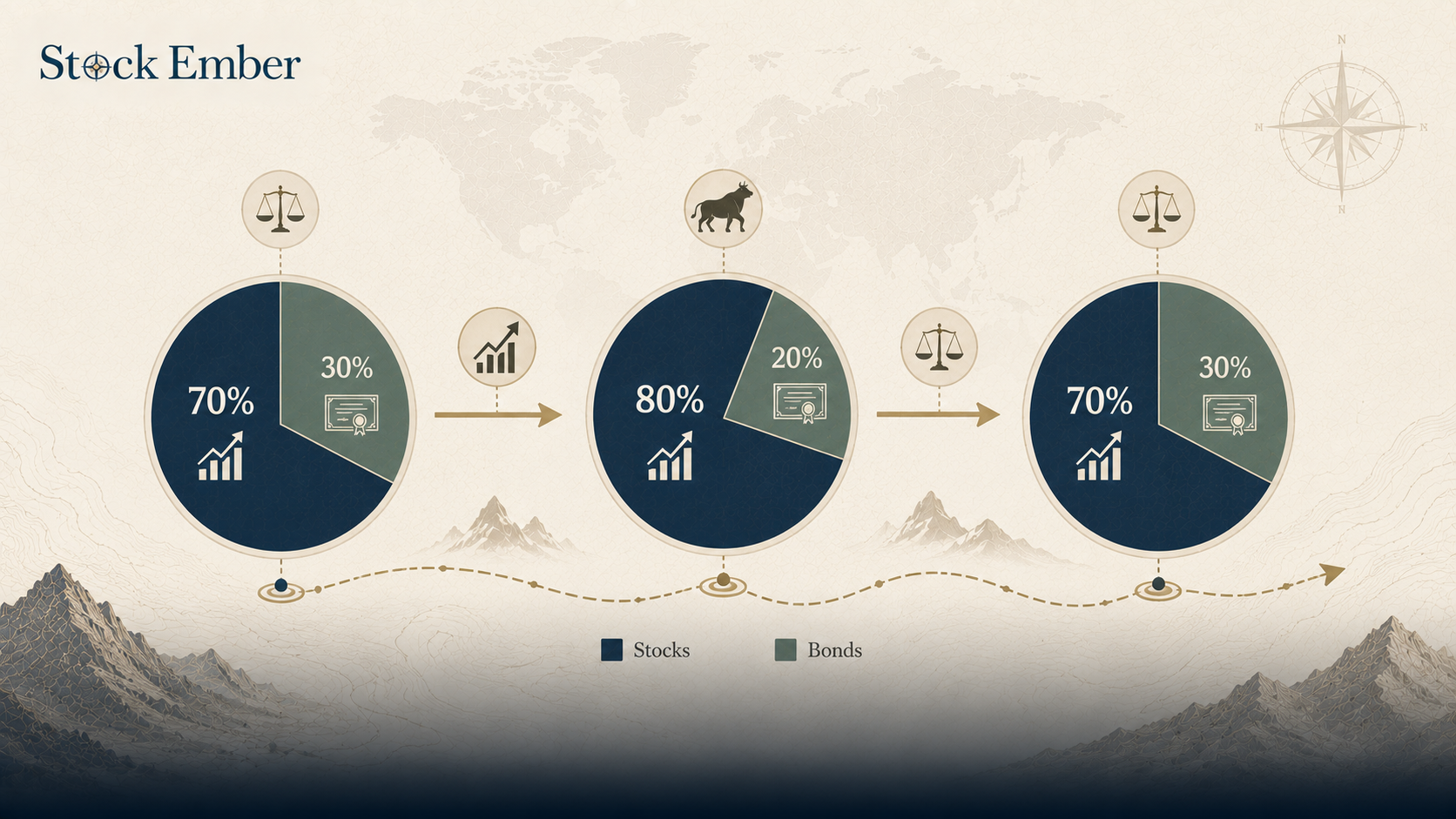
Strategic asset allocation (SAA) is a long-term investment strategy that sets fixed target percentage weights for major asset classes such as stocks, bonds, and cash. These targets are based on an investor's risk tolerance, time horizon, and financial goals. By periodically rebalancing back to these baseline policy targets, it provides an anchored framework that prevents emotional market timing during economic cycles.
Strategic asset allocation is a long-term investment strategy that establishes fixed target weights for different asset classes such as stocks, bonds, and cash, based on an investor's risk tolerance, time horizon, and financial goals.
Setting a permanent policy baseline prevents emotional market timing during volatile economic cycles. Rather than chasing short-term market trends, a strategic allocation establishes an anchored framework designed to compound wealth steadily over decades.
Understanding what is strategic asset allocation and how it differs from active tactics provides the foundation for systematic portfolio growth.
Quick Takeaways
01Strategic asset allocation establishes a permanent baseline target mix of stocks, bonds, and cash tailored to your multi-year financial goals.
02Unlike short-term market timing, strategic allocation uses periodic rebalancing to maintain target risk levels regardless of market noise.
03A disciplined policy baseline helps investors avoid panic selling during market downturns and prevents portfolio drift over long horizons.
04Implementing a strategic allocation through low-cost index ETFs minimizes fee drag and tax friction over a 10-year period.
What Is Strategic Asset Allocation?
Understanding what is strategic asset allocation (SAA) starts with recognizing it as a long-term policy framework that divides capital among major asset classes according to specific percentage targets.
Each asset class serves a distinct structural purpose in your portfolio. Equities (stocks) provide long-term capital growth, fixed income (bonds) offer income stability and downside protection, and cash reserves provide liquidity. By establishing baseline targets such as 70% stocks and 30% bonds, you create a benchmark designed to match your personal risk capacity.
By focusing on broad asset class behavior over multi-decade periods rather than individual stock selection, strategic allocation accounts for the vast majority of a portfolio's long-term return variability.
Strategic vs. Tactical Asset Allocation: Key Differences
Strategic asset allocation establishes a permanent, long-term policy baseline, whereas tactical asset allocation makes temporary, short-term portfolio tilts to exploit market mispricings.
Your strategic allocation reflects your personal investor profile, your age, financial capacity, and investment horizon. It remains constant unless your long-term goals or financial circumstances fundamentally change.
In contrast, what is tactical asset allocationinvolves actively shifting 5% to 10% of portfolio weights into undervalued sectors or defensive cash when economic indicators signal market stress. While tactical shifts attempt to generate extra returns, they increase trading turnover, transaction costs, and tax drag relative to a disciplined strategic baseline.
Dimension
Strategic Asset Allocation (SAA)
Tactical Asset Allocation (TAA)
Time Horizon
Long-term (10+ years)
Short-term (months to 1–2 years)
Primary Goal
Risk-adjusted baseline compounding
Outperforming benchmarks / downside timing
Trading Activity
Low (infrequent rebalancing)
High (frequent sector/asset tilts)
Cost & Tax Drag
Minimal turnover and tax friction
Higher fees and short-term capital gains tax
How Strategic Asset Allocation Works: Target Weights & Rebalancing
Strategic asset allocation works by enforcing periodic rebalancing to restore target asset weights whenever market movements cause portfolio drift.
Over time, outperforming assets naturally grow to represent a larger share of your total portfolio. For instance, an initial 60/40 stock-to-bond portfolio might drift to 75/25 during a prolonged bull market, silently increasing your equity exposure right before an economic contraction.
Diagram showing portfolio drift and strategic asset allocation rebalancing back to baseline target weights.
Investors restore their strategic baseline using two primary rebalancing approaches:
Calendar-Based Rebalancing: Resetting portfolio weights back to baseline targets on a set schedule, such as once per year.
Threshold-Based Rebalancing: Triggering rebalancing trades only when an asset class deviates from its target weight by a set percentage (e.g., ±5%).
Building Your Strategic Baseline with Passive Indexing
Building a strategic baseline with passive index ETFs allows long-term investors to capture broad market returns while minimizing fee drag over multi-year horizons.
Combining strategic asset allocation with what is passive investing creates a low-cost, low-maintenance wealth engine. Instead of paying high management fees for active stock selectors who rarely beat benchmark indexes over 10 years, passive strategic investors hold broad global indexes.
Consider a $10,000 investment held over a 10-year period:
Disciplined Strategic Index Portfolio (Illustrative 7.0% Gross Return minus 0.10% Fee = 6.90% Net Return): Compounds to approximately $19,488 over 10 years.
High-Cost Active Strategy (Illustrative 7.0% Gross Return minus 1.00% Fee/Friction = 6.00% Net Return): Compounds to approximately $17,908 over 10 years.
These figures are hypothetical illustrations based on assumed constant returns, not a guarantee or prediction of actual investment performance, which will vary.
Sticking to a passive strategic baseline preserves over $1,500 in compound wealth per $10,000 invested simply by reducing management costs and unnecessary trading friction.
Common Pitfalls for Strategic Investors
Common pitfalls for strategic investors include abandoning policy targets during market downturns, over-rebalancing in taxable accounts, and failing to update target weights as personal timelines shorten.
Watch out for these three core mistakes:
Abandoning Target Weights During Volatility: Panic selling equities during market crashes locks in paper losses and prevents your portfolio from participating in market rebounds.
Creating Unnecessary Tax Drag: Rebalancing too frequently in taxable brokerage accounts generates realized capital gains taxes that erode long-term compounding. Rebalancing inside tax-advantaged accounts or using new cash contributions eliminates this tax friction.
Maintaining a Static Asset Mix as You Age: While SAA provides a multi-year policy anchor, your baseline targets must adjust gradually as you near retirement or require capital liquidity.
In practice, many long-term investors find that the hardest part of strategic asset allocation isn't choosing the original target weights, it's doing nothing when market headlines urge you to trade. Having a written strategic policy agreement with yourself makes it much easier to stay calm and execute disciplined rebalancing when prices drop.
Conclusion
Strategic asset allocation serves as the foundational anchor of a successful long-term investment plan. By establishing clear policy targets and disciplined rebalancing routines, you insulate your portfolio from emotional decision-making and market timing traps. Paired with low-cost passive index funds, a strategic allocation ensures your wealth compounds efficiently through all market conditions.
When you are ready to select broad index funds to construct your policy portfolio, reviewing our ETF reviews is a practical next step.
FAQ
5 questions
What is the main purpose of strategic asset allocation?
When evaluating what is strategic asset allocation, its main purpose is to establish a long-term policy baseline that balances growth and risk according to your personal financial horizon. It removes emotion from investing and prevents market timing by maintaining fixed asset weights across economic cycles.
What is the difference between strategic and tactical asset allocation?
Strategic asset allocation sets a permanent policy mix designed for multi-year compounding. Tactical asset allocation makes temporary, short-term adjustments to exploit market mispricings or manage near-term volatility before returning to the strategic baseline.
How often should a strategic asset allocation be rebalanced?
Most long-term investors rebalance strategic allocations either on a calendar schedule (such as once per year) or whenever an asset class drifts by a set threshold (such as 5% away from its target policy weight).
What is a common example of strategic asset allocation?
A classic example is a 70/30 stock-to-bond portfolio, where 70% of capital is allocated to broad-market equity index funds for growth and 30% is allocated to high-quality bond funds for downside protection and stability.
Why is strategic asset allocation effective for index investors?
Strategic asset allocation paired with broad index ETFs captures market-wide compounding while keeping trading fees, management expense ratios, and capital gains tax drag to a minimum over a 10-year horizon.
Disclaimer
This guide was written with AI assistance and reviewed by the StockEmber editorial team for accuracy. StockEmber provides independent education, not personal financial advice. Investing puts your capital at risk: the value of investments can go down as well as up, you may get back less than you invest, and past performance doesn’t guarantee future results. Some links may support our work at no additional cost to you.
The StockEmber Team is our in-house desk of independent research writers. We test brokerage platforms, read the fine print on fees and custody, and cover ETFs and long-horizon investing for people who plan to hold for decades — not days.