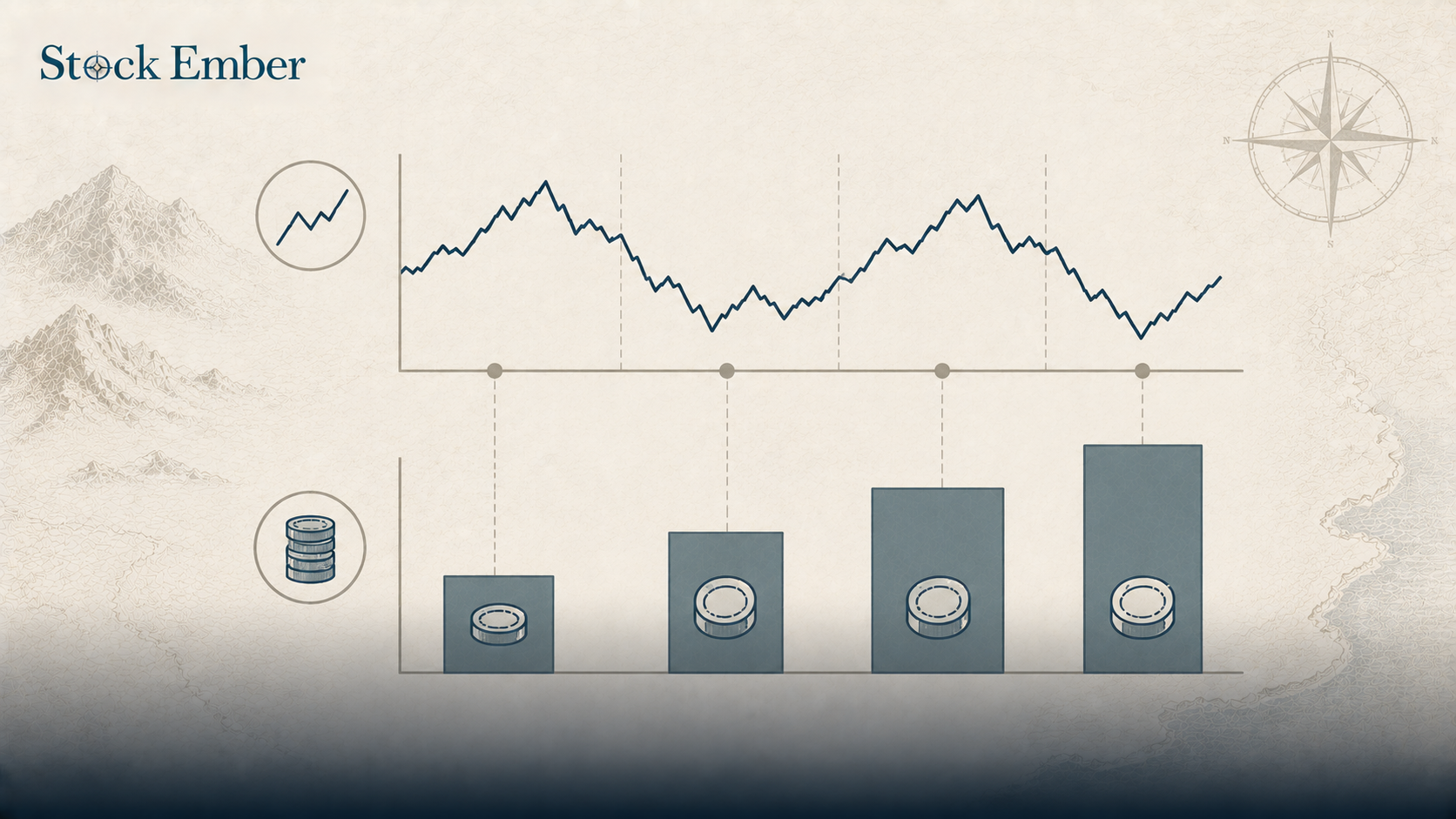
Dollar-cost averaging is an investment strategy of deploying a fixed monetary sum into a security or index fund at regular, automated intervals regardless of market price movements. This systematic execution automatically buys more shares when prices fall and fewer when prices rise, lowering average share costs and removing market-timing anxiety over long compounding horizons.
Dollar-cost averaging is an investment strategy where you deploy a fixed dollar amount into a security or portfolio at regular, automated intervals regardless of short-term market price fluctuations.
Trying to time market dips often triggers emotional stress and costly delays. By committing to periodic contributions, dollar-cost averaging removes market-timing anxiety and turns short-term volatility into an automated accumulation tool for multi-decade compounding. This guide explains how periodic investing lowers your average unit cost and integrates with long-term indexing.
Quick Takeaways
01Dollar-cost averaging commits fixed monetary amounts at regular intervals, removing emotional guesswork from market entry.
02The mechanical engine automatically buys more shares when prices are low and fewer when prices are high, reducing average share costs over time.
03While lump-sum investing mathematically outperforms in rising markets, dollar-cost averaging offers crucial psychological protection against poor entry timing.
04Combining periodic contributions with broad-market index exchange-traded funds (ETFs) builds a disciplined, automated baseline for multi-decade wealth growth.
What Is Dollar-Cost Averaging?
Dollar-cost averaging (DCA) is a systematic execution strategy that divides a total sum of capital into equal periodic purchases over a defined timeframe.
When you explore what is dollar cost averaging (and its common written form, what is dollar-cost averaging), you'll find that the core principle is replacing emotional market timing with mechanical discipline. Instead of attempting to guess whether asset prices will rise or fall next week, you invest a consistent amount such as $500 on the first day of every month regardless of prevailing economic headlines.
This systematic approach treats market volatility as an operational feature rather than a threat. Because your deposit amount remains constant, price drops allow your fixed capital to purchase a larger quantity of assets, laying the foundation for long-term compound growth.
How Dollar-Cost Averaging Works: Share Accumulation and Unit Math
Dollar-cost averaging works by varying the number of shares purchased each period based on market prices, lowering the average cost per share relative to the average market price.
To understand the mathematical engine behind periodic investing, consider how fixed monthly capital behaves across fluctuating market cycles:
Diagram illustrating share accumulation during market price fluctuations.
Month
Fixed Contribution
Share Price
Shares Acquired
Cumulative Shares
Month 1
$1,000
$50.00
20.00
20.00
Month 2
$1,000
$40.00
25.00
45.00
Month 3
$1,000
$25.00
40.00
85.00
Month 4
$1,000
$40.00
25.00
110.00
In this four-month scenario, you invested a total of $4,000. The average share price across those four months was $38.75 (($50 + $40 + $25 + $40) / 4). However, because your fixed $1,000 monthly contribution purchased 40 shares during the Month 3 market drop, your actual average cost per share was only $36.36 ($4,000 total invested divided by 110 total shares) according to the principles of dollar-cost averaging.
By automatically acquiring more asset units at lower prices, the strategy reduces your average unit cost below the simple average market price without requiring you to time the bottom. However, dollar-cost averaging does not guarantee a profit or protect against losses in a declining market. If prices keep falling, your portfolio can still be worth less than the total amount you invested.
Dollar-Cost Averaging vs. Lump-Sum Investing
Comparing dollar-cost averaging to lump-sum investing involves balancing statistical probability against psychological risk management.
When you have a lump sum of capital such as an annual bonus or inheritance, you face a choice between deploying all funds immediately or spreading them out over time:
Statistical Probability: A February 2023 Vanguard Research study, Cost Averaging: Invest Now or Temporarily Hold Your Cash?, compared both strategies across rolling one-year periods from 1976 to 2022. It found that lump-sum investing outperformed cost averaging more than two-thirds of the time, between 61.6% and 73.7% depending on the market. Because broad equity markets have historically trended upward over long horizons, keeping capital in cash can create "cash drag," reducing your market exposure.
Psychological Protection: Despite the statistical odds, investing a large sum right before a sudden market crash can trigger intense regret. Behavioral economists call the urge to avoid that feeling regret aversion. An investor who loses 20% immediately after deploying a lump sum may panic and sell at the bottom. Dollar-cost averaging trades a small margin of expected return for emotional peace of mind, ensuring you stay committed to your plan.
For most investors accumulating wealth from regular employment income, dollar-cost averaging is not merely an optional tactic; it is the natural, automated rhythm of saving.
Integrating Dollar-Cost Averaging With Passive Index Funds
Integrating dollar-cost averaging with broad-market index ETFs creates a fully automated wealth-building system that requires no ongoing security analysis.
When you adopt what is passive investing, you stop attempting to pick winning stocks and instead aim to capture broad market growth. Automating recurring purchases into a target portfolio aligned with your asset allocation turns long-term investing into a background habit.
Consider the 10-year impact of an automated $500 monthly investment compounding at an illustrative 7.0% annual gross return:
Total Cash Invested: $60,000 over 120 months ($500 x 120).
Projected Portfolio Balance: Approximately $86,542 after 10 years.
This is a hypothetical illustration, not a forecast. Actual returns vary from year to year and are not guaranteed, fees and taxes are not included, and your balance could end up lower than the total amount you invested.
By setting up recurring paycheck deductions or automated bank transfers into low-cost index ETFs, you remove willpower and short-term market noise from your financial progress.
Common Pitfalls in Dollar-Cost Averaging
Common pitfalls in dollar-cost averaging include pausing contributions during market downturns, extending deployment timelines excessively, and ignoring fixed transaction fee friction.
Avoiding these three operational mistakes helps preserve the effectiveness of periodic investing:
Pausing DCA Contributions During Market Crashes
The fundamental mathematical benefit of dollar-cost averaging occurs when asset prices fall, allowing your fixed contribution to accumulate cheap shares. If fear causes you to pause deposits during a market correction, you destroy the exact mechanism that lowers your average share cost. Maintaining your regular contribution schedule during downturns keeps the strategy working as designed and positions you to benefit if prices later recover.
Accumulating Excess Cash Drag Over Unusually Long Horizons
When deploying a large cash windfall through dollar-cost averaging, stretching the process over multiple years increases cash drag. While spreading purchases across six to 12 months provides reasonable emotional insulation, keeping funds in low-yielding cash for two or three years exposes your wealth to inflation and missed compounding.
Ignoring Transaction Fees on Micro-Contributions
If your brokerage charges fixed commissions or foreign exchange fees per trade, making frequent micro-investments can eat away at your principal. For instance, a $5 fixed fee on a $100 monthly contribution represents an immediate 5% loss. Ensure your broker offers zero-commission ETF trading or consolidate purchases into larger quarterly installments if fixed fees apply.
In practice, many long-term investors find that an automated monthly transfer into broad-market index ETFs is one of the simplest ways to reduce investing stress. When capital flows automatically every payday, short-term market dips transform from scary events into routine opportunities to accumulate more index units.
Conclusion
Dollar-cost averaging is an automated behavioral mechanism that eliminates market-timing anxiety and turns volatility into lower average unit costs. Whether deploying a regular salary contribution or managing a lump-sum entry, systematic periodic purchases enforce long-term discipline across all market cycles.
Pairing automated contributions with low-cost index funds provides a reliable, low-stress foundation for multi-decade compounding. When you are ready to explore low-cost index funds that fit an automated recurring contribution plan, checking our ETF reviews is a practical next step.
FAQ
5 questions
What is the main benefit of dollar-cost averaging?
The main benefit of dollar-cost averaging is that it removes emotional market timing and behavioral anxiety from investing. By committing a fixed amount on a regular schedule, you automatically buy more shares when prices drop and fewer when prices rise, lowering your overall average cost per share over time.
Is dollar-cost averaging better than lump-sum investing?
According to Vanguard Research, lump-sum investing has historically outperformed dollar-cost averaging roughly two-thirds of the time, largely because equity markets have tended to rise over long horizons. However, dollar-cost averaging provides vital psychological protection against worst-case entry timing, preventing investors from panicking or selling during sudden market drops.
What happens if you pause dollar-cost averaging during a market crash?
Pausing contributions during a market downturn ruins the primary mathematical advantage of dollar-cost averaging. Market corrections allow your fixed deposit to buy shares at lower prices; stopping deposits means missing those lower-cost units, which could add to long-term gains if prices later recover.
Can you automate dollar-cost averaging with index ETFs?
Yes, most modern brokerages allow you to establish automated recurring transfers and scheduled purchases into broad-market index ETFs. Setting up automated payroll deductions or monthly bank transfers turns long-term wealth accumulation into a disciplined background habit.
What is cash drag in dollar-cost averaging?
Cash drag occurs when uninvested funds sit idle in cash while waiting to be deployed over an extended dollar-cost averaging schedule. During prolonged bull markets, holding cash instead of deploying it exposes capital to inflation drag and missed market gains.
Disclaimer
This guide was written with AI assistance and reviewed by the StockEmber editorial team for accuracy. StockEmber provides independent education, not personal financial advice. Investing puts your capital at risk: the value of investments can go down as well as up, you may get back less than you invest, and past performance doesn’t guarantee future results. Some links may support our work at no additional cost to you.
The StockEmber Team is our in-house desk of independent research writers. We test brokerage platforms, read the fine print on fees and custody, and cover ETFs and long-horizon investing for people who plan to hold for decades — not days.