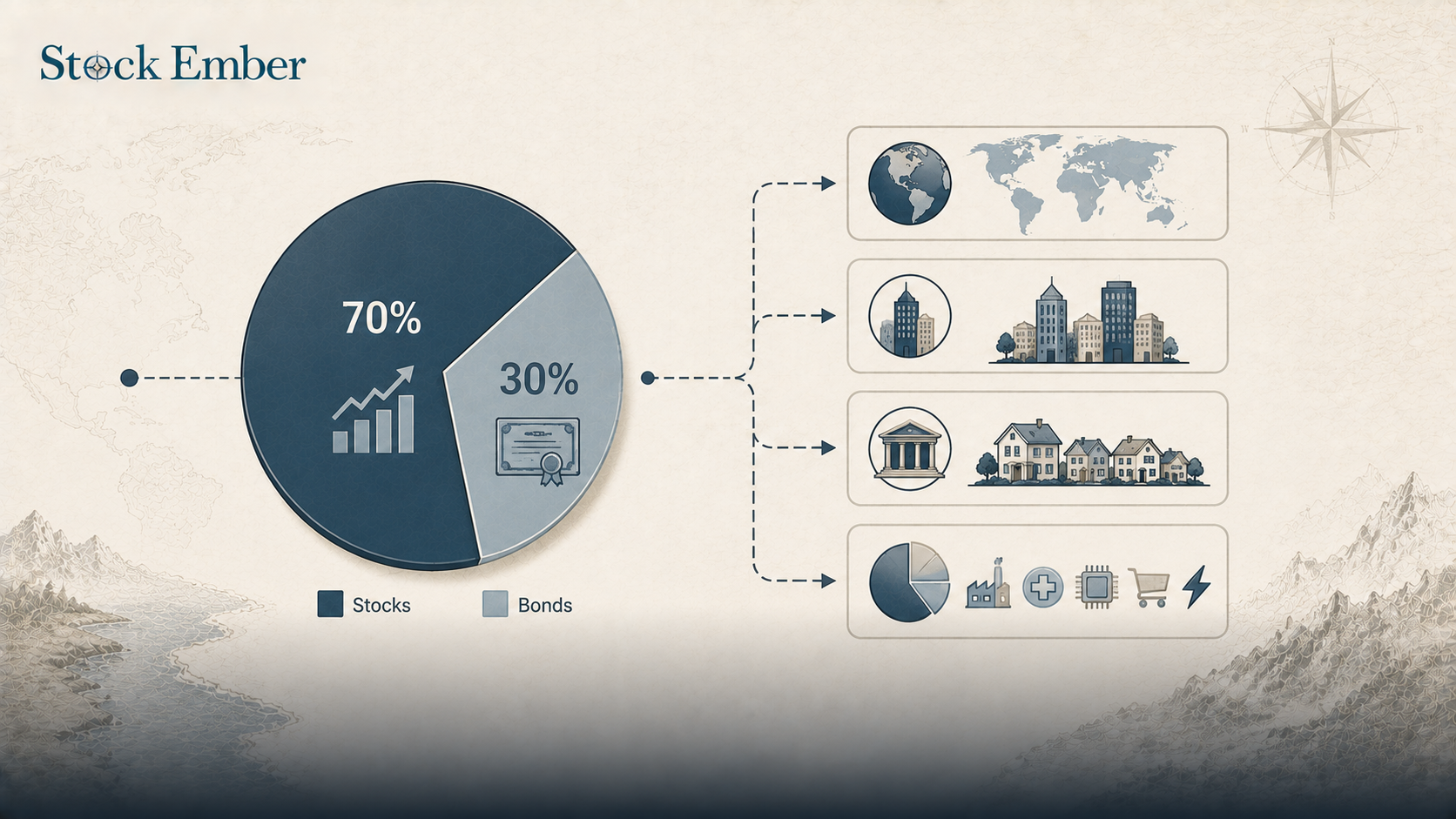
Asset allocation is the macro portfolio strategy of dividing investment capital across broad asset classes such as equities, fixed income, and cash, to balance risk and return based on an investor's timeline and goals. By setting an appropriate stock-to-bond ratio, investors establish a disciplined baseline that manages volatility and supports long-term compound growth.
What is asset allocation? It is the macro-level strategy of dividing an investment portfolio across broad asset categories such as stocks, bonds, and cash to balance long-term risk and return based on individual financial goals, timeline, and risk tolerance.
Deciding how much of your wealth sits in growth assets versus stability assets drives the majority of your overall portfolio returns over time. Rather than attempting to guess short-term market movements, setting a structured asset allocation gives you a disciplined framework to withstand economic downturns and compound wealth over multi-decade horizons.
This guide answers the question “What is asset allocation?” in practical terms, explaining how asset classes function, how to structure your stock-to-bond ratio, and how to execute your strategy cleanly.
Quick Takeaways
01Asset allocation sets the macro percentage split between stocks, bonds, and cash to balance expected returns against market volatility.
02Your optimal allocation depends primarily on your investment time horizon, risk tolerance, and capacity to absorb paper drawdowns.
03Asset allocation sets the overarching macro buckets, while portfolio diversification populates those buckets across broad geographic markets and sectors.
04Using low-cost broad-market index exchange-traded funds (ETFs) to implement your allocation plan can preserve significantly more compound growth over a 10-year horizon by reducing fee drag.
What Is Asset Allocation?
Asset allocation is the foundational portfolio design process that determines how your investment capital is distributed across major financial asset classes to achieve a specific risk-and-return profile.
Instead of focusing on individual stock selection or market timing, asset allocation establishes the high-level policy of your portfolio. A landmark 1986 study by Brinson, Hood, and Beebower, published in the Financial Analysts Journal, found that asset allocation policy explained over 90% of the variation in large pension funds' quarterly returns over time, far outweighing the impact of individual security selection.
By deliberately dividing capital between growth-oriented assets and stability-oriented assets, you build an investment blueprint tailored to your personal financial requirements.
The Three Primary Asset Classes
The three primary asset classes used in traditional portfolio allocation are equities, fixed income, and cash equivalents, each serving a distinct operational purpose in wealth management.
Understanding the role of each building block allows long-term investors to construct a balanced portfolio:
Equities (Stocks): Represent ownership shares in companies. Equities serve as the primary engine for long-term capital growth and inflation protection, but they carry higher short-term price volatility and drawdown risk (the risk of a temporary drop from a portfolio's previous peak value)
Fixed Income (Bonds): Represent loans made to governments or corporations that pay regular interest. Fixed income typically provides predictable cash flow, helps preserve capital, and has often acted as a volatility buffer during stock market crashes, although bond prices can also fall, especially when interest rates rise.
Cash and Cash Equivalents: Include money market funds, Treasury bills, and high-yield savings accounts. Cash offers high liquidity and price stability, but its purchasing power tends to erode whenever inflation outpaces the interest it earns, a risk that compounds over multi-decade horizons.
Key Factors Influencing Your Asset Allocation
Determining your target asset allocation requires evaluating your investment time horizon, emotional risk tolerance, and overall financial capacity to absorb portfolio drawdowns.
Rather than relying on outdated age-based rules of thumb, long-term investors should evaluate allocation based on two core parameters:
1. Investment Time Horizon
Your time horizon is the number of years or decades before you need to withdraw capital from your portfolio. Investors with a multi-decade timeline can maintain a high equity allocation (such as 80% to 90% stocks) because they have ample time to recover from severe market downturns. Conversely, investors approaching short-term capital needs require a higher fixed-income allocation to lock in stability.
2. Risk Tolerance vs. Risk Capacity
Risk tolerance measures your psychological comfort with market declines, while risk capacity measures how much financial loss your balance sheet can withstand without disrupting your lifestyle. An aggressive 80/20 stock-to-bond portfolio historically experiences sharper peak-to-trough drawdowns during severe bear markets than a moderate 60/40 or conservative 40/60 model. Choosing an allocation that exceeds your emotional limit often leads to panic selling at market bottoms.
Asset Allocation vs. Portfolio Diversification
Asset allocation establishes the macro percentage split between major asset classes, whereas portfolio diversification determines how capital is spread within those specific asset buckets.
While the terms are often used interchangeably, distinguishing between them is critical for effective portfolio management:
Diagram comparing macro asset allocation against micro portfolio diversification.
Setting a target policy of 70% equities and 30% fixed income is an exercise in asset allocation. Populating that 70% equity bucket across thousands of global companies, multiple market capitalizations, and diverse economic sectors is the job of portfolio diversification. Asset allocation sets the broad risk dial; diversification ensures that no single company or industry failure ruins that asset bucket.
Executing Asset Allocation Through Low-Cost Passive Indexing
Executing a macro asset allocation strategy using low-cost passive index funds provides comprehensive global market exposure while eliminating active manager fees and security selection risk.
Adopting a passive investing strategy allows you to build a complete global portfolio using just two or three broad-market index ETFs.
Consider the 10-year fee impact of implementing a 70/30 asset allocation strategy on a $10,000 portfolio:
Active Multi-Asset Fund (0.75% Expense Ratio): Compounding at an illustrative 7.0% gross annual return minus 0.75% fees yields approximately $18,335 after 10 years.
Passive ETF Model Portfolio (0.08% Expense Ratio): Compounding at an illustrative 7.0% gross annual return minus 0.08% fees yields approximately $19,525 after 10 years.
In this illustration, using low-cost index ETFs preserves nearly $1,190 more per $10,000 invested over a single decade, keeping more of your money compounding rather than paying fund management friction. These figures assume a constant 7.0% gross annual return with no taxes or trading costs; actual returns will vary, and the value of your investments can fall as well as rise.
Maintaining Your Strategy: Rebalancing and Allocation Drift
Maintaining your intended asset allocation requires periodic portfolio rebalancing to reset asset weights back to their target proportions after unequal market performance causes allocation drift.
During a prolonged equity bull market, your stock allocation may naturally grow from a target 70% up to 85% of your total portfolio. This allocation drift unintentionally increases your risk exposure right when markets are elevated.
Rebalancing systematically restores your intended risk profile by trimming overperforming assets and redirecting capital into underperforming ones. This disciplined execution forces you to sell high and buy low without relying on emotional market forecasts.
In practice, many long-term investors rebalance once a year or whenever an asset class drifts more than 5% from its target weight. That simple routine is often enough to keep a portfolio aligned with its long-term risk profile without incurring unnecessary tax or fee drag.
Conclusion
The answer to “What is asset allocation?” comes down to one principle: it is the primary driver of long-term investment performance, establishing a macro balance between capital growth and downside protection. By tailoring your stock-to-bond ratio to your time horizon and drawdown capacity, you create a resilient strategy capable of enduring market cycles.
Implementing your target allocation with broad-market index ETFs helps keep management fees low, which can leave more of your 10-year compound returns working in your portfolio. When you are ready to evaluate broad index funds that fit your target asset allocation model, exploring our ETF reviews is a logical next step.
FAQ
5 questions
What is the main purpose of asset allocation?
Asset allocation establishes the macro balance between long-term capital growth and downside stability. By dividing capital across stocks, bonds, and cash, it controls portfolio volatility and ensures your investment risk matches your personal timeline and financial capacity.
What is the difference between asset allocation and portfolio diversification?
Asset allocation sets the macro policy split between major asset categories (such as 70% equities and 30% fixed income). Portfolio diversification determines how those specific buckets are populated across global regions, industry sectors, and market capitalizations.
What are the three main asset classes in asset allocation?
The three primary asset classes are equities (stocks for long-term growth and inflation protection), fixed income (bonds for capital preservation and income stability), and cash equivalents (for short-term liquidity and safety).
How do you choose the right stock-to-bond allocation?
Your optimal stock-to-bond ratio depends on your investment time horizon and capacity for paper drawdowns. Multi-decade horizons allow higher equity allocations (80%–90% stocks), whereas shorter horizons require higher bond allocations to protect capital against sudden market drops.
How often should you rebalance your asset allocation?
Most long-term investors rebalance annually or whenever an asset class drifts by more than 5% from its target weighting. Periodic rebalancing restores your intended risk profile by trimming outperforming assets and buying underperforming ones.
Disclaimer
This guide was written with AI assistance and reviewed by the StockEmber editorial team for accuracy. StockEmber provides independent education, not personal financial advice. Investing puts your capital at risk: the value of investments can go down as well as up, you may get back less than you invest, and past performance doesn’t guarantee future results. Some links may support our work at no additional cost to you.
The StockEmber Team is our in-house desk of independent research writers. We test brokerage platforms, read the fine print on fees and custody, and cover ETFs and long-horizon investing for people who plan to hold for decades — not days.