A Roth 401(k) is an employer-provided retirement plan where contributions are made using wages that have already been taxed. In exchange for paying income tax upfront, all investment earnings compound tax-free, and qualified withdrawals made after age 59½ and after the 5-year holding period are exempt from federal income taxes. Unlike a personal Roth IRA, it features higher annual workplace contribution limits and has no income restrictions.
A Roth 401(k) is an employer-sponsored retirement savings account funded with after-tax dollars, allowing your investments to grow tax-free and qualified withdrawals in retirement to come out 100% federal income tax-free.
Deciding how to fund retirement often comes down to when you pay taxes: today or decades from now. For long-term investors, choosing after-tax contributions lowers take-home pay today in exchange for sheltered compound growth. This guide covers how the account works, the 10-year tax trade-off, and the withdrawal rules you need to know.
Quick Takeaways
01Contributions come from after-tax income, meaning you get no upfront tax deduction today.
02Investment growth and qualified distributions in retirement are completely tax-free once you meet age and holding rules.
03There are no income eligibility caps to participate, unlike a personal Roth account.
04Nonqualified early withdrawals follow a pro-rata rule, so each withdrawal is split between tax-free contributions and taxable earnings.
What Is a Roth 401(k)?
A Roth 401(k) is an after-tax savings feature inside an employer retirement plan that pairs high workplace contribution limits with tax-free qualified Roth withdrawals.
When people search "what is Roth 401k," the core Roth 401k meaning centers on tax timing. In a traditional workplace plan, contributions lower your taxable income today, but withdrawals in retirement are taxed as ordinary income. With a Roth 401k explained simply, that order flips: you pay income taxes on wages upfront, deposit net dollars into your plan, and, under current law, owe no federal income tax on qualified investment gains or withdrawals. Because it exists inside an employer plan rather than an independent brokerage, you can only contribute if your workplace offers it.
How a Roth 401(k) Works
A Roth 401(k) works through automatic payroll deductions where after-tax dollars enter your account and invest in market assets like index funds.
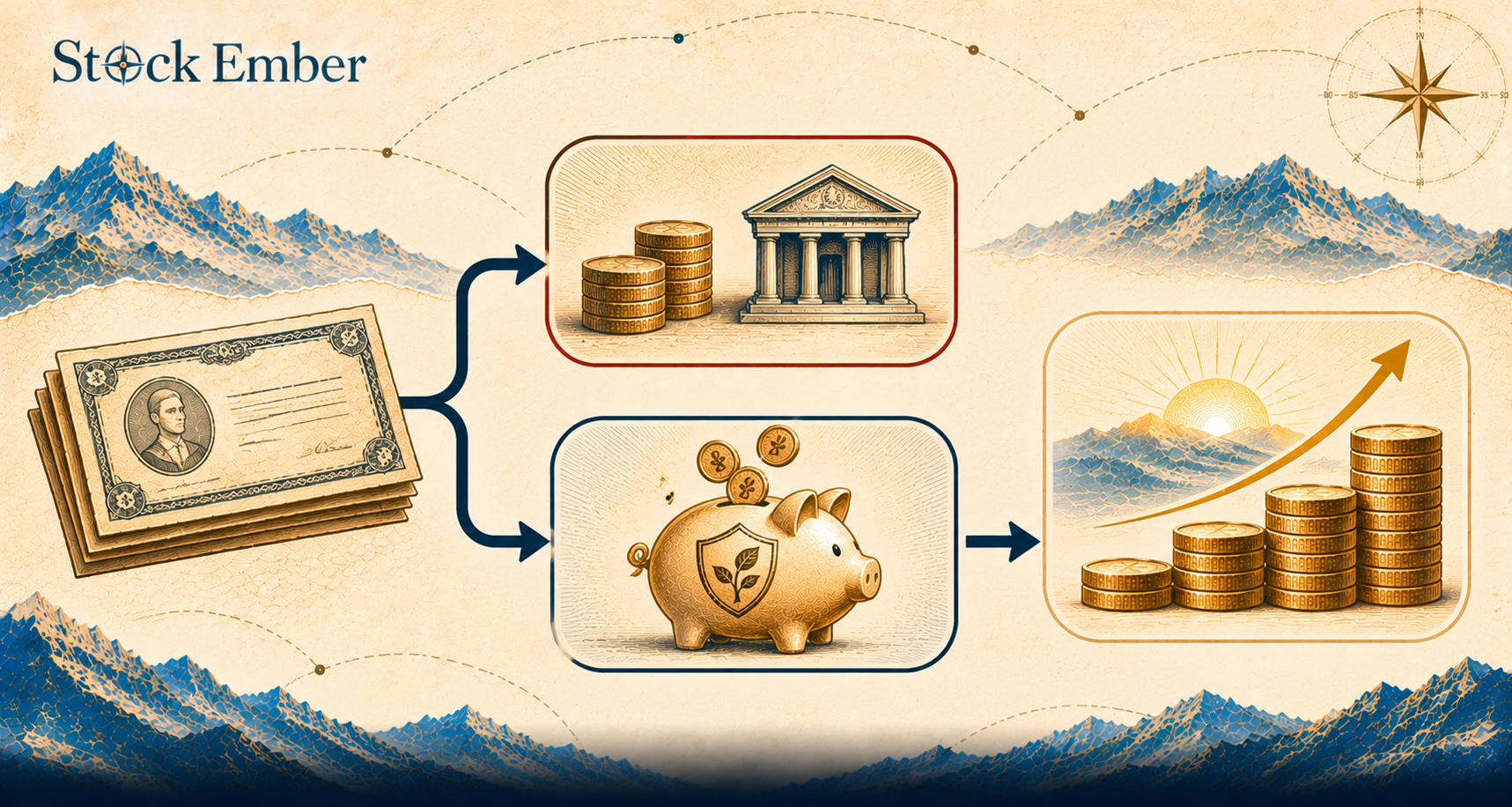
Diagram of after-tax paycheck deductions flowing into a Roth 401k retirement account
For 2026, employee elective deferrals are capped at $24,500 under IRC Section 402(g), with an extra catch-up allowance of $8,000 for workers age 50 and older, or $11,250 for those aged 60 through 63, if the plan allows catch-up contributions. Unlike an individual Roth account, there are no income limits. High earners phased out of a Roth IRA or other tax-advantaged accounts can contribute the full amount if their workplace offers the plan.
Under the SECURE 2.0 Act, employers may allow you to designate matching contributions as Roth if your plan offers this option, though you owe income tax on that match in the year it is contributed. In addition, as confirmed by the Internal Revenue Service, pre-death Required Minimum Distributions (RMDs) are no longer required for Roth 401(k) accounts, leaving your balance invested for life.
The 10-Year Tax-Drag Trade-Off
Choosing a Roth 401(k) matters because paying taxes upfront reduces the starting capital you have available to invest; at equal tax rates the 2 options tend to produce similar after-tax results, so the Roth comes out ahead mainly when your retirement tax rate is higher than your current rate.
Consider an illustrative 10-year scenario in which you invest $10,000 of pre-tax income annually in a 24% tax bracket. In a traditional plan, the full $10,000 goes to work immediately. Over 10 years at an assumed 7% annual return, a hypothetical rate rather than a guaranteed result, the full pre-tax balance compounds, but every dollar withdrawn later is taxed as ordinary income. In a Roth 401(k), you pay $2,400 in taxes upfront each year, leaving $7,600 to invest.
While the Roth balance grows tax-free, you pay $24,000 in taxes upfront over 10 years that a traditional plan would defer rather than eliminate, since traditional withdrawals are taxed later. If your retirement bracket matches your current bracket, the 2 paths tend to finish close to even; the Roth choice tends to pay off when your retirement bracket is higher.
In practice, many long-term investors find that splitting contributions between pre-tax and Roth accounts provides helpful tax diversification, offering flexible withdrawal options when future tax brackets are uncertain.
Withdrawal Rules and the Pro-Rata Trap
To withdraw money from a Roth 401(k) tax-free and penalty-free, the withdrawal must be a qualified distribution, which requires reaching age 59½ and satisfying the 5-year aging rule.
The 5-year clock begins on January 1 of the tax year of your first plan contribution. Once you meet both rules, all withdrawals of contributions and investment growth are completely tax-free.
Many savers confuse workplace rules with a personal Roth IRA. In an individual Roth IRA, IRS ordering rules let you withdraw direct contributions at any time without taxes or penalties. A Roth 401(k) does not offer that flexibility.
If you take a nonqualified early withdrawal from a Roth 401(k), the IRS applies the pro-rata rule. Every dollar withdrawn is split proportionally between your tax-free contributions and your taxable investment earnings. You must pay ordinary income tax plus a 10% penalty on the earnings share. When weighing a Roth 401(k) vs. traditional 401(k), this distribution rule makes a workplace plan poorly suited for emergency cash needs.
Common Mistakes to Avoid
Watch for 3 Roth 401(k) mistakes: overpaying taxes during peak earning years, misunderstanding employer vesting schedules, and taking early nonqualified distributions.
First, locking in high tax rates during your peak earning years can be costly. If you earn at the top of your career in a 32% or 35% bracket, taking an upfront tax hit makes less sense if you expect to live on less in retirement.
Second, investors often forget that employer matching funds follow vesting schedules. While your personal salary deferrals belong to you immediately, company match dollars may require several years of service before they fully vest. Leaving your job early means forfeiting unvested funds.
Finally, taking a nonqualified withdrawal before age 59½ generally makes the earnings share subject to income tax and a 10% penalty under the pro-rata rule. That early withdrawal permanently shrinks the capital base that drives your future compound returns.
Conclusion
A Roth 401(k) offers a practical way to build tax-free retirement wealth, particularly for savers currently in lower tax brackets or those seeking tax diversification. The core trade-off lies in paying taxes today on your contributions in exchange for sheltered compounding and tax-free distributions decades down the road. If you change jobs, rolling an inactive workplace plan into an individual account can give you greater investment choice and simpler distribution rules.
When you are ready to evaluate platforms for your personal retirement accounts, our Broker reviews are the place to start. Investing in market securities involves risk of loss, and future tax laws remain subject to change, so treat this education as a foundation for your own planning rather than personal tax advice.
FAQ
5 questions
Can you roll over a Roth 401(k) into a Roth IRA?
Yes. When you leave your employer, you can complete a direct rollover of your Roth 401(k) balance into an individual Roth IRA. Doing so does not trigger taxes because the funds have already been taxed. Rolling into a Roth IRA provides 2 key benefits: access to wider investment choices beyond your workplace plan menu and greater withdrawal flexibility under standard Roth IRA ordering rules.
What happens to your Roth 401(k) when you leave your job?
If you leave your job, your vested balance remains yours. You typically have 4 choices: if the balance meets plan minimums, roll the balance over into a new employer Roth 401(k), transfer the account into an individual Roth IRA, or cash out the account. Cashing out generally triggers income tax, and often a 10% penalty, on the earnings portion of a nonqualified withdrawal, so it should usually be avoided
Can you take a loan against a Roth 401(k)?
If your employer plan permits 401(k) loans, you can borrow from your Roth account balance. IRS rules generally limit loans to 50% of your vested balance up to $50,000. You repay the loan with interest back into your own account via payroll deductions. However, if you leave your job before paying the balance, the unpaid loan may be treated as a taxable early distribution.
Do Roth 401(k) withdrawals affect your Social Security taxes?
Qualified Roth 401(k) withdrawals do not count toward your provisional income, which is the IRS measure used to determine whether your Social Security retirement benefits are subject to income tax. Because qualified distributions are entirely federal income tax-free, they help retirees keep their taxable income below statutory thresholds that would otherwise trigger taxation on their Social Security checks.
Can high earners contribute to a Roth 401(k)?
Yes. Unlike an individual Roth IRA, which phases out contribution eligibility based on modified adjusted gross income, a Roth 401(k) has zero income limits. Any employee whose workplace offers a Roth 401(k) option can contribute up to the maximum annual elective deferral limit, regardless of how much money they earn in salary or bonuses.
Disclaimer
This guide was written with AI assistance and reviewed by the StockEmber editorial team for accuracy. StockEmber provides independent education, not personal financial advice. Investing puts your capital at risk: the value of investments can go down as well as up, you may get back less than you invest, and past performance doesn’t guarantee future results. Some links may support our work at no additional cost to you.
The StockEmber Team is our in-house desk of independent research writers. We test brokerage platforms, read the fine print on fees and custody, and cover ETFs and long-horizon investing for people who plan to hold for decades — not days.