A 457 plan is an employer-sponsored US retirement account for state and local government workers and eligible non-profit employees. Contributions are deducted from your paycheck on a pre-tax basis, or on a Roth basis if your governmental plan offers it, and you can withdraw funds without the 10% early penalty after leaving your job, even before age 59½.
A 457 plan is a tax-advantaged workplace retirement account for US state and local government employees and certain non-profit workers, allowing you to defer part of your salary into investments.
If you work for a school district, city agency, or hospital, you may already have a pension and wonder where to put extra savings. A 457 plan offers valuable tax breaks and rare early-withdrawal flexibility, yet high fees and strict rollover rules can trip you up. Here is a 457 plan explained in plain terms, including its 10-year costs and hidden traps.
Quick Takeaways
01A 457 plan lets eligible public-sector and non-profit workers shelter extra pay from taxes while building long-term stock and bond investments.
02Unlike a 401(k) or 403(b), a 457(b) allows penalty-free withdrawals once you leave your employer, even before age 59½, though income taxes still apply on pre-tax payouts.
03You can contribute up to the full annual limit in both a 457(b) and a 403(b) in the same year if your employer offers both plans.
04In our illustrative example, a 1-percentage-point higher annual fee left a $100,000 portfolio roughly 9% smaller over 10 years; returns vary and losses are possible, so check fees before you commit extra dollars.
What Is a 457 Plan?
The 457 plan meaning comes from Internal Revenue Code Section 457, which defines it as a deferred compensation plan, an arrangement where you delay receiving part of your pay, and paying tax on it, until retirement. Like any retirement account, it is a tax wrapper rather than an investment itself. Your savings grow only when invested in stock or bond funds on your plan's menu, and those funds can lose value when markets drop.
Most workers use the standard 457(b) plan, while a narrower 457(f) plan covers only select executives at state and local governments or tax-exempt organizations. Under IRS Section 457(b) rules, accounts fall into two groups:
Governmental 457(b) plans: Offered by state and local governments, public schools, and public universities. Your money sits in a trust, shielded from employer creditors, and can roll into another retirement account when you change jobs.
Non-governmental 457(b) plans: Offered by tax-exempt 501(c) non-profits, hospitals, and unions. Your balance stays the employer's legal property until paid out, leaving it exposed to general creditors if the organization goes bankrupt.
How a 457(b) Plan Works
You fund a 457(b) through payroll deductions, choosing pre-tax contributions to lower taxable income today or, if your governmental plan offers them, designated Roth contributions with after-tax dollars for tax-free qualified withdrawals later. For 2026, the Internal Revenue Service (IRS) sets the standard limit at $24,500. In a governmental 457(b), workers aged 50 and older can add an $8,000 catch-up contribution, while those aged 60 through 63 qualify for $11,250 (tax-exempt 457(b) plans do not offer these age-based catch-ups).
A special 3-year pre-retirement catch-up also lets eligible workers contribute up to $49,000 total if they under-contributed in earlier years (it cannot be combined with the age-based catch-up in the same year).
Two rules set the 457(b) apart from other workplace accounts:
Penalty-free withdrawals after leaving your job: Once you leave your employer, you can withdraw your balance at any age without the 10% early withdrawal penalty. Pre-tax payouts still owe ordinary income tax, and in-service withdrawals remain strictly limited.
A separate contribution cap: Your 457(b) limit does not share space with a 403(b) or 401(k). Eligible workers with both plans can contribute the full limit to each in the same year.
Why a 457 Plan Matters and the 10-Year Cost Lens
For long-term investors, a 457 plan adds tax-sheltered compounding alongside a pension or a Roth IRA and creates an early-retirement bridge before age 59½. Still, those tax perks only pay off if fees do not eat your returns.
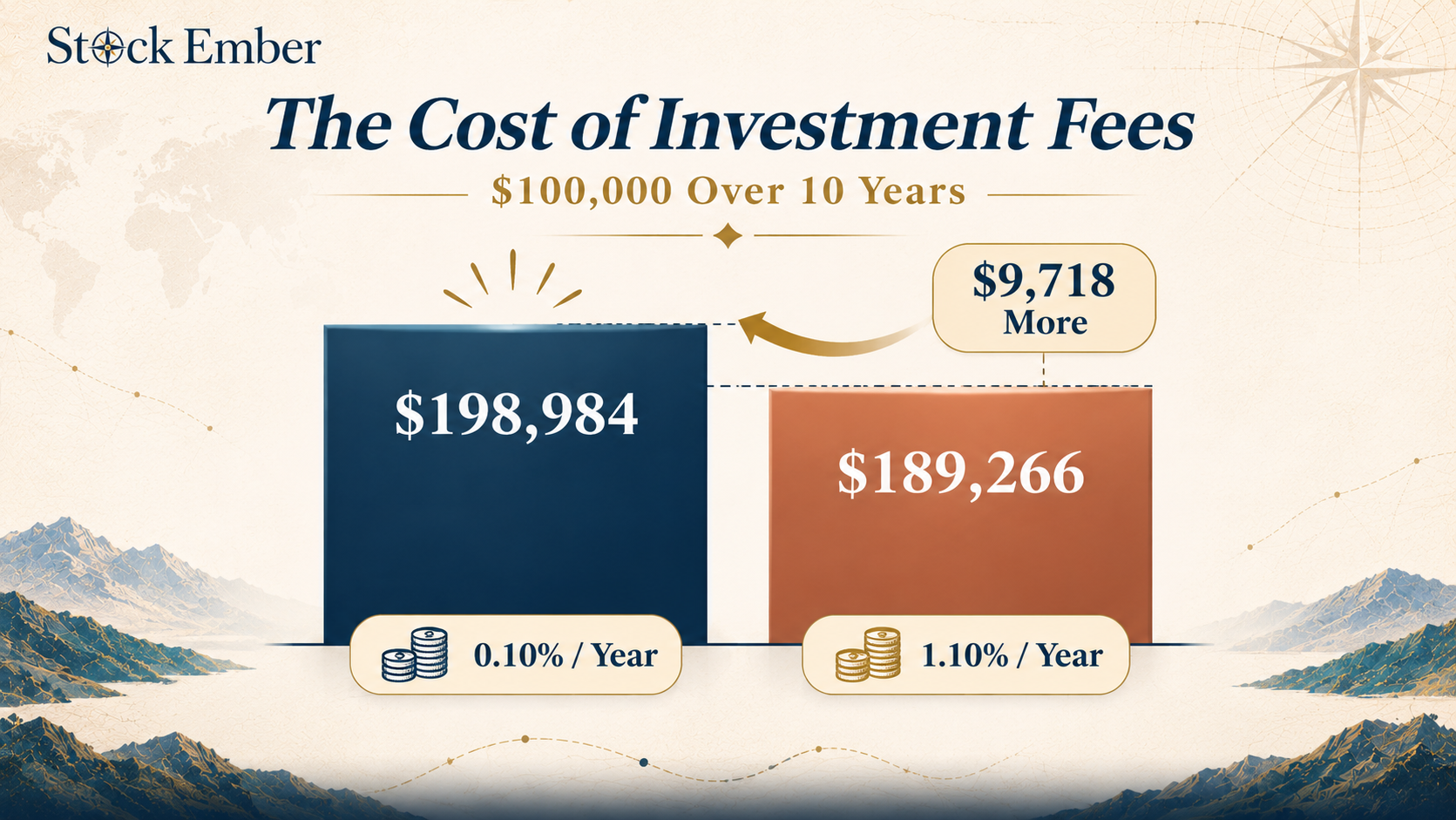
Smaller public-sector 457(b) menus often carry layered administrative charges and high expense ratios, the yearly percentage fee a fund charges. Suppose an illustrative $100,000 balance earns 6% a year before fees over 10 years.
At 0.10% in annual fees, it grows to roughly $177,400. At 1.10% a year, it reaches about $161,300, roughly $16,100, or 9%, less after a decade. Market returns vary and losses remain possible, so keeping costs low is one lever you control.
Chart showing how a 1% higher annual fee reduces a $100,000 portfolio over 10 years
In practice, many public-sector investors review their 457(b) fund menu line by line first. When a plan offers only expensive active funds, they often prioritize an employer-matched account or low-cost IRA before adding extra dollars here.
457(b) vs. 403(b) vs. Roth IRA: Key Differences
A 457(b), a 403(b), and a Roth IRA work best as complements rather than substitutes, depending on employer matching, fees, and your timeline.
Feature
457(b) Plan
403(b) Plan
Roth IRA
Eligibility
Government and eligible 501(c) workers
Public school, hospital, and 501(c)(3) workers
Earners below IRS income limits
2026 limit
$24,500 employee + employer combined
$24,500 employee ($72,000 total)
$7,500 ($8,600 if age 50+)
Before age 59½
Penalty-free after leaving job (tax due on pre-tax)
10% early penalty unless exception applies
Contributions withdraw tax- and penalty-free
Rollovers
Governmental rolls to IRA/403(b); non-governmental restricted
Rolls freely to an IRA or workplace plan
Stays in an IRA or rolls to another Roth IRA
Common Mistakes and Traps to Watch
Even seasoned savers hit surprises when they assume a 457 plan works like a 401(k). Watch for 3 traps:
Rolling outside accounts into a 457(b): Money moved into a 457(b) from a 401(k), 403(b), or IRA keeps its old tax rules, so withdrawals before age 59½ still face the 10% early penalty.
Forgetting employer contributions share your limit: Unlike a 401(k) or 403(b), any employer match counts toward your single $24,500 annual 457(b) limit. A $2,000 match lowers your maximum contribution to $22,500.
Overlooking non-governmental restrictions: Non-governmental 457(b) balances cannot roll into an IRA or 403(b) when you leave your job. Instead, they pay out on a fixed schedule or move only to another non-governmental 457(b), and they remain exposed to employer creditors. In both governmental and non-governmental plans, required minimum distributions (RMDs), the mandatory yearly withdrawals, start at age 73 (age 75 if you were born in 1960 or later).
Conclusion
A 457 plan can be a valuable tax shelter for public-sector and non-profit workers, especially if you want penalty-free access to savings after leaving your job before age 59½. Before contributing, confirm whether your plan is governmental or non-governmental, weigh its 10-year fees, and check whether an employer-matched account deserves your first dollar.
When you are ready to compare low-cost accounts for supplemental savings or an eligible rollover, explore our broker reviews. Investing always puts your money at risk and past returns never promise future results, so treat this guide as educational background rather than personal tax or investment advice.
FAQ
5 questions
What happens to a 457 plan when you leave your job?
When you leave your employer, you can leave your balance invested in the plan, take penalty-free withdrawals at any age, or move the money. If you hold a governmental 457(b), you can roll the balance into an IRA, 403(b), or 401(k). Non-governmental 457(b) balances cannot move to an IRA and must follow your plan's payout schedule or transfer to another eligible non-governmental 457(b).
Can you take a loan from a 457(b) plan while still employed?
Whether you can borrow from your 457(b) depends on the type of employer sponsoring the plan. Governmental 457(b) plans may offer participant loans if the specific plan document permits them, and under IRS rules these loans are typically capped at the lesser of $50,000 or 50% of your vested balance. Non-governmental 457(b) plans offered by tax-exempt non-profits generally do not allow participant loans.
What counts as an unforeseeable emergency withdrawal in a 457 plan?
While you are still working for the sponsoring employer, withdrawals are mostly limited to a severe unforeseeable emergency, although some governmental plans also allow in-service withdrawals at age 59½. Qualifying events include sudden illness, an accident, property loss from a natural disaster, or imminent eviction or foreclosure. Routine expenses like buying a home or paying college tuition do not qualify, and withdrawals are limited to the amount needed.
Does a 457(b) plan have required minimum distributions?
Yes, traditional pre-tax 457(b) accounts are subject to IRS required minimum distributions (RMDs) once you reach age 73 (age 75 if you were born in 1960 or later), though most plans let you delay withdrawals until you retire if you are still working for that employer. Under SECURE 2.0 rules, designated Roth 457(b) balances are exempt from lifetime RMDs during the original owner's life.
Are 457(b) contributions subject to Social Security and Medicare taxes?
Generally yes: employee contributions to a 457(b) plan remain subject to whichever Social Security and Medicare payroll taxes (FICA) already apply to your wages, even when you choose pre-tax deferrals, though some state and local government jobs are not covered by Social Security. Pre-tax contributions reduce your federal taxable income for the year, and in many states your state taxable income, but they do not bypass FICA payroll taxes.
Disclaimer
This guide was written with AI assistance and reviewed by the StockEmber editorial team for accuracy. StockEmber provides independent education, not personal financial advice. Investing puts your capital at risk: the value of investments can go down as well as up, you may get back less than you invest, and past performance doesn’t guarantee future results. Some links may support our work at no additional cost to you.
The StockEmber Team is our in-house desk of independent research writers. We test brokerage platforms, read the fine print on fees and custody, and cover ETFs and long-horizon investing for people who plan to hold for decades — not days.