A 401k loan lets you borrow money from your own employer-sponsored retirement account and repay the principal plus interest back into your balance over time. While it requires no credit check, borrowed funds are sold out of your investments and miss market compounding until repaid, and leaving your job can trigger taxes and early withdrawal penalties.
Understanding what a 401k loan is starts with a simple rule: it lets you borrow money from your own employer-sponsored retirement account and pay it back with interest.
When an unexpected bill hits, tapping your retirement balance can look cheaper than taking on high-interest debt, especially since the interest goes back into your account. Yet borrowing from your future self carries hidden costs that compound over a decade. This guide breaks down how a 401k loan works, the rules set by regulators, and what borrowing really costs a long-term portfolio.
Quick Takeaways
01A 401(k) loan requires no credit check, but your employer must allow loans under your specific plan rules.
02Borrowed cash is sold out of your investments, so you may miss market growth until every dollar is repaid.
03You repay the loan and interest with after-tax dollars, and that interest gets taxed a second time in retirement.
04Leaving or losing your job can accelerate repayment; any unpaid balance may be taxed as income, plus a 10% early withdrawal penalty if you are under 59½.
What Is a 401k Loan?
In plain terms, the 401k loan meaning comes down to borrowing against your workplace retirement savings instead of applying to a bank. While federal law permits employer plans to offer participant loans, companies aren't required to provide them, and each plan sets its own terms.
Unlike an early withdrawal, a loan isn't taxed as income when taken, provided you repay it on schedule. Most workplace plans hold tax-deferred savings, meaning you delay income tax until withdrawal, unlike a Roth IRA, where after-tax contributions grow tax-free. To fund the loan, your plan sells shares in your account, pulling that money out of the market until repaid.
How a 401k Loan Works: Limits, Rates, and Repayment
To see a 401k loan explained in practice, look at limits, rates, and repayment. Under IRS plan loan rules, you can borrow up to the lesser of $50,000 or 50% of your vested balance (the share of your account you own outright, including your contributions and vested employer funds). The $50,000 cap is reduced by your highest outstanding loan balance over the prior 12 months, minus what you still owe today. Some plans also allow a loan of up to $10,000 even if that exceeds half your vested balance, as long as the excess is secured with additional collateral.
Because your balance backs the loan, there's no credit check or credit-score impact. Many plans charge around the prime rate (the benchmark rate banks charge top borrowers) plus 1% to 2%; your plan documents list the exact rate, origination fee, and any annual maintenance fees. You repay principal and interest via automatic payroll deductions (repayments taken from your paycheck) at least quarterly over up to 5 years, or longer when buying a primary home.
The Hidden 10-Year Cost of Borrowing From Your 401k
Beyond the interest rate on paper, a 401(k) loan can carry a less visible cost: the market compounding you may forfeit while your money sits uninvested. Three drags can shrink what your portfolio is worth a decade later:
Missed market growth: If your funds would have earned 8% a year while your loan charges 6% interest, your account loses that spread until repaid.
Double taxation on interest: You repay principal and interest with after-tax dollars (money already taxed as income). In a traditional 401(k), that interest enters your pre-tax balance and gets taxed again at withdrawal.
Lost employer contributions: Some plans freeze contributions during repayment, costing you your employer's 401k match, money that would otherwise compound alongside your deferrals.
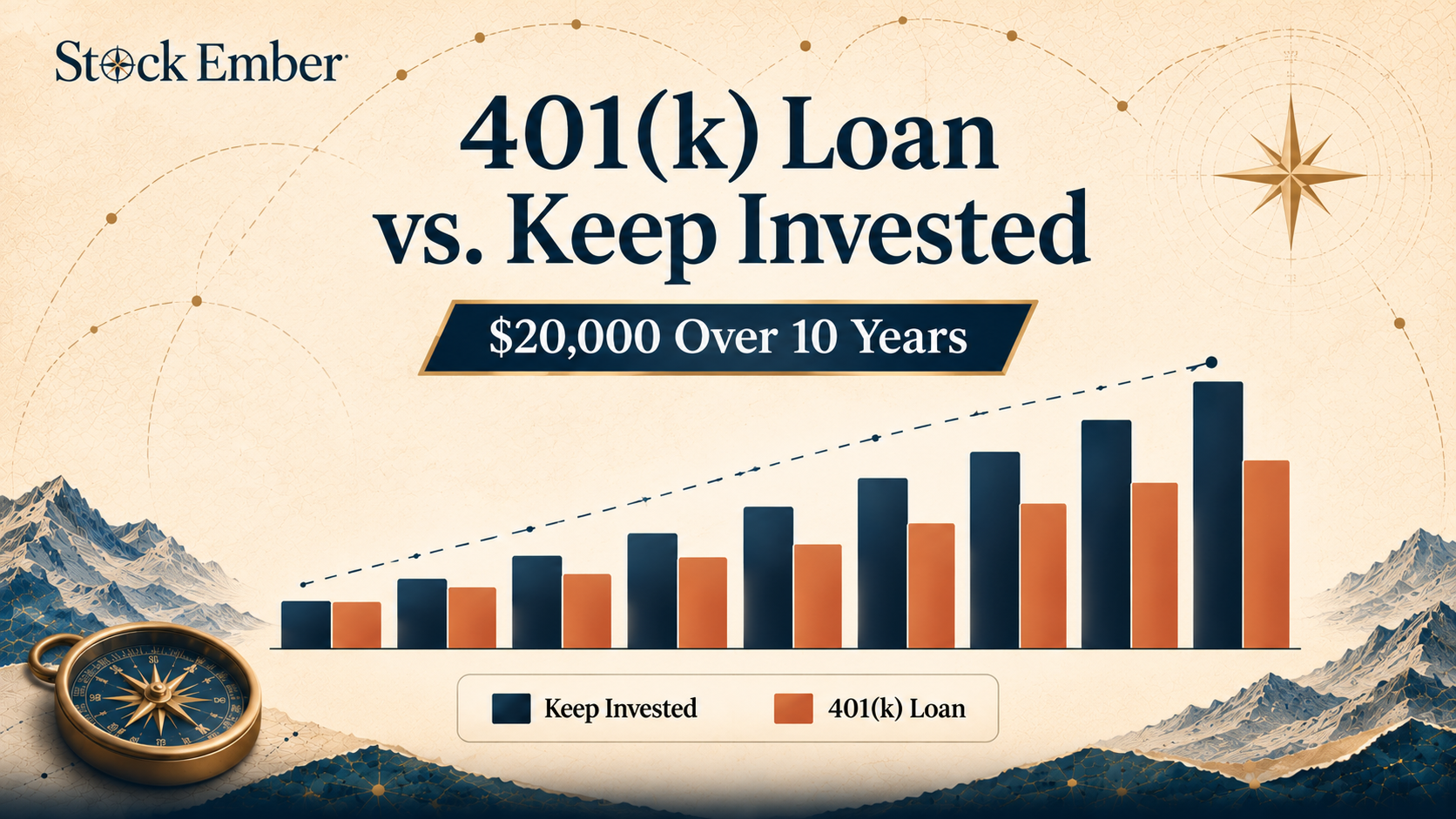
Bar chart comparing 10-year portfolio growth with and without a $20,000 401(k) loan
Consider a hypothetical 10-year example. Leaving $20,000 invested at an illustrative 8% annual return grows to roughly $43,178 in 10 years. Borrowing $20,000 for 5 years at 6% interest, reinvesting monthly payments at 8% as they return, after $75 in fees and 22% tax on the interest, leaves roughly $40,700 at year 10. That's about $2,500 behind, or over $11,000 behind if a $1,000 annual match pauses during repayment. These figures assume a steady 8% annual return, which is not guaranteed; actual returns vary and can be negative, and in a falling market the cost of borrowing could be smaller than shown.
Scenario (Hypothetical 10-Year Illustration)
Untouched $20,000 Balance
$20,000 401(k) Loan (5-Year Payoff)
Market exposure
Invested at 8% for all 10 years
Pulled from market during payoff
Tax on loan interest
Not applicable
Repaid after-tax; taxed again later
Estimated value at year 10
~$43,178
~$40,700 (~$32,000 if match pauses)
Why a 401k Loan Matters for Long-Term Investors
Borrowing from a workplace retirement plan matters because it turns a long-horizon compounding engine into a short-term cash source. Because interest returns to your own account, it's easy to fall into mental accounting, treating a 401(k) loan as a cost-free shortcut rather than a drag on future wealth.
For a long-term investor, a significant risk may come less from the loan interest itself than from missing a market rebound while the money sits outside the portfolio.
Retirement accounts work best when capital stays undisturbed for decades. Weighing a 401k loan means comparing the immediate cost of outside financing against the lasting loss of tax-advantaged compounding.
Common 401k Loan Mistakes to Watch
Three avoidable mistakes can cause lasting damage from 401(k) borrowing:
Leaving or losing your job before payoff: Resigning, layoffs, or job changes can trigger rapid repayment. Any unpaid balance becomes a plan loan offset (when an unpaid loan is deducted from your balance and reported as a distribution). To avoid this, you can roll the offset amount over into an eligible retirement account (by depositing an equal amount to keep its tax-deferred status) by your federal tax-filing due date, including extensions. Otherwise, you generally owe ordinary income tax, plus a 10% early withdrawal penalty if you are under age 59½.
Halting new paycheck contributions: Cutting deferrals to afford loan payments means missing market dips and forfeiting employer matching dollars.
Treating your 401(k) as a repeat cash reserve: Taking back-to-back loans keeps retirement savings underinvested instead of building a separate emergency fund.
Conclusion
A 401k loan gives you fast access to your own savings without a credit check, but the real price can show up years later in missed market growth and double-taxed interest. Before borrowing, check your employer's plan rules on fees, contribution freezes, and job-separation deadlines.
When you're ready to compare account providers for your broader portfolio, our broker reviews are a helpful place to start. Pulling money out of a retirement account puts your long-term growth at risk, so treat this guide as educational background rather than personal financial or tax advice.
FAQ
5 questions
Does a 401(k) loan affect your credit score?
No, taking a 401(k) loan does not affect your credit score. Because you are borrowing against your own vested retirement balance rather than applying to an outside lender, your plan provider does not run a credit check or report the loan to credit bureaus. Even if you miss payments and default, the unpaid balance is treated as a taxable distribution rather than a credit report delinquency.
Can you still contribute to your 401(k) while paying back a loan?
Whether you can keep contributing depends on your employer's specific plan rules. Many workplace plans allow you to continue making regular paycheck deferrals while repaying a loan, though tight cash flow makes that harder. However, some plans suspend new employee contributions or pause employer matching contributions until the loan is paid off, which can significantly reduce your long-term retirement savings.
Do you pay taxes or penalties when you take out a 401(k) loan?
You do not owe income taxes or early withdrawal penalties when you take out a 401(k) loan, as long as you follow the plan's repayment schedule. However, you repay the loan and interest using after-tax dollars, and that interest is taxed a second time when you withdraw it in retirement. If the loan defaults or goes unpaid, the outstanding balance is generally taxed as income, plus a 10% early withdrawal penalty if you are under 59½.
Can you take out more than one 401(k) loan at a time?
Federal rules do not ban having multiple 401(k) loans, so it depends on what your employer’s plan allows. Some plans restrict workers to a single active loan at a time, while others permit 2. Regardless of the loan count, your combined borrowing cannot exceed the IRS cap—the lesser of 50% of your vested balance or $50,000, reduced by your highest loan balance over the past 12 months.
How long do you have to repay a 401(k) loan if you buy a home?
While standard 401(k) loans must be repaid within 5 years through at least quarterly payments, federal rules allow a longer repayment period if you use the money to buy your primary residence. Employers are not required to offer this extended window, and each plan sets its own maximum term, provided you supply documentation showing the funds are for a home purchase.
Disclaimer
This guide was written with AI assistance and reviewed by the StockEmber editorial team for accuracy. StockEmber provides independent education, not personal financial advice. Investing puts your capital at risk: the value of investments can go down as well as up, you may get back less than you invest, and past performance doesn’t guarantee future results. Some links may support our work at no additional cost to you.
The StockEmber Team is our in-house desk of independent research writers. We test brokerage platforms, read the fine print on fees and custody, and cover ETFs and long-horizon investing for people who plan to hold for decades — not days.