

A Roth IRA is an Individual Retirement Account in the United States funded with after-tax money, allowing your investment earnings to compound completely tax-free and enabling tax-free qualified withdrawals in retirement.
If you want to protect your long-term returns from taxes decades down the road, choosing the right account wrapper is critical. Knowing what is roth ira structure and how its tax treatment works helps you decide how to fund your retirement efficiently alongside standard accounts. This guide breaks down the legal mechanics, IRS constraints, and where this wrapper fits in a portfolio.
Quick Takeaways
- A Roth IRA uses after-tax contributions, meaning you pay income tax upfront so all qualified capital gains and dividends grow 100% tax-free.
- You can withdraw your original principal contributions at any time without taxes or early withdrawal penalties.
- Unlike traditional retirement accounts, Roth IRAs have no Required Minimum Distributions (RMDs) during the original owner's lifetime.
- High earners who exceed direct income limits can still access the wrapper using conversion strategies.
- Keep in mind: paying tax upfront means you lose the immediate deduction a Traditional IRA offers, and if your income exceeds the annual limit, direct contributions are not allowed without using a conversion strategy.
What Is a Roth IRA and How Does It Work?
A Roth IRA operates as an individual tax-advantaged account wrapper designed to eliminate federal tax liabilities on long-term compound growth.
When you contribute to a Roth IRA, you use income that has already been taxed in the current year. Because you receive no upfront tax deduction, the Internal Revenue Service (IRS) grants a major trade-off: all capital gains, dividends, and interest generated inside the account grow entirely tax-free. When you take qualified distributions in retirement, you pay zero income tax on those withdrawals.
The 10-Year Compounding Tax Drag
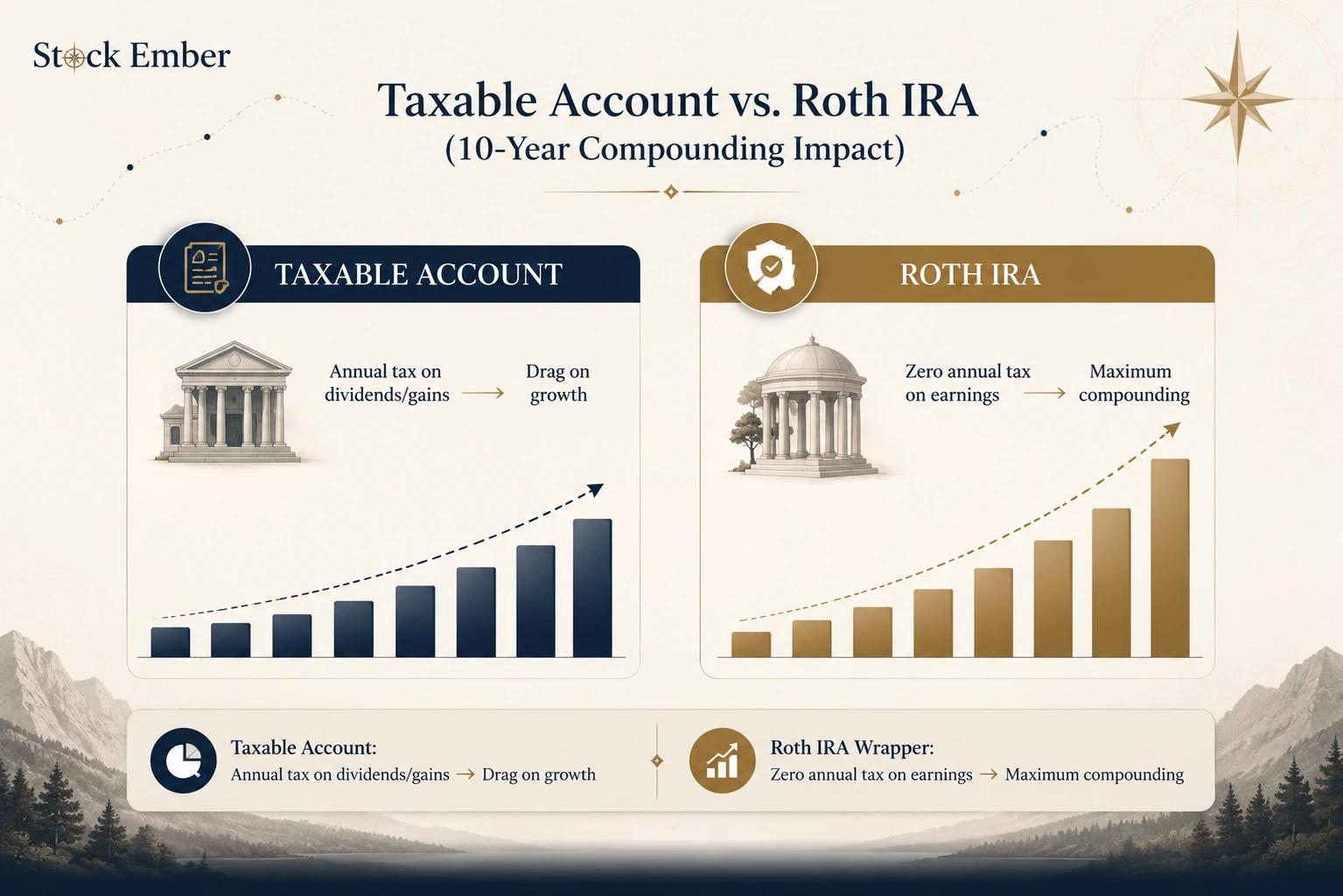
To appreciate the value of a tax wrapper, consider the hidden cost of holding investments in a standard taxable account. In a taxable brokerage account, every dividend paid and capital gain realized triggers an annual tax obligation.
If you hold a $50,000 index portfolio returning 7% annually over 10 years, annual tax drag on dividends and rebalancing quietly eats away at your compound growth. For illustration only: assuming a 2% annual dividend yield taxed at 15% each year, a taxable account could lose roughly $5,000 to $8,000 in compounded growth over a decade compared to a tax-sheltered Roth IRA — actual results vary based on your specific holdings, tax bracket, and portfolio turnover. Inside a Roth IRA wrapper, that full return stays inside your portfolio to compound.
Core IRS Rules and Constraints
While the Roth IRA offers clear tax efficiency, it operates under strict legal guidelines set by federal tax law:
- Annual Contribution Limits: For 2026, the maximum annual contribution limit is $7,500 for individuals under age 50, with a $1,100 catch-up contribution ($8,600 total) for those aged 50 and older. According to the IRS (Notice 2025-67). You must have taxable earned income equal to or exceeding your contribution.
- Withdrawal Restrictions: You can withdraw your principal contributions at any time, for any reason, completely tax- and penalty-free. However, to withdraw investment earnings tax-free, you must be at least age 59½ and satisfy the five-year holding rule (the account must be open for at least five tax years)
- No Required Minimum Distributions (RMDs): Unlike Traditional IRAs or 401(k) plans, original Roth IRA owners are never forced to take distributions at age 73 or 75 Your money can continue compounding tax-free for your entire lifetime.
Roth IRA vs. Traditional IRA: Tax Now or Tax Later?
The fundamental difference between a Roth IRA and a Traditional IRA comes down to whether you pay income tax today or when you withdraw money in retirement.
A Traditional IRA provides an upfront tax deduction on your contributions today, lowering your current taxable income. However, every dollar withdrawn in retirement is taxed as ordinary income. A Roth IRA flips this timing: you pay income tax today, locking in tax-free growth and tax-free distributions in the future.
Deciding which account wrapper fits your strategy depends on comparing your current tax rate to your expected tax bracket in retirement:
- Choose a Roth IRA if: You are currently in a lower tax bracket than you expect to be in during retirement, or if you value penalty-free access to your principal contributions before retirement.
- Choose a Traditional IRA if: You are currently in a high tax bracket and want an immediate deduction to reduce current tax liabilities.
To compare both individual account options side-by-side, read our detailed guide on roth ira vs traditional ira
Roth IRA vs. 401(k): Comparing Account Structures
A Roth IRA is an individually owned tax account opened at a brokerage, while a 401(k) is an employer-sponsored retirement plan provided through your workplace.
While both wrappers help long-term investors accumulate wealth for retirement, they differ significantly in contribution caps, employer matching, and investment choices:
| Feature | Roth IRA | Workplace 401(k) |
|---|---|---|
| Account Type | Individual (opened at a brokerage) | Employer-sponsored workplace plan |
| Annual Limit (Under 50) | $7,500 | $24,500 |
| Employer Match | None | Common (e.g., 100% match up to 5%) |
| Investment Options | Broad selection (ETFs, stocks, bonds) | Menu selected by employer plan |
| Access to Principal | Contributions withdrawable anytime | Restricted until separation or age 59½ |
Many workplace plans also offer a Roth 401(k) option, combining higher workplace contribution limits with after-tax Roth rules. See our dedicated breakdown on roth ira vs 401k to learn how to structure both accounts together.
Understanding the Traditional IRA Baseline
A Traditional IRA serves as the foundational pre-tax individual account wrapper, trading current-year tax deductions for taxable withdrawals in retirement.
Before alternative account types were created, the Traditional IRA was the standard vehicle for self-directed retirement savings. Because contributions can be tax-deductible depending on your income and workplace pension coverage, it remains a common option for managing tax exposure during high-earning years.
Understanding how pre-tax compounding operates provides essential context when evaluating after-tax accounts. For a complete look at pre-tax account rules, read our overview on what is a traditional ira
High Earners and the Backdoor Roth IRA Strategy
High earners whose income exceeds IRS limits cannot contribute directly to a Roth IRA, but they can access the wrapper legally through a two-step conversion strategy.
The IRS enforces Modified Adjusted Gross Income (MAGI) phase-out thresholds that restrict direct contributions for high-earning single and married tax filers. Once your income passes these limits, direct contribution limits drop to zero.
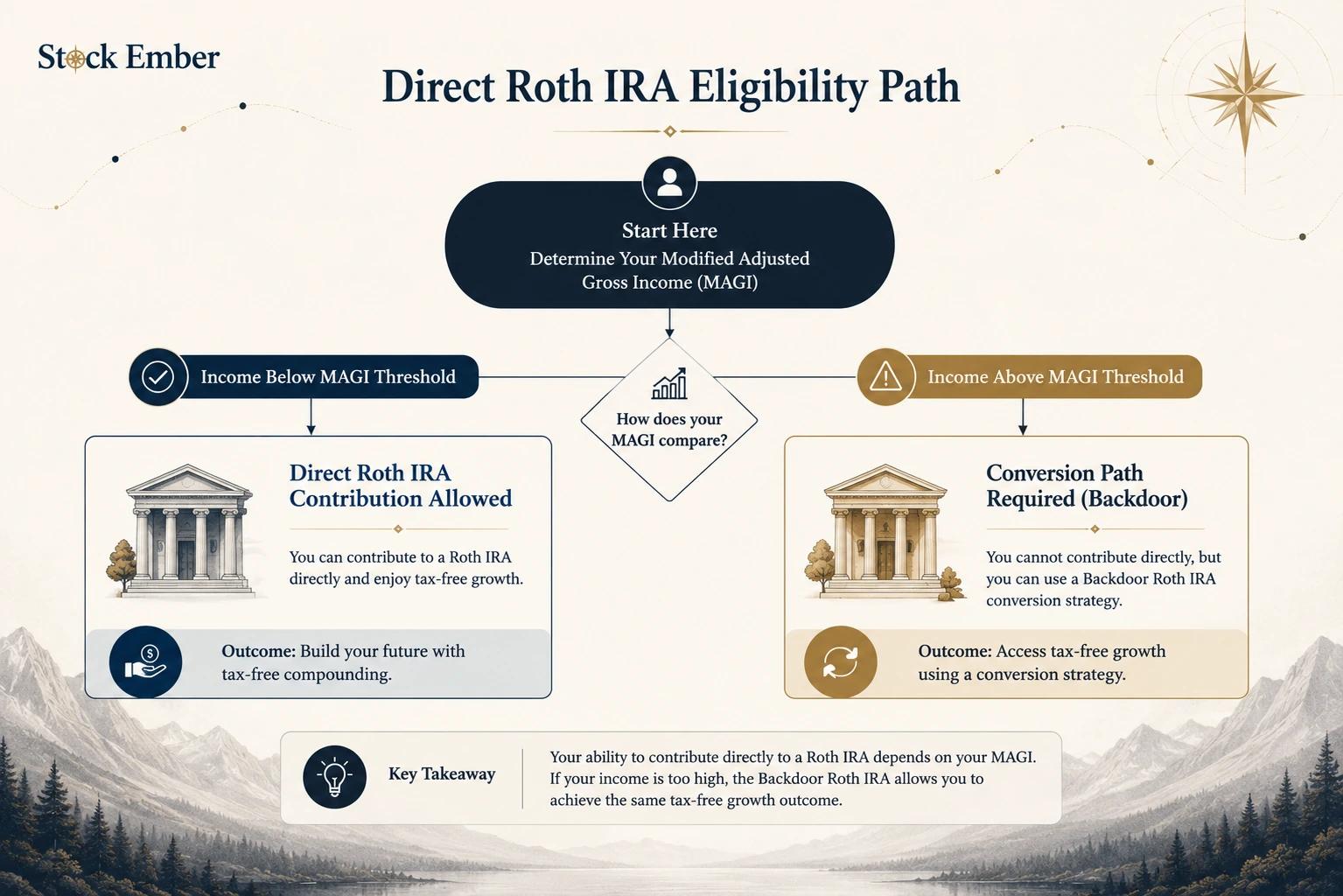
To navigate this constraint, investors use a strategy known as a "Backdoor Roth." First, you make a non-deductible contribution to a Traditional IRA (which has no income caps for contributions). Second, you convert those funds into a Roth IRA.
While straightforward, executing a conversion requires paying attention to the IRS pro-rata rule (which treats all your traditional IRA balances — pre-tax and after-tax combined — as a single pool when calculating how much of your conversion is taxable) if you already hold pre-tax IRA balances. If your income exceeds eligibility limits, explore our step-by-step guide to the backdoor roth ira
Building Long-Term Wealth Early: Custodial Roth IRAs
A Custodial Roth IRA is a tax-advantaged retirement account managed by an adult on behalf of a minor child who earns taxable income.
Children of any age can hold a Roth IRA as long as they have documented earned income from wages, self-employment, or formal work. Gifts and allowances do not qualify as earned income. The maximum contribution is capped at $7,500 or 100% of the child's earned income, whichever is lower.
Starting early gives young investors decades of uninterrupted compound interest. Learn about account setup and eligible income rules in our guide on the custodial roth ira
Tax Wrappers Outside the US: UK ISAs and SIPPs
Tax-advantaged investing is used globally, though different countries structure their tax shells with distinct contribution limits and withdrawal rules.
If you are an international investor or comparing tax structures across jurisdictions, examining how foreign tax wrappers function highlights key differences in tax policy:
- UK Stocks & Shares Individual Savings Account (ISA): Functions similarly to a Roth IRA regarding tax treatment—funded with after-tax money with zero capital gains or dividend taxes on growth. However, unlike a Roth IRA, an ISA has no age restrictions or early withdrawal penalties. For a detailed breakdown, see what is an isa account
- UK SIPP (Self-Invested Personal Pension): Operates similarly to a Traditional IRA or 401(k). Investors receive upfront tax relief on contributions, but withdrawals in retirement are subject to income tax. Read more in our guide on what is a sipp
Where Your Account Lives: Tax Wrappers vs. Brokerage Accounts
A tax wrapper like a Roth IRA is not an investment asset itself, but rather a legal tax structure applied to your brokerage account.
Beginner investors sometimes confuse the account wrapper with the investments held inside it or the institution hosting the account. It helps to break down the structure into three distinct layers:
- The Brokerage Platform: The financial institution that holds your funds and clears transactions.
- The Account Wrapper: The legal tax structure (such as a Roth IRA, Traditional IRA, or taxable account) governing tax treatment.
- The Underlying Assets: The index funds, ETFs, individual stocks, or bonds you purchase inside that account wrapper.
You open a Roth IRA container through a financial brokerage. Once funded, you must choose how to allocate those funds across underlying investments. To understand how brokers manage and protect asset custody, read our primer on what is a brokerage account
How These Tax Accounts Connect in Your Portfolio Path
Structuring an efficient savings strategy involves funding tax-advantaged wrappers in a clear order of priority before investing through standard taxable accounts.
For most long-horizon investors, allocating cash across accounts follows a logical order to capture employer benefits and maximize tax efficiency:
- Capture Workplace Match: Fund your employer 401(k) up to the full match threshold to secure all available employer dollars.
- Max Out Your Roth IRA: Contribute up to the annual limit ($7,500) to secure tax-free compounding and tax-free distributions.
- Fill Remaining Workplace Capacity: Direct additional funds back to your 401(k) to utilize remaining annual tax-sheltered allowances.
- Invest via Taxable Accounts: Direct extra long-term savings into a standard brokerage account once your tax wrappers are fully funded.
Where to Start: Choosing Your Account Strategy
Selecting the right account structure begins with reviewing your current tax rate, investment timeline, and access to workplace retirement plans.
If you expect your income and tax bracket to rise over time, prioritizing an after-tax wrapper like a Roth IRA locks in current rates while protecting decades of future returns. Conversely, if you are currently in your peak earning years, balancing after-tax savings with pre-tax accounts can optimize your current tax burden while maintaining retirement flexibility.
Conclusion
A Roth IRA is one of the most effective tax-advantaged account wrappers for long-term investors, allowing after-tax contributions to compound completely free of dividend and capital gains taxes. By eliminating annual tax drag and providing flexible access to your original principal, it creates a durable container for multi-decade wealth accumulation. Comparing your current tax bracket against your future financial goals will help determine how heavily to prioritize this account wrapper in your portfolio.
When you are ready to compare platforms and open an account container, our independent broker reviews evaluate platform fees, available investments, and operational usability.