Municipal bonds are fixed-income debt securities issued by state, county, or city governments to fund local public infrastructure projects. Investors who buy these bonds receive regular interest payments that are generally exempt from federal income taxes, as well as state taxes for in-state residents. They provide tax-advantaged income for investors in higher income tax brackets.
Municipal bonds are issued by state and local governments, cities, or public authorities to raise capital for public infrastructure projects. They pay regular interest that is generally exempt from federal income taxes.
When you compare fixed-income investments, a bond paying 4% tax-free might sound modest next to a corporate bond paying 6%. However, for investors in higher income tax brackets, keeping every dollar of interest can yield a higher net return than paying income taxes on corporate yields. This guide breaks down how munis work, how to calculate your true return, and where investors make costly account placement errors.
Quick Takeaways
01These bonds are debt obligations issued by local governments to finance public projects like schools, highways, and water systems.
02Interest earned from tax free municipal bonds is generally exempt from federal income tax and often exempt from state and local taxes for in-state residents.
03General Obligation bonds rely on taxing power, while Revenue bonds rely on cash flows from specific public facilities.
04Evaluating tax-free municipal bonds requires calculating your tax-equivalent yield to compare them fairly against taxable corporate or Treasury debt.
05Placing tax exempt municipal bonds inside tax-advantaged accounts like IRAs wastes their main tax benefit and should be avoided.
What Are Municipal Bonds?
These bonds, often called "munis," are loans that investors extend to state, county, or city governments, as well as local public agencies. In exchange for this capital, the government issuer promises to pay regular interest, usually twice a year, and return the original principal balance when the bond reaches maturity.
Local governments issue municipal tax free bonds to build and maintain public infrastructure, such as public schools, bridges, hospitals, and sewer systems. For investors building an income portfolio, munis occupy a unique position within the broader types of bonds. Unlike corporate bonds whose payouts trigger federal income tax, interest from tax exempt municipal bonds stays out of federal tax returns.
It is helpful to remember that these tax-free bonds come with trade-offs. Because the federal government provides tax exemptions on municipal interest, state and local issuers can offer lower nominal interest rates than corporations with similar credit profiles. Whether that lower yield works in your favor depends on your overall tax bracket.
Types of Municipal Bonds: General Obligation vs. Revenue
They fall into two major categories based on how the borrowing government promises to repay bondholders.
General Obligation (GO) Bonds are backed by the full faith, credit, and taxing power of the issuing government entity. The city or state can levy property taxes, income taxes, or sales taxes to ensure full repayment of interest and principal.
Because local governments possess the legal authority to raise taxes, General Obligation bonds historically carry lower credit default rates than corporate debt, with 10-year cumulative default rates for investment-grade munis remaining below 0.1%, compared to over 2% for investment-grade corporate debt, according to Moody's Investors Service.
Revenue Bonds are backed by revenue streams generated by a specific public project, rather than general tax dollars. Examples include toll roads, municipal water utilities, airport terminals, or public housing developments. If project revenues decline due to lower toll usage or falling utility consumption, bondholders bear the financial risk. As a result, Revenue bonds typically offer higher coupon yields to compensate for this project-specific risk.
Tax Advantages and Tax-Equivalent Yield
The primary appeal of munis is their tax-favored treatment. Interest earned on qualifying municipal debt is free from federal income tax. Furthermore, if you purchase bonds issued by your home state or local municipality, the interest is usually exempt from state and local income taxes as well, a benefit often called "triple tax-exempt" status.
To compare a tax-free municipal yield with a taxable corporate or Treasury yield, investors use the tax-equivalent yield formula.
For example, if you sit in a 32% federal tax bracket and evaluate a municipal bond paying a 4.0% yield, the math looks like this:
Tax-Equivalent Yield = 0.040 / (1 − 0.32) = 5.88%
In this scenario, a taxable corporate bond would need to pay 5.88% just to match the take-home income of the 4.0% tax-free municipal bond. Comparing relative yields with a standard bond equivalent yield calculation helps buy-and-hold investors select the asset class that maximizes net return after taxes.
How and Where to Buy Municipal Bonds
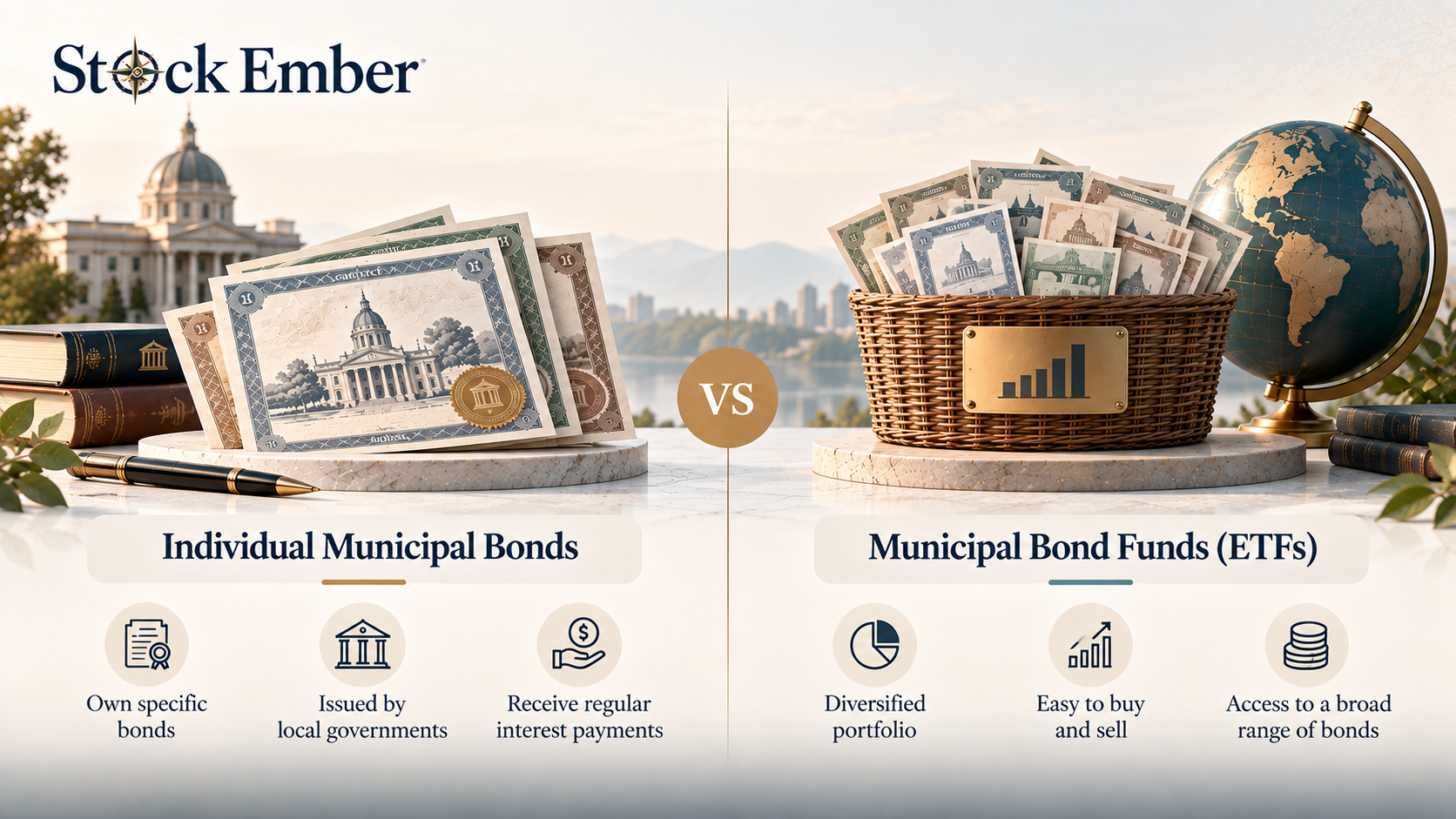
Investors who want to buy munis can choose between purchasing individual municipal securities or buying shares of diversified municipal bond funds.
Visual breakdown comparing buying individual municipal bonds to municipal bond ETFs.
If you wonder where to buy municipal bonds, individual bonds are traded over-the-counter through major online brokerage platforms. Individual bonds normally sell in minimum face-value increments of $5,000, making building a diversified portfolio of single bonds capital-intensive for smaller accounts.
For most buy-and-hold investors, municipal bond ETFs or mutual funds offer a simpler alternative. Funds hold hundreds of underlying municipal securities across multiple states and municipal sectors, providing instant credit diversification, lower minimum investment requirements, and daily market liquidity.
In practice, many long-term income investors find that holding these broad ETFs saves considerable research effort compared to evaluating individual city financial reports and bond call schedules.
Common Mistakes and Account Pitfalls
While munis offer clear income benefits, several common pitfalls can erode your long-term returns:
Holding Munis in IRAs or 401(k) Accounts: Placing tax-free municipal bonds inside a Traditional IRA or 401(k) is a serious mistake. These tax-deferred accounts already protect holdings from annual taxes. Putting a low-yielding municipal bond inside an IRA wastes its tax advantage while converting tax-free interest into fully taxable ordinary income upon withdrawal.
Ignoring the Alternative Minimum Tax (AMT): Certain munis, known as private-activity bonds, fund public-private projects like industrial parks or airport terminals. Interest from private-activity bonds can trigger federal Alternative Minimum Tax (AMT) for high-earning taxpayers.
Buying Out-of-State Bonds Without Checking Local Taxes: If you reside in a state with high income tax rates and purchase these bonds from another state, you still owe state income tax on that interest income.
Feature
General Obligation (GO) Bonds
Revenue Bonds
Backing Source
Full taxing power of city/state
Cash flows from specific project (tolls, utilities)
Credit Risk
Generally lower
Higher (project-dependent)
Yield Potential
Generally lower nominal yield
Slightly higher nominal yield
Primary Risk Factor
Broad municipal fiscal health
Project revenue shortfalls
Regulatory disclosures provided by the US SEC highlight that municipal securities face market price volatility whenever interest rates rise, even if default risk remains low.
Conclusion
Municipal bonds offer an effective way for high-bracket investors to generate income exempt from federal and local taxes. However, low nominal yields, interest rate sensitivity, and account location rules mean munis are not ideal for every portfolio or tax status. Before committing funds, calculate your tax-equivalent yield to verify that tax-free interest truly beats taxable alternatives.
When you are ready to evaluate diversified bond funds that fit your asset allocation, our ETF reviews provide a practical starting point. All investments carry risk of loss and past performance does not promise future returns, so use this guide as an educational context as you plan your fixed-income strategy.
FAQ
5 questions
What are municipal bonds and how do they work?
They are debt obligations issued by local government entities to fund public works like schools, roads, and utilities. When an investor purchases a municipal bond, they lend money to the issuer in exchange for regular interest payments, usually twice per year, and the return of their principal at maturity.
Are municipal bonds completely tax free?
Municipal bond interest is generally exempt from federal income taxes. If you buy bonds issued by your home state, the interest is often exempt from state and local taxes as well. However, capital gains earned from selling a municipal bond for a profit before maturity remain fully taxable, and certain private-activity bonds may be subject to the federal Alternative Minimum Tax.
Is a municipal bond safer than a corporate bond?
These securities historically carry lower credit default rates than corporate bonds, particularly General Obligation bonds backed by a government's power to tax residents. However, they are not risk-free. Revenue bonds depend on project earnings, and all of them fluctuate in market price when benchmark interest rates rise.
Should you hold municipal bonds in an IRA or 401(k)?
Investors should generally avoid holding tax-exempt municipal bonds inside tax-deferred accounts like Traditional IRAs or 401(k)s. Tax-advantaged accounts already shield assets from ongoing taxes, so placing low-yielding bonds inside them wastes their core tax advantage while turning tax-free interest into taxable income upon distribution.
What is the main risk of holding municipal bonds?
The primary risk for most muni investors is interest rate risk. When broader interest rates rise, existing municipal bond market prices drop. Additional risks include credit default risk on revenue-dependent bonds, inflation risk eroding long-term purchasing power, and liquidity risk if individual bonds need to be sold on secondary markets before maturity.
Disclaimer
This guide was written with AI assistance and reviewed by the StockEmber editorial team for accuracy. StockEmber provides independent education, not personal financial advice. Investing puts your capital at risk: the value of investments can go down as well as up, you may get back less than you invest, and past performance doesn’t guarantee future results. Some links may support our work at no additional cost to you.
The StockEmber Team is our in-house desk of independent research writers. We test brokerage platforms, read the fine print on fees and custody, and cover ETFs and long-horizon investing for people who plan to hold for decades — not days.