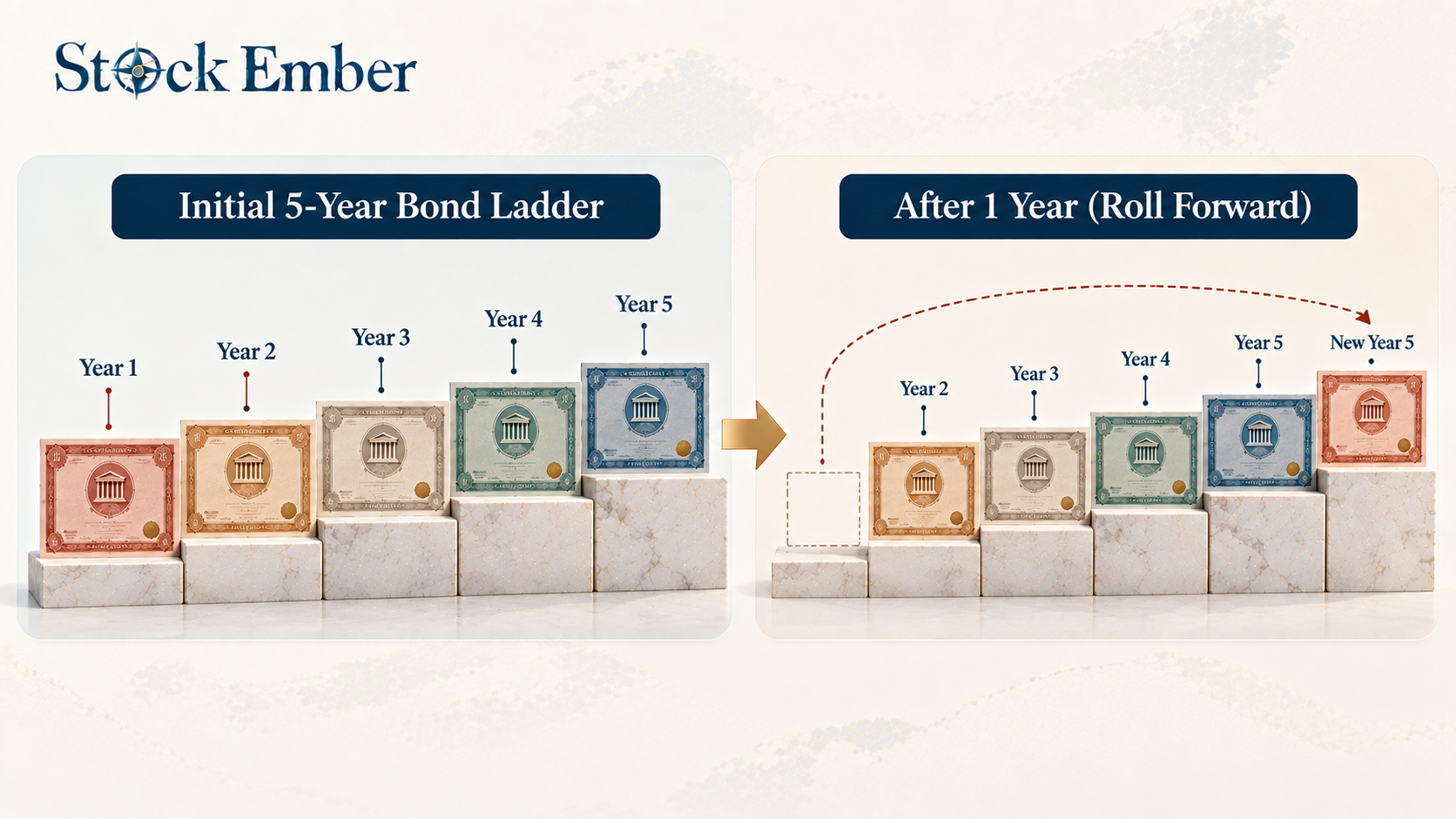
Building a bond ladder involves purchasing multiple fixed-income securities with staggered maturity dates over a chosen timeline. As short-term bonds mature, the returned principal is reinvested into longer-term bonds at current market rates, providing regular cash flow and reducing interest rate risk.
A bond ladder is an investment strategy where you divide capital across multiple fixed-income securities with staggered maturity dates. As each bond matures, you reinvest the principal into new long-term rungs or use the cash for income needs.
Managing a fixed-income portfolio requires balancing steady income with protection against changing interest rates. When interest rates rise, existing bond prices drop; when rates fall, reinvesting maturing cash yields less. A structured maturity schedule helps solve this trade-off by spreading reinvestment across different interest rate cycles.
Consider this your build-a-bond-ladder guide: it breaks down how the strategy works, how to construct one, and how it protects long-term capital.
Quick Takeaways
01Staggering bond maturities provides predictable cash flow while reducing the risk of locking all capital into a single interest rate environment.
02Constructing a ladder involves picking a time horizon, dividing capital into equal rungs, selecting high-quality bonds, and rolling maturing funds.
03Individual bond ladders offer contractual principal repayment, whereas target-maturity bond exchange-traded funds (ETFs) provide lower initial capital requirements and higher liquidity.
04Callable bonds can disrupt a ladder's cash flow in a declining interest rate environment.
What Is a Bond Ladder?
A bond ladder is a fixed-income portfolio structure where individual bonds mature at regular, sequential intervals over time. Instead of buying a single bond that matures 10 years from now, you spread your total investment across multiple maturities, such as 1, 2, 3, 4, and 5 years.
If you want the steps to build a bond ladder explained in plain terms, think of each bond as a single rung on a ladder. The spacing between maturities represents the distance between rungs, and the maturity of the longest bond sets the overall height of the ladder.
When market interest rates shift, a laddered portfolio automatically adjusts over time. If interest rates rise, maturing short-term rungs provide fresh cash to buy new bonds at higher yields. If interest rates drop, the longer-term rungs continue paying older, higher interest rates.
This staggered structure removes the need to guess where interest rates are heading next. Understanding these mechanics is an essential part of evaluating different types of bonds for income generation.
How to Build a Bond Ladder Step by Step
Learning how to build a bond ladder step by step involves four structured implementation phases:
Set Your Target Horizon and Spacing: Decide how long you want your ladder to run and how often you need capital to mature. A classic conservative ladder uses a 5-year horizon with 1-year spacing (rungs maturing at years 1, 2, 3, 4, and 5).
Divide Capital Equally: Split your total allocation evenly across every rung. For instance, a $50,000 portfolio spread across a 5-year ladder allocates exactly $10,000 to each maturity date.
Select High-Quality Securities: Choose non-callable sovereign bonds, such as US Treasuries, or top-rated corporate bonds. Standardize your maturity dates so payments land on predictable annual or semi-annual schedules.
Roll Maturing Principal: When the year-1 bond matures, take the returned principal and reinvest it into a new 5-year bond at the top of the ladder. This maintains the ladder's structure indefinitely while capturing current market yields.
Diagram illustrating a 5-year bond ladder maturity schedule and annual reinvestment cycle.
In practice, many long-term investors build the Treasury rungs of a ladder by buying new issues at Treasury auctions, which avoids the markups dealers often add to bonds traded on the secondary market.
Individual Bond Ladders vs. Target-Maturity Bond ETFs
Investors can build ladders using either individual bonds or specialized target-maturity bond ETFs. Each approach has distinct trade-offs regarding capital minimums, trading costs, and administrative effort.
Feature
Individual Bond Ladder
Target-Maturity Bond ETF
Capital Minimum
High ($1,000 to $5,000 per bond rung)
Low (cost of one share per ETF rung)
Default Risk
Concentrated on selected individual issuers
Spread across many bonds; corporate funds often hold hundreds
Maturity Repayment
Contractual principal returned at maturity
Fund liquidates at target date and distributes cash
Trading Friction
Wider bid-ask spreads for small retail lots
High liquidity with tight stock-exchange spreads
Ongoing Costs
No annual fee; markup or spread paid at purchase
Annual expense ratio plus brokerage trading costs
Buying individual bonds guarantees the return of face value at maturity, assuming the issuer does not default.
However, buying individual bonds through a brokerage usually requires more capital, since most bonds trade in $1,000 face-value units and some issues set higher minimums. If you buy new Treasuries directly, TreasuryDirect sells them in $100 increments, which lowers the entry point.
Target-maturity bond ETFs hold a basket of bonds that all mature in a specific year, offering smaller investors multi-bond diversification with low capital minimums.
Managing Risks: Call Options, Inflation, and Default
While staggering maturities reduces interest rate exposure, a bond ladder is not immune to fixed-income risks:
Callable Bond Risk: Issuer call features allow corporate bond issuers to pay off debt early if interest rates fall. If an issuer calls a 4% bond during a low-rate environment, you receive cash back early but must reinvest it at lower market yields, breaking your cash-flow structure.
Credit Default Risk: Holding corporate bonds exposes your portfolio to company-specific financial distress. If an issuer defaults, you risk losing both interest income and principal. Sticking to sovereign debt or highly rated investment-grade issues helps protect capital.
Inflation Risk: Fixed coupon payments lose purchasing power over extended periods when price inflation stays elevated. A 3% annual coupon yield provides negative real returns if inflation runs at 4%.
How Bond Laddering Improves Portfolio Risk Metrics
Combining a structured fixed-income ladder with equities can create a more balanced asset allocation that may help limit severe portfolio drawdowns. While stocks aim to provide long-term capital growth, the predictable income and principal returns from a bond ladder can help buffer overall portfolio volatility during equity market downturns, although stocks and bonds can fall at the same time, particularly when interest rates rise sharply.
By potentially reducing portfolio volatility while still generating cash returns, a laddered allocation may improve your overall risk-adjusted performance. Financial analysts measure this risk-adjusted performance using specific ratios. Understanding what is a good Sharpe ratio helps you evaluate whether adding fixed-income balance improves total returns relative to the risk taken.
A portfolio that yields stable cash flows with smaller peak-to-trough declines achieves a cleaner risk profile than one exposed entirely to equity market swings.
Conclusion
Building a bond ladder provides a disciplined framework for managing cash flow while handling interest rate shifts. By dividing capital across staggered maturity rungs, you ensure that a portion of your portfolio matures regularly, providing liquidity and fresh opportunities to reinvest at current market yields.
Remember that fixed-income investments carry credit, inflation, and reinvestment risks. Prices of individual bonds fluctuate prior to maturity, and corporate issuers can default. Using a ladder strategy helps manage market timing uncertainty, but it does not eliminate systemic economic risks.
When you are ready to explore low-cost fund options to automate your fixed-income allocation, our ETF reviews provide a clear place to start.
FAQ
5 questions
How do you build a 5-year bond ladder?
To build a 5-year bond ladder, split your fixed-income capital into five equal portions. Purchase individual bonds or target-maturity ETFs maturing in 1, 2, 3, 4, and 5 years. Each year, as the shortest-term bond matures, reinvest the returned principal into a new 5-year bond at the top of the ladder.
Is a bond ladder better than a traditional bond fund?
An individual bond ladder entitles you to each bond's face value at its maturity date, provided the issuer does not default, so you avoid locking in a price loss if you hold every bond to maturity. Inflation can still reduce the real value of that returned principal. Traditional bond funds maintain a constant average duration and do not have a single maturity date, exposing investors to fluctuating market values when interest rates shift.
How much money do you need to build a bond ladder?
A five-rung individual bond ladder built through a brokerage typically requires $5,000 to $25,000, because most bonds trade in $1,000 face-value units and some issues set higher minimums. If you buy new Treasuries directly, TreasuryDirect sells them in $100 increments, which lowers the entry point considerably. Investors with smaller amounts can also construct a bond ladder with lower friction using target-maturity bond ETFs, which require only the cost of one share per rung.
What happens when a bond in a ladder matures?
When a bond matures, the issuer pays back the full face value (principal) of the bond to the investor. In an active bond ladder strategy, this returned cash is reinvested into a new bond at the longest rung of the ladder to maintain constant maturity spacing and capture current yield.
What are the main risks of a bond ladder?
The primary risks of a bond ladder include inflation risk (fixed coupon payments losing purchasing power over time), credit default risk (corporate issuers failing to pay principal), and call option risk (issuers paying off high-yielding debt early when market interest rates fall).
Disclaimer
This guide was written with AI assistance and reviewed by the StockEmber editorial team for accuracy. StockEmber provides independent education, not personal financial advice. Investing puts your capital at risk: the value of investments can go down as well as up, you may get back less than you invest, and past performance doesn’t guarantee future results. Some links may support our work at no additional cost to you.
The StockEmber Team is our in-house desk of independent research writers. We test brokerage platforms, read the fine print on fees and custody, and cover ETFs and long-horizon investing for people who plan to hold for decades — not days.