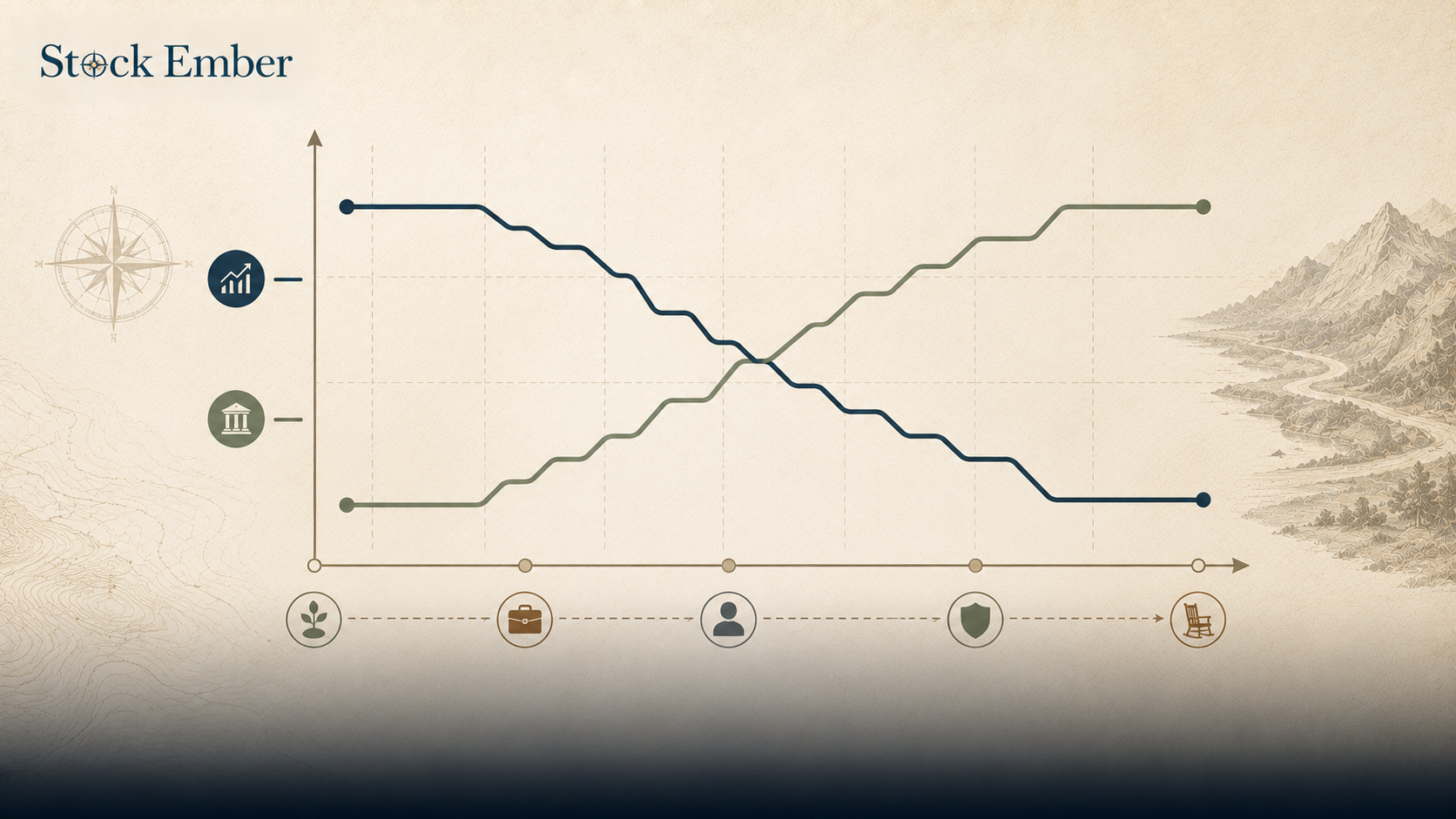
A target date fund (TDF) is an all-in-one mutual fund or ETF that automatically rebalances its asset allocation over time, shifting from growth-oriented equities to conservative bonds as a specified target retirement year approaches. Managed along a predetermined "glide path," it provides a hands-off, globally diversified portfolio designed to reduce risk as the investor nears retirement.
A target date fund (TDF) is an all-in-one mutual fund or ETF that automatically shifts its asset mix from growth-oriented stocks to conservative bonds as a specified target year approaches.
Designed for long-term lifecycle investing, these portfolios serve as the default investment choice in most modern employer retirement plans. Instead of manually selecting, monitoring, and rebalancing individual asset classes, you choose a single fund aligned with your estimated retirement year.
Understanding how these funds automate risk reduction and evaluating their fee structures helps you determine if this approach fits your long-term wealth goals.
Quick Takeaways
01A TDF automatically lowers investment risk over time by gradually reducing stock exposure and increasing bond allocations.
02The fund's "glide path" governs how asset allocation changes leading up to and through your target retirement year.
03Low-cost, index-based target date funds package global diversification at a fraction of the cost of actively managed alternatives.
04While target date funds simplify asset allocation, they are not risk-free and can still experience drawdowns near retirement.
What Is a Target Date Fund?
A target date fund also known as a lifecycle or age-based fund is a diversified, multi-asset portfolio managed according to a specific target year in the future.
Funds are typically named in five-year increments, such as Target Retirement 2050, 2055, or 2060. To select a fund, you simply match the year in the fund's name to the approximate year you plan to retire or begin withdrawing capital.
Structurally, a target date fund operates as a "fund-of-funds". Rather than buying individual stocks or bonds directly, the fund holds a combination of underlying index funds covering domestic equities, international equities, and broad bond markets.
How Target Date Funds Work: Understanding the Glide Path
The core engine of a TDF is its glide path, the predetermined formula that dictates how the fund's asset allocation shifts from aggressive growth to capital preservation over time.
When you are decades away from retirement, the fund holds a high percentage of stocks (often 80% to 90%) to maximize long-term growth potential. As the target date draws closer, the manager automatically dials down stock exposure and increases bond holdings to protect accumulated savings from market volatility.
These funds generally follow one of two glide path structures:
"To-Retirement" Funds: The glide path stops reducing stock exposure precisely at the target date, maintaining a static asset allocation from that point forward.
"Through-Retirement" Funds: The glide path continues to gradually reduce equity exposure for 15 to 20 years past the target date, managing longevity risk throughout your retirement years.
This systematic, hands-off approach applies the core principles of what is passive investing, ensuring your portfolio continuously de-risks without requiring emotional timing calls.
Diagram illustrating a target date fund glide path shifting allocation over time.
Both strategies build global market exposure through domestic stocks, international stocks, and total bond indexes. The primary difference lies in convenience versus control.
Feature
Target Date Fund (TDF)
DIY Three-Fund Portfolio
Rebalancing Effort
Fully automated internal rebalancing
Manual rebalancing once or twice per year
Expense Ratios
Slightly higher to cover wrapper management
Lowest possible expense ratios
Customization
Fixed glide path; identical for all investors in that year
Fully customizable stock-to-bond ratio
Behavioral Simplicity
Single-ticker "set-and-forget" structure
Requires managing individual fund positions
The 10-Year Fee Advantage: Index-Based vs. Actively Managed TDFs
Not all target date funds are built equally, and underlying fund fees can significantly impact your net wealth over a decade of compounding.
These funds fall into two main fee categories:
Passive Index-Based TDFs: Built using low-cost index funds, charging total expense ratios often between 0.08% and 0.12% per year, according to Morningstar industry data.
Actively Managed TDFs: Built using actively managed underlying funds, carrying total expense drag that can reach 0.55% to 0.75% or higher, according to Morningstar industry data.
Consider a $10,000 retirement balance held over 10 years:
Low-Cost Index TDF (Illustrative 7.0% Gross Return minus 0.08% Fee = 6.92% Net Return): Grows to approximately $19,525 over 10 years.
Actively Managed TDF (Illustrative 7.0% Gross Return minus 0.65% Fee = 6.35% Net Return): Grows to approximately $18,509 over 10 years.
These figures are hypothetical and for illustration only; actual returns will vary and are not guaranteed.
Choosing an index-based target date fund preserves over $1,000 in additional capital per $10,000 invested over a single decade simply by eliminating unnecessary management markups.
Common Pitfalls for Target Date Fund Investors
While target date funds eliminate asset allocation stress, misunderstandings about how they operate can lead to costly mistakes.
Watch out for these three common traps:
Assuming Near-Term Funds Are Protected From Capital Loss: Holding bonds reduces volatility, but bonds are still subject to interest rate shocks. Investors near their target date can still experience short-term paper losses during market downturns.
Tinkering and Adding Individual Sector Funds: Adding extra stock or sector ETFs alongside a TDF destroys the carefully balanced global asset allocation designed by the fund's glide path.
Holding TDFs in Taxable Brokerage Accounts: These funds frequently rebalance internally and distribute capital gains, making them far more tax-efficient inside tax-advantaged accounts like IRAs or 401(k)s than in taxable accounts.
In practice, many long-term investors discover that the greatest value of a TDF isn't mathematical, it's psychological. By hiding the daily noise of individual stock and bond movements behind a single fund ticker, it prevents you from making emotional, panic-driven trades during market corrections.
Conclusion
TDFs offer a disciplined, hands-off framework for life-cycle investing, allowing you to automate broad diversification and gradual risk reduction through a single fund choice. By selecting low-cost, index-based TDFs, you protect your long-term compounding from excessive fee drag while maintaining focus on your overarching retirement timeline.
When you are ready to explore specific underlying broad-market funds and index options, reviewing our ETF reviews is a practical next step.
FAQ
5 questions
What is the main advantage of a target date fund?
The main advantage of these funds is hands-off simplicity. It automatically provides global diversification across stocks and bonds while systematically rebalancing and de-risking your portfolio as you near retirement, eliminating the need for manual portfolio management.
Can you lose money in a target date fund near retirement?
Yes, these funds are not guaranteed or risk-free. While they hold a higher proportion of bonds near their target date to reduce volatility, fixed-income assets can still experience paper losses during interest rate hikes or severe economic market downturns.
What is the difference between "to" and "through" target date funds?
A "to-retirement" fund stops adjusting its stock-to-bond ratio at the target date, holding a static asset allocation into retirement. A "through-retirement" fund continues gradually reducing equity exposure for 15 to 20 years past the target date to manage longevity risk during retirement.
Is a target date fund better than a DIY three-fund portfolio?
A TDF offers automated rebalancing and psychological simplicity, making it ideal for hands-off investors. A DIY three-fund portfolio requires manual rebalancing once or twice a year but allows for full customization and slightly lower expense ratios.
How do I choose the right target date fund year?
Choose the fund whose name matches the approximate year you plan to retire or begin withdrawing funds (e.g., 2055 or 2060). If you prefer a slightly more conservative approach, you can choose an earlier target year with higher bond exposure.
Disclaimer
This guide was written with AI assistance and reviewed by the StockEmber editorial team for accuracy. StockEmber provides independent education, not personal financial advice. Investing puts your capital at risk: the value of investments can go down as well as up, you may get back less than you invest, and past performance doesn’t guarantee future results. Some links may support our work at no additional cost to you.
The StockEmber Team is our in-house desk of independent research writers. We test brokerage platforms, read the fine print on fees and custody, and cover ETFs and long-horizon investing for people who plan to hold for decades — not days.