A margin call is a demand from a broker for an investor to deposit additional cash or securities into a margin account when equity falls below a required threshold. It occurs when market drops erode account equity relative to borrowed debt. If unfulfilled, the broker can sell assets to cover the shortfall.
A margin call is a broker's demand for an investor to deposit additional cash or securities when the equity value in a margin account falls below a required threshold. It occurs because borrowed funds create leverage, which multiplies investment losses during market drops.
Watching your stock holdings lose value is difficult, but seeing your broker step in to demand immediate funds makes a market dip far more stressful. Borrowing money to buy assets can double your gains during bull markets, yet it accelerates losses just as quickly when prices fall. This guide explains how margin calls work, why brokers enforce strict account thresholds, and how long-term investors can protect their wealth from forced liquidations.
Quick Takeaways
01A margin call happens when your account equity drops below your broker's required maintenance margin.
02Federal regulations require a 25% minimum maintenance margin, but individual brokers often enforce higher internal requirements.
03To resolve a call, you must deposit cash, add marginable securities, or sell existing assets promptly.
04Brokers hold the legal right to liquidate your positions immediately without advance notice if you breach equity thresholds.
What Is a Margin Call?
A margin call is an automated risk-management tool that brokers use to protect borrowed capital. When you open a standard brokerage account, you typically pay for investments using cash. If you apply for margin privileges, your broker allows you to borrow money against the value of your existing portfolio to buy additional securities.
Using borrowed money adds leverage to your portfolio. Federal Reserve rules under Regulation T set the initial margin requirement at 50%, meaning you must supply at least half of the purchase price in cash. Once you buy the stock, regulatory bodies like FINRA enforce a minimum maintenance margin of 25% under their FINRA rules. This means your personal equity in the account must never drop below 25% of the total market value of your holdings.
Many brokerage firms enforce stricter internal limits, known as house requirements, which often range between 30% and 40%. If market price declines push your equity below this designated percentage, your broker issues a margin call.
How a Margin Call Is Triggered
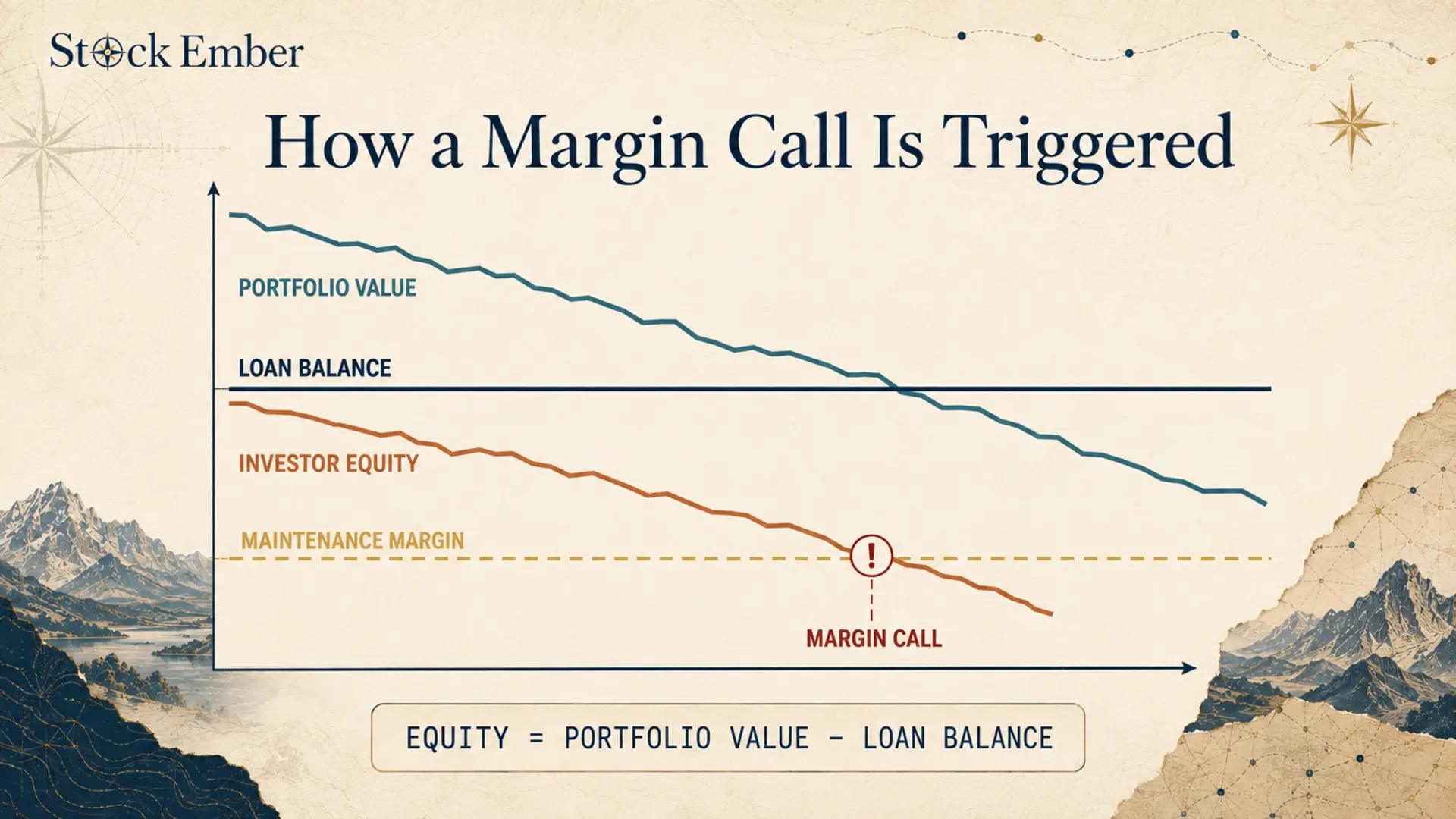
Knowing what is a margin call is only half the picture — understanding exactly when one gets triggered matters just as much. A margin call is triggered when declining asset values cause your equity percentage to fall below the maintenance margin threshold. Because your loan amount remains constant while the market value of your assets falls, all price declines directly erode your personal equity.
To see how the math works, consider a simple scenario:
Initial Purchase: You deposit $5,000 of cash and borrow $5,000 on margin to purchase $10,000 worth of stock (100 shares at $100 per share).
Initial Equity: Your equity is $5,000, which equals 50% of the account value.
Broker Maintenance Requirement: Your broker enforces a 30% maintenance margin requirement.
If the stock price drops from $100 to $60, your 100 shares are now worth $6,000. Your loan balance remains unchanged at $5,000.
Account Equity = Total Market Value − Loan Balance
Your remaining account equity is $1,000 ($6,000 − $5,000). To check your equity percentage:
Your equity percentage is now 16.67% ($1,000 / $6,000). Because 16.67% is well below the broker's 30% maintenance requirement, your account enters a margin deficit.
Visual example of a margin call calculation showing portfolio equity falling below maintenance limits.
To meet the 30% maintenance rule on a $6,000 portfolio, you need $1,800 in equity ($6,000 × 0.30). With only $1,000 in equity, your broker issues a margin call for the $800 difference.
How to Resolve a Margin Call and Broker Liquidation Rights
When a margin call occurs, you must resolve the equity shortfall quickly. Investors generally have three options to satisfy the demand:
Deposit Cash: Transfer fresh funds into the account to restore equity above the maintenance threshold.
Deposit Securities: Move eligible, fully paid marginable stocks or ETFs into the account to increase total asset value.
Sell Holdings: Liquidate a portion of your securities to pay down the margin loan balance.
While brokers often send a notification giving you 24 to 72 hours to deposit funds, fine-print customer agreements give firms full legal rights to act immediately. If market volatility is severe, a broker can sell your positions immediately without advance notice, without your consent, and without allowing you to choose which stocks are sold.
Why Leverage and Margin Calls Harm Long-Term Portfolios
Margin trading can severely damage a long-term compounding strategy. The primary threat comes from forced liquidation at market bottoms. When prices plunge across the market, margin calls force you to sell assets at depressed prices. This locks in paper losses as permanent capital loss, leaving you with fewer shares when the market recovers.
Borrowing money also carries ongoing costs. Brokers charge variable interest rates on margin loans, often ranging from 8% to 12% per year. Over a 10-year holding period, carrying a $10,000 margin loan at 10% annual interest drains $10,000 in cash from your account—money that would otherwise stay invested and compound. This ongoing cash drain drags down total returns, even if your stock holdings remain flat.
How Investors Can Avoid a Margin Call
Once you understand what is a margin call and how it gets triggered, the next logical step is prevention. The simplest way to eliminate margin call risk is to invest using a cash-funded account. Patient buy-and-hold investors build wealth by accumulating assets they own outright, avoiding interest costs and debt obligations.
If you choose to maintain margin capability for short-term flexibility, consider these protective steps:
Maintain Cash Reserves: Keep an uninvested cash buffer inside or alongside your account to absorb price swings.
Set Downside Rules: Use automated trading tools like a stop loss order to exit declining positions before they breach maintenance thresholds.
Borrow Conservatively: Limit borrowing to a small percentage of your portfolio rather than maxing out available credit.
Conclusion
Understanding how margin calls work highlights why borrowed capital is a double-edged sword. Margin calls are automated mechanisms designed to protect lenders from default, not to protect investors from market drops. Forced asset sales during market corrections lock in losses and ruin the long-term compounding process. Building a durable portfolio relies on patient, cash-funded asset accumulation that allows you to ride out market drawdowns on your own schedule.
When you're ready to evaluate account features and trading conditions across platforms, our Broker reviews & rankings offer a clear starting point for your research. Investing always carries risk of capital loss and past performance does not promise future results, so treat this guide as educational context rather than individual financial advice.
FAQ
4 questions
What is a margin call in simple terms?
A margin call occurs when the value of your account falls below the minimum required balance set by your broker after you borrow money to buy stocks.
What happens if I cannot deposit extra funds during a margin call?
If you fail to add cash or eligible assets, your broker has the legal right to sell any of your holdings without prior notice to cover the shortfall.
Can a margin call happen in a standard cash account?
No. Margin calls only happen in margin accounts, where you borrow money from the broker to trade. Standard cash accounts do not use borrowed funds.
How can long-term buy-and-hold investors avoid margin calls entirely?
The simplest way to avoid margin calls is to stick to a standard cash account and invest using money you already own, rather than borrowing on margin.
Disclaimer
This guide was written with AI assistance and reviewed by the StockEmber editorial team for accuracy. StockEmber provides independent education, not personal financial advice. Some links may support our work at no additional cost to you.
The StockEmber Team is our in-house desk of independent research writers. We test brokerage platforms, read the fine print on fees and custody, and cover ETFs and long-horizon investing for people who plan to hold for decades — not days.