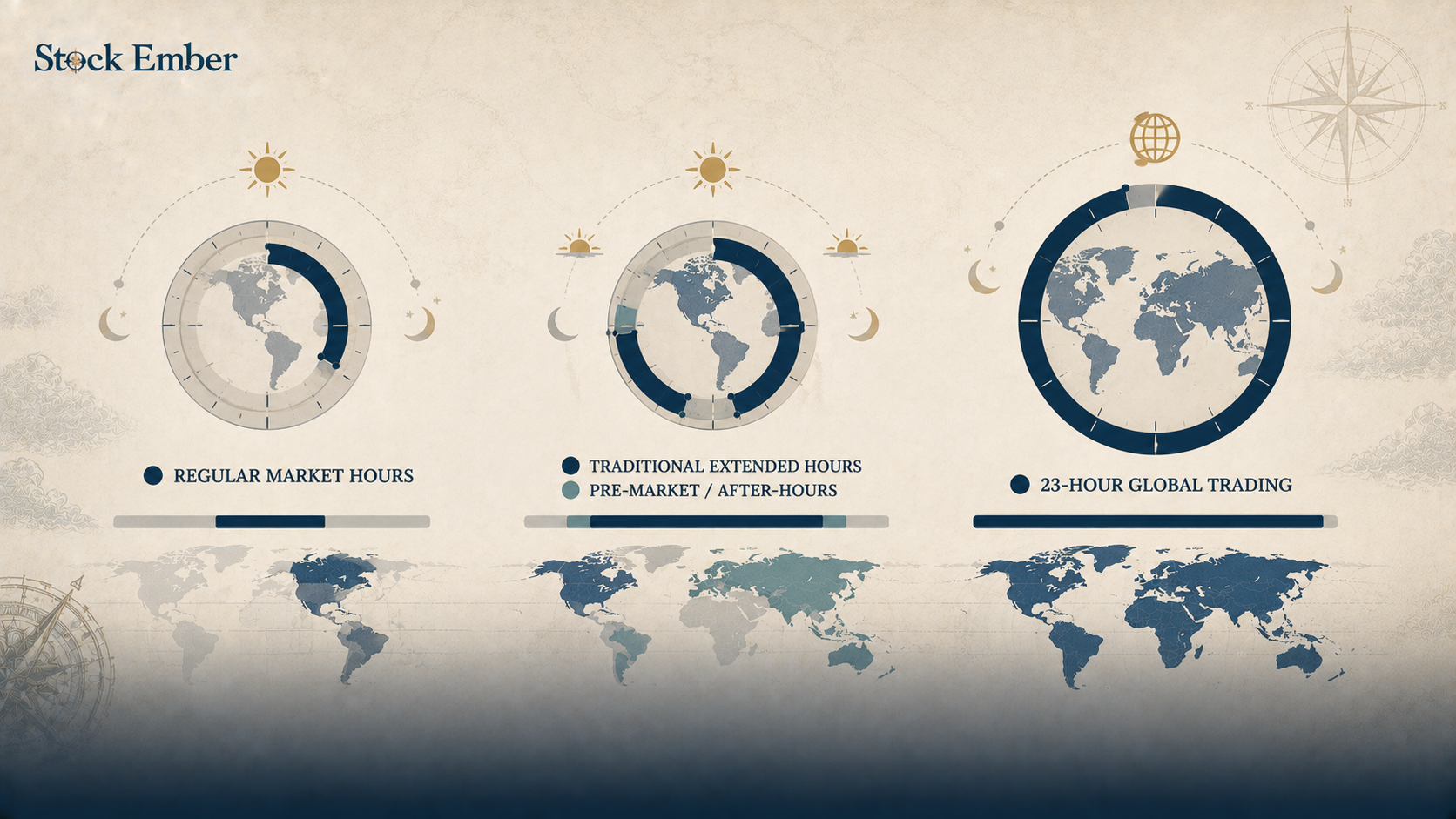
Nasdaq plans to expand U.S. stock trading to a nearly 23-hour continuous schedule starting in December 2026, subject to SEC approval. The proposal extends official exchange clearing across overnight hours to give global investors direct market access during their local business days.
With Nasdaq 23 hours trading set to launch on December 6, 2026, the exchange is creating a continuous exchange-cleared market for global investors.
Driven by growing demand from Asian and European market participants who want immediate access to U.S. equities during their local business hours, Nasdaq 23 hours trading marks a major shift in stock exchange operations. However, while 24/5 trading offers greater flexibility, long-term investors should understand the hidden execution costs and liquidity risks of off-hours sessions before placing overnight orders.
Quick Takeaways
01Nasdaq plans to operate an official exchange session for roughly 23 hours a day, five days a week, beginning December 6, 2026.
02The expanded hours aim to serve international investors across Asia and Europe who trade U.S. equities during their daytime business hours.
03Trading overnight involves significantly lower trading volume, which widens bid-ask spreads and increases execution costs for retail investors.
04Long-term buy-and-hold investors rarely need overnight execution and are generally better served by placing orders during regular market hours.
What Is Nasdaq’s 23-Hour Trading Plan?
Nasdaq’s "Global Trading Hours" initiative is an official proposal submitted to federal regulators to extend standard stock exchange operations across nearly the entire 24-hour weekday cycle.
Under the proposed regulatory filing with the SEC, Nasdaq intends to bridge the multi-hour gap that currently exists between the U.S. post-market close and the next morning's pre-market opening. By maintaining matching engines overnight, Nasdaq aims to allow global investors to trade equity securities directly on a regulated national exchange regardless of their local time zone.
The initiative is scheduled to launch in December 2026, following final regulatory approval from the SEC. The primary driver behind this move is the rising international appetite for major U.S. technology stocks and index funds.
Overseas investors in places like Tokyo, Singapore, and London currently face obstacles or higher friction when attempting to trade U.S. shares during their primary business hours. Nasdaq’s plan seeks to capture this round-the-clock order flow directly on its primary matching platform.
How the 23-Hour Schedule Works
The proposed daily schedule will operate continuously for 23 hours from Sunday evening through Friday afternoon, leaving a single one-hour pause for system maintenance and clearing processes.
Under the announced framework, the daily trading cycle begins at 9:00 PM Eastern Time (ET) and runs through 8:00 PM ET the following day. The remaining hour between 8:00 PM ET and 9:00 PM ET serves as a quiet window for broker-dealers and clearinghouses to run nightly account processing and batch settlements.
Thin volume, wider spreads, international participation
Trading throughout this expanded 23-hour block will connect directly into standard clearing networks, ensuring that trades execute under central counterparty protections rather than off-exchange private agreements.
Nasdaq Extended Hours vs. Overnight Trading: What Is Changing?
The main shift is moving overnight trading from private brokerage networks onto an official, exchange-cleared national marketplace.
Historically, Nasdaq extended hours referred strictly to the pre-market session (4:00 AM to 9:30 AM ET) and post-market session (4:00 PM to 8:00 PM ET) surrounding regular trading hours. During these traditional windows, liquidity is lower than during the day, but trades still clear through established exchange protocols.
In recent years, several brokerage accounts began offering 24/5 trading by routing retail overnight orders through private venues known as Alternative Trading Systems (ATS). While ATS platforms allowed investors to trade at night, these private pools often suffered from fragmented order books, lower trade visibility, and isolated pricing that could differ between brokers.
Diagram showing the 24-hour timeline of Nasdaq's proposed global trading session schedule.
By bringing extended hours trading directly onto Nasdaq's central matching engine, the exchange standardizes execution rules and consolidates liquidity into a single order book. Initially, overnight trading is expected to focus on high-volume S&P 500 and Nasdaq-100 stocks along with major equity exchange-traded funds (ETFs).
The Hidden Costs of Overnight Trading
Overnight stock trading carries higher execution costs, primarily because low trading volume leads to wider bid-ask spreads and price slippage.
The bid-ask spread is the gap between the highest price a buyer is willing to pay and the lowest price a seller is willing to accept. During regular market hours, thousands of market makers and institutional funds compete, keeping spreads extremely narrow, often just a single penny per share on major stocks.
Overnight, far fewer market participants are active. As a result, the bid-ask spread widens. A stock that trades during the day with a $0.01 spread ($100.00 bid / $100.01 ask) might trade at night with a $0.30 spread ($99.85 bid / $100.15 ask).
The 10-Year Friction Impact
Paying a $0.30 wider spread may seem insignificant on a single 100-share trade ($30 extra in hidden cost). However, if an investor consistently executes orders in thin off-hours markets, these hidden friction costs act like a recurring tax on portfolio growth:
Single Purchase: Buying $10,000 worth of stock with a 0.30% wider spread costs an extra $30 upfront.
Compounded Loss: If that $30 had remained in the portfolio earning a historical 7% average annual return, it would grow to nearly $60 over ten years.
Repeated Behavior: Making ten such off-hours trades per year drains hundreds of dollars from your compounding baseline over a decade.
Because price slippage is common during low-volume hours, brokers typically disable market orders overnight. Instead, traders must use limit orders, which specify the maximum price you are willing to pay or the minimum price you are willing to accept.
In practice, many long-term investors find that placing orders during overnight sessions creates unnecessary anxiety without providing any practical financial advantage. Watching share prices fluctuate on thin overnight volume often tempts investors to second-guess disciplined asset allocations.
Common Pitfalls for Buy-and-Hold Investors
The main pitfalls of 23-hour stock trading involve behavioral traps, such as overreacting to off-hours headlines and treating long-term investments like round-the-clock trading vehicles.
Overreacting to Late-Night News: Earnings reports and geopolitical headlines often break outside regular hours. In thin overnight markets, small sell orders can cause dramatic price dips. Long-term investors who panic and sell overnight often realize losses right before primary market liquidity returns at 9:30 AM ET to stabilize prices.
Expecting Day-Session Liquidity: Assuming an order will fill instantly at the displayed price during overnight hours can lead to disappointment or unfulfilled limit orders.
Encouraging Over-Trading: Constant market access can transform a calm, long-term buy-and-hold strategy into active market timing. Research consistently shows that higher trading frequency reduces long-term net returns due to transaction costs and emotional errors.
Conclusion
The move toward Nasdaq 23 hours trading marks a major evolution in global market structure. While round-the-clock access offers international investors greater flexibility, it does not alter the foundational rules of long-term wealth creation. Tighter bid-ask spreads and deep institutional liquidity mean that regular market hours remain the most cost-effective time for buy-and-hold investors to execute trades.
When you are ready to evaluate how your platform handles off-hours execution, our broker reviews offer a clear breakdown of costs and feature sets.
Investing always puts your capital at risk and past performance never guarantees future results, so treat expanded trading hours as an operational feature rather than a reason to change a disciplined investment plan.
FAQ
5 questions
When does Nasdaq's 23-hour trading start?
Nasdaq plans to launch its 23-hour global trading schedule in December 2026, pending regulatory approval from the SEC. The transition will take place gradually to allow brokerages, market makers, and clearinghouses to update their infrastructure and risk management systems.
What are Nasdaq's new overnight trading hours?
Under the proposed schedule, trading will run continuously for 23 hours each weekday, operating from 9:00 PM Eastern Time (ET) to 8:00 PM ET the following day. A mandatory one-hour maintenance break will take place between 8:00 PM ET and 9:00 PM ET for system clearing.
Is Nasdaq's 23-hour trading day fully approved yet?
No, the 23-hour trading day is not yet fully approved. Nasdaq has submitted its proposal to the U.S. Securities and Exchange Commission (SEC) for review. Implementation depends on formal regulatory approval, system testing, and clearinghouse readiness.
How is this different from Nasdaq's existing extended hours?
Traditional extended hours consist of pre-market (4:00 AM - 9:30 AM ET) and post-market (4:00 PM - 8:00 PM ET) sessions surrounding regular hours. The new overnight session fills the multi-hour gap from 9:00 PM to 4:00 AM ET, moving overnight trades from private broker networks directly onto Nasdaq's central exchange matching engine.
Will all stocks be available during overnight trading?
No, overnight trading will initially focus on highly liquid equities, including major S&P 500 and Nasdaq-100 constituent stocks, along with widely held exchange-traded funds (ETFs). Smaller-cap or less liquid stocks may not be available overnight due to thin trading volume and wider bid-ask spreads.
Disclaimer
This guide was written with AI assistance and reviewed by the StockEmber editorial team for accuracy. StockEmber provides independent education, not personal financial advice. Some links may support our work at no additional cost to you.
The StockEmber Team is our in-house desk of independent research writers. We test brokerage platforms, read the fine print on fees and custody, and cover ETFs and long-horizon investing for people who plan to hold for decades — not days.