Inflation is caused by three primary economic forces: excess buyer demand (demand-pull), rising business production costs (cost-push), and rapid expansion of the total money supply. When overall spending outpaces the economy's output capacity or input costs increase, prices rise and purchasing power drops. Because stock markets react to central bank interest rate policy, inflation shifts also drive broad financial market trends.
Inflation is the gradual rise in prices across an economy over time, which reduces the purchasing power of money. When inflation occurs, a single unit of currency buys fewer goods and services than it did previously.
Watching everyday expenses rise can make holding cash feel safe during uncertain times. However, persistent price increases quietly erode uninvested savings over long periods. This guide breaks down what causes inflation, how central bank policies react, and what rising prices mean for long-term portfolio growth.
Quick Takeaways
01Inflation is driven by three primary forces: excess buyer demand, rising production costs, and money supply growth.
02Central banks raise interest rates to cool inflation, which often creates short-term stock market volatility.
03Holding excess cash during inflationary periods causes a permanent loss of purchasing power over 10-year horizons.
04A diversified portfolio of productive assets like equities has historically preserved purchasing power over long horizons.
What Is Inflation and How Does It Work?
To answer what inflation is and what causes it, you first need to understand how price changes are measured. Inflation is not just a price jump in a single product, such as gas or eggs. Instead, it is a broad, sustained increase in the overall price level of goods and services across an entire economy.
Economists and central banks track inflation using statistical indexes. The most common metric in the United States is the Consumer Price Index (CPI), published monthly by the U.S. Bureau of Labor Statistics. The CPI measures the average change over time in the prices paid by urban consumers for a market basket of consumer goods and services. Another key metric is the Personal Consumption Expenditures (PCE) index, which central banks closely monitor to set interest rate targets.
When inflation remains low and predictable, typically around 2% per year, businesses can plan investments and consumers can budget effectively. But when inflation climbs rapidly, cash loses value faster than it can earn interest in traditional bank accounts.
What Are the Main Causes of Inflation?
Understanding what are the main causes of inflation requires looking at how supply, demand, and money interact in a national economy. At its core, inflation happens when the total demand for goods and services outstrips the total supply available, or when the cost of producing those goods increases significantly.
There are three broad economic mechanisms that drive general price increases:
Demand shifts that pull prices higher when buyers outbid each other for limited goods.
Supply disruptions that push production costs up, forcing companies to charge more.
Monetary expansions where the total supply of currency grows faster than real economic output.
While temporary price spikes in a single sector usually settle quickly, broad inflation occurs when these factors ripple across energy, labor, transport, and raw materials simultaneously.
What Are the 5 Causes of Inflation?
To break macroeconomics down into practical terms, economists point to five distinct catalysts. When looking at what are the 5 causes of inflation, each plays a specific role in pushing price levels higher:
Demand-Pull Inflation: This happens when consumer and business demand for products exceeds the economy's capability to supply them. With too much money chasing too few goods, sellers raise prices.
Cost-Push Inflation: This occurs when production costs rise. Increases in raw material prices, energy costs, or wages force companies to pass higher operational expenses on to end consumers to protect profit margins.
Monetary Expansion: When central banks increase the money supply rapidly, through lower borrowing rates or asset purchases, the total currency in circulation expands. If currency growth outpaces economic output, each dollar loses purchasing power.
Built-in Inflation (Wage-Price Spiral): As living costs rise, workers demand higher wages to maintain their standard of living. Businesses then raise prices further to cover higher payroll costs, creating a self-reinforcing cycle.
Exchange Rate Shifts: When a national currency weakens against foreign currencies, imported goods become more expensive. This currency depreciation increases the cost of imported raw materials and finished products.
Evaluating what are the causes of inflation through these five lenses helps explain why price trends rarely have a single isolated origin.
What Causes Inflation in the US?
Looking at what causes inflation in the US offers a clear view of how fiscal stimulus, central bank policy, and global trade events interact in a major market. Historically, major inflationary periods in the United States have been triggered by a combination of global energy shocks, sudden shifts in consumer demand, and monetary expansion.
For instance, post-pandemic inflation in the U.S. resulted from historic federal fiscal stimulus, extended central bank rate cuts, and severe global supply chain bottlenecks. As factory shutdowns limited product availability, household savings surged, leading to sharp demand-pull pressure across shipping, housing, and consumer goods.
Additionally, energy price volatility plays a heavy role in U.S. price indexes. Because oil and gas feed into transport, agriculture, and manufacturing, energy price surges quickly spread into broader CPI measurements.
How Inflation Impacts the Stock Market
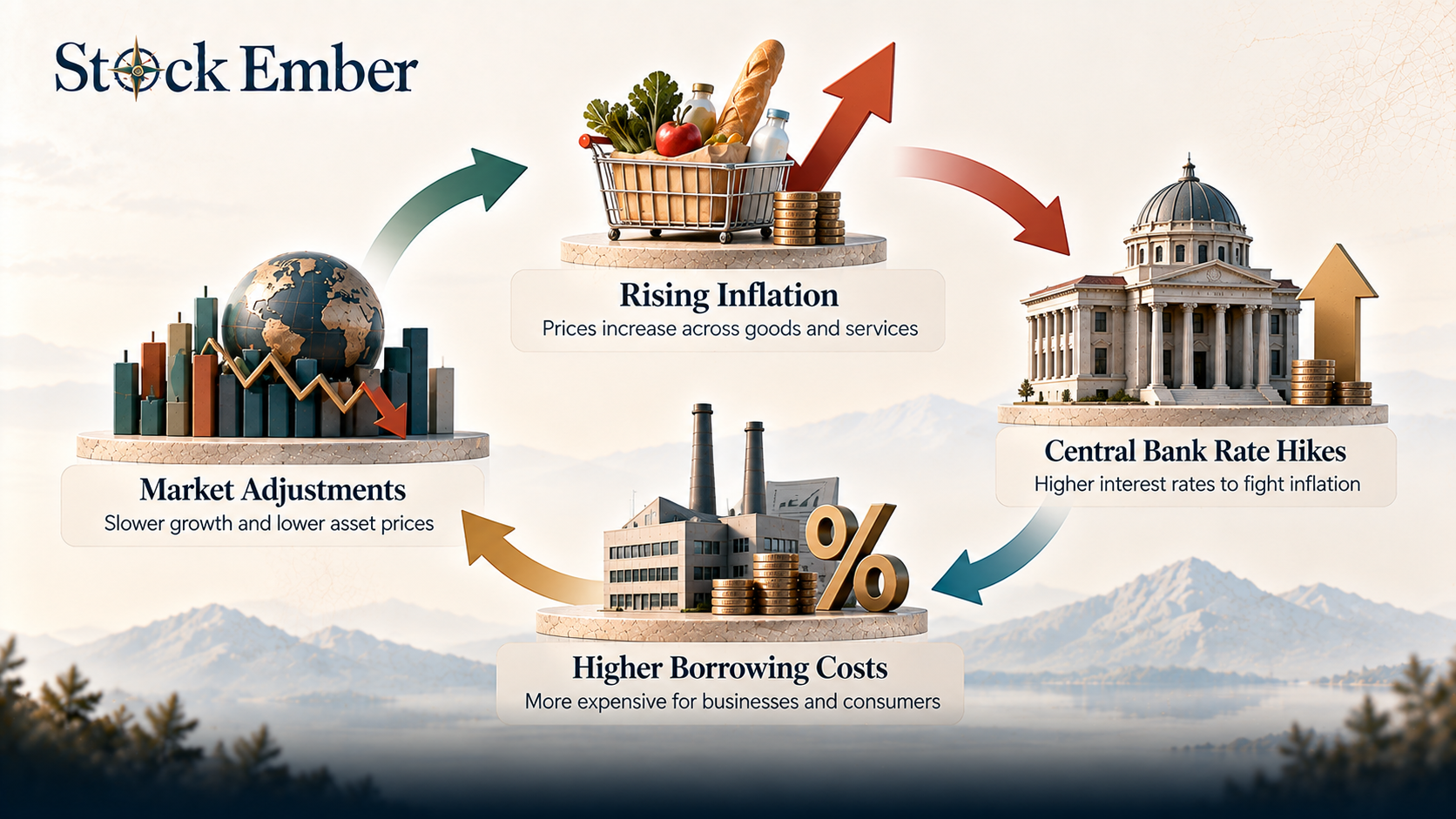
Inflation directly affects financial markets by altering corporate profit margins and central bank monetary policies. When inflation rises above target levels, central banks step in to cool economic activity by raising benchmark interest rates.
Higher interest rates increase borrowing costs for businesses and consumers, slowing economic expansion. This policy response often shifts the broader market cycle into a period of slower growth or contraction. Higher rates also increase the discount rate applied to future corporate earnings, which can compress equity valuations and trigger temporary stock market volatility.
Despite short-term volatility, equities represent ownership in real companies. High-quality businesses with strong pricing power can pass rising input costs on to customers, maintaining profit growth and protecting real portfolio value over multi-year periods.
Diagram showing how inflation and central bank interest rate increases impact stock market valuations.
Cash vs. Real Assets: The 10-Year Purchasing Power Drag
Holding cash during periods of high inflation creates a quiet but permanent loss of real wealth. While bank deposits feel safe in nominal terms, inflation constantly erodes what those dollars can actually buy over time.
Consider the ten-year impact of holding $10,000 in cash during a period of 3% average annual inflation versus maintaining a broad equity portfolio.
Asset Strategy
Nominal 10-Year Portfolio Value
Estimated Real Value (Adjusted for 3% Inflation)
10-Year Purchasing Power Gain / Loss
Uninvested Cash (0% Yield)
$10,000
$7,441
-25.6%
Cash in Savings Account (1.5% APY)
$11,605
$8,635
-13.7%
Diversified Equity Portfolio (7.0% Return)
$19,672
$14,637
+46.4%
Over a ten-year horizon, sitting in cash causes a real purchasing power loss. In contrast, productive assets like broad index funds have historically grown faster than inflation, preserving purchasing power over long horizons.
In practice, many long-term investors find that holding excess cash during high-inflation periods feels reassuring day-to-day, but proves far more costly over a decade than enduring market volatility.
Common Investor Traps During Inflation
When inflation headlines dominate the news, investors often react emotionally and make choices that harm long-term returns:
Selling Equities to Move to Cash: Panic selling stocks during inflation-driven drawdowns locks in market losses and exposes savings to severe purchasing power erosion.
Chasing Short-Term Commodity Trends: Attempting to trade individual commodities or single-sector funds after inflation spikes often leads to buying at cyclical tops.
Ignoring Real Returns: Focusing only on nominal investment returns without subtracting inflation creates a false sense of financial progress.
Focusing on real returns after inflation rather than nominal figures helps investors maintain perspective during economic shifts.
Conclusion
Inflation is a natural economic process driven by demand imbalances, supply shocks, wage trends, and money supply expansion. While central bank rate hikes intended to curb price gains often cause temporary market pullbacks, attempting to dodge volatility by holding cash leaves savings vulnerable to steady purchasing power loss over long horizons.
Staying invested in productive businesses and low-cost index funds remains a proven approach to building real wealth across economic shifts. When you are ready to choose broad index funds that can help your capital outpace rising prices, our ETF reviews are the place to start.
Investing always carries a risk of loss and past returns do not guarantee future performance, so treat this guide as an educational foundation rather than individual financial advice.
FAQ
5 questions
What is inflation and what causes it?
Inflation is the broad, sustained increase in prices across an economy over time, reducing cash purchasing power. It is caused by three main economic mechanisms: excess consumer and business demand, rising production costs for businesses, and rapid growth in the overall money supply.
What are the 5 main causes of inflation?
The five primary causes of inflation are demand-pull (excess spending), cost-push (higher production and labor expenses), monetary expansion (rapid money supply growth), built-in inflation (a wage-price spiral), and exchange rate depreciation (rising costs for imported goods).
What causes inflation in the US?
Inflation in the U.S. is typically caused by a mix of major macroeconomic shifts, including federal fiscal stimulus, central bank monetary policy shifts, global supply chain bottlenecks, labor market tightness, and sudden spikes in global energy or commodity prices.
How do central bank interest rates stop inflation?
Central banks raise benchmark interest rates to increase the cost of borrowing for consumers and businesses. Higher rates slow down spending and investment across the economy, cooling excess demand and helping bring inflation back toward official targets.
How does inflation affect stock market investments?
While high inflation and subsequent interest rate hikes can trigger short-term stock market volatility and lower equity valuations, broad stock portfolios historically outperform inflation over 10-year horizons because productive companies can adjust prices to maintain profit growth.
Disclaimer
This guide was written with AI assistance and reviewed by the StockEmber editorial team for accuracy. StockEmber provides independent education, not personal financial advice. Investing puts your capital at risk: the value of investments can go down as well as up, you may get back less than you invest, and past performance doesn’t guarantee future results. Some links may support our work at no additional cost to you.
The StockEmber Team is our in-house desk of independent research writers. We test brokerage platforms, read the fine print on fees and custody, and cover ETFs and long-horizon investing for people who plan to hold for decades — not days.