Treasury bills (T-bills) are short-term U.S. government debt obligations maturing in one year or less, issued at a discount with no periodic coupon payments. Treasury bonds (T-bonds) are long-term securities maturing in 20 to 30 years that pay fixed coupon interest every six months. While both offer state and local tax exemptions, T-bills carry reinvestment risk when rates drop, whereas T-bonds carry interest rate price risk if sold prior to maturity.
Treasury bills (T-bills) are short-term government debt obligations maturing in one year or less, while Treasury bonds (T-bonds) are long-term debt securities maturing in 20 to 30 years.
Choosing between short-term capital preservation and long-term income lock-in is a foundational decision for fixed-income investors. While both instruments carry the same backing from the U.S. government, their cash flows, market price behavior, and interest rate sensitivities differ significantly. This guide compares their structural mechanics, payout designs, and key risk trade-offs across market cycles.
Quick Takeaways
01Treasury bills mature in 52 weeks or less, whereas Treasury bonds mature in 20 to 30 years.
02T-bills are zero-coupon instruments bought at a discount, while T-bonds pay fixed interest every six months.
03T-bonds carry high price volatility if sold before maturity, while T-bills face reinvestment risk when rates fall.
04Direct Treasuries offer state and local income tax exemptions across all maturity lengths.
What Are Treasury Bills and Treasury Bonds?
Treasury bills and Treasury bonds represent opposite ends of the U.S. sovereign debt spectrum, differing primarily in maturity length and payout structure. Both are issued by the U.S. Department of the Treasury to finance government operations, making their credit safety identical.
Treasury bills are short-term money market instruments issued with maturity terms of 4, 8, 13, 17, 26, or 52 weeks. Because of their short lifespan, they serve primarily as liquid cash equivalents for capital preservation.
Treasury bonds sit at the long end of the maturity spectrum, issued in 20-year and 30-year terms. They are designed for investors seeking stable income streams over multiple decades. Between these two extremes sit Treasury notes, which mature in 2 to 10 years. Understanding where each instrument sits among all types of bonds helps investors match fixed-income holdings to specific financial goals.
Under official U.S. Department of the Treasury rules on TreasuryDirect, individual investors can purchase both bills and bonds directly at auction or through secondary brokerage accounts.
In practice, many long-term investors use T-bills for cash reserves needed within a year, while reserving T-bonds for long-horizon liability matching or retirement income streams.
Cash Flow Structure: Discount Yield vs. Coupon Payments
The primary operational difference between T-bills and T-bonds lies in how they deliver financial returns to investors over time.
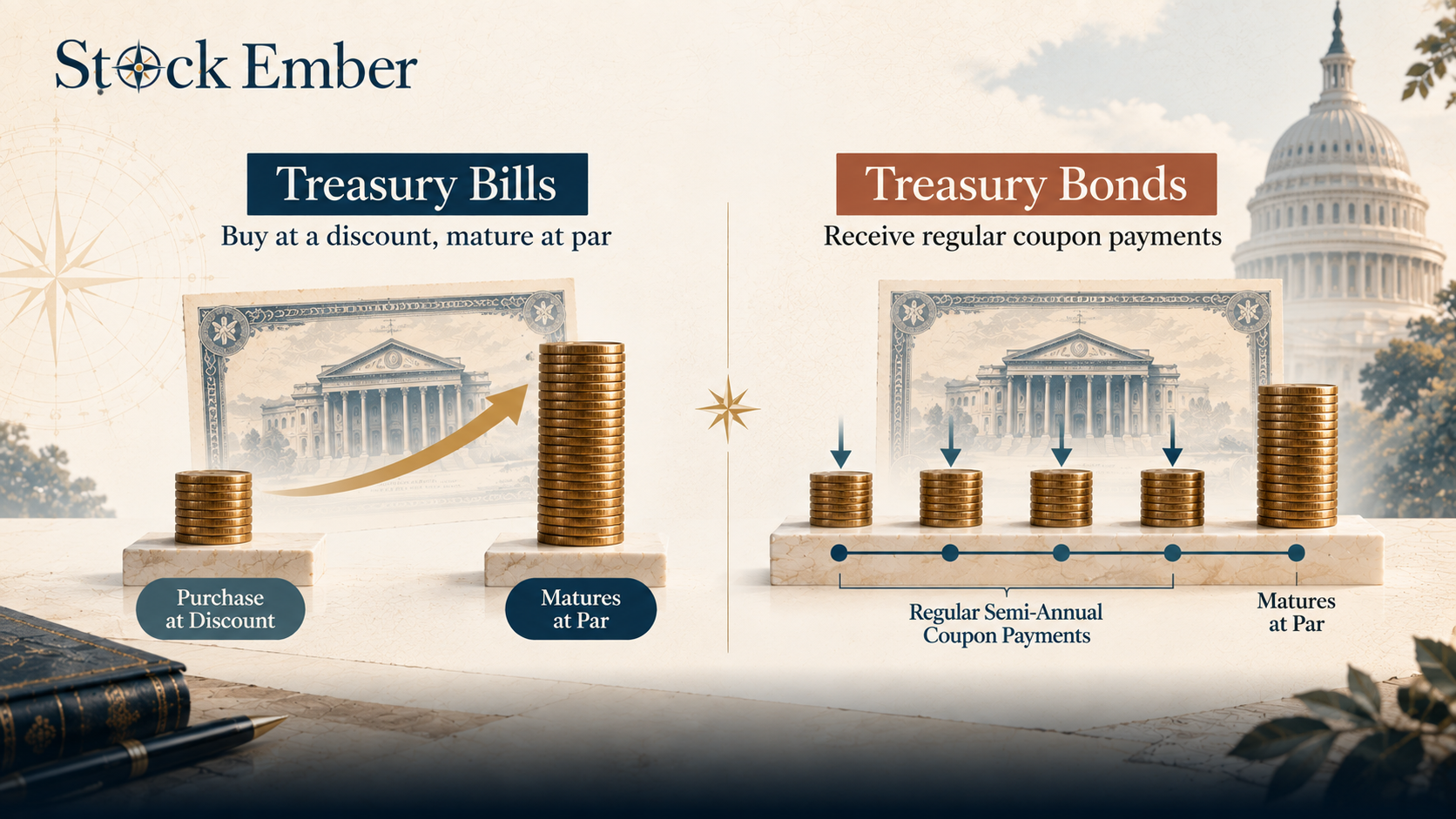
Treasury bills do not pay periodic interest. Instead, they are zero-coupon securities sold at a discount to their face value (par value). When a T-bill matures, the government pays the full face value. The difference between the discounted purchase price and the face value represents the interest earned. For example, buying a $1,000 face-value 52-week T-bill for $950 yields $50 in total interest upon maturity.
Diagram comparing Treasury bill discount returns with Treasury bond semi-annual coupon payments.
Treasury bonds pay fixed coupon interest every six months until maturity. When you buy a 30-year Treasury bond with a 4% coupon rate, you receive $20 every six months for every $1,000 of face value owned. At the end of 30 years, the government returns the original $1,000 principal.
When comparing T-bills vs Treasury bonds, this structural difference changes how cash flows enter your portfolio. T-bills deliver a single lump sum at maturity, while T-bonds produce regular, predictable cash distributions over decades.
Risk Trade-Off: Interest Rate Risk vs. Reinvestment Risk
Evaluating government debt requires weighing price volatility against the risk of declining interest rates. While neither instrument carries meaningful default risk, both face distinct market risks.
Treasury bonds carry significant interest rate risk (also known as duration risk). Because a 30-year bond locks in a fixed coupon payment for decades, its secondary market price fluctuates heavily when broader interest rates shift. If market rates rise, existing T-bonds with lower coupon rates fall in value. An investor who needs to sell a 30-year bond long before maturity may face severe principal losses if rates have risen since purchase.
Treasury bills carry minimal price volatility because their short maturities keep them close to face value. However, T-bills face high reinvestment risk. If you continuously roll over 13-week T-bills during a period when the central bank lowers rates, your interest yield declines each time a bill matures.
Evaluating reinvestment risk vs duration risk involves a fundamental trade-off: T-bonds lock in income for decades but expose your principal to interim market volatility, whereas T-bills protect your principal value but expose your future income to falling interest rates.
Yield Curve Reality: How Interest Rate Cycles Impact Yields
The relationship between short-term bill yields and long-term bond yields shifts constantly depending on the shape of the yield curve. Under standard market conditions, long-term Treasury bonds offer higher yields than short-term Treasury bills to compensate investors for locking up capital and taking on duration risk.
However, during certain economic phases, the central bank raises short-term rates to slow inflation, causing the yield curve to invert. According to data tracked by the Federal Reserve Bank, during an inverted yield curve, 4-week or 26-week T-bills may offer higher nominal yields than 30-year T-bonds.
While a higher short-term yield on T-bills appears attractive, it only lasts as long as short-term rates remain elevated. Once the rate-cutting cycle begins, T-bill yields drop rapidly, whereas a 30-year Treasury bond maintains its locked-in coupon rate regardless of broader economic shifts.
Treasury Bills vs. Bonds: Key Comparison Summary
Comparing key structural features side by side highlights how short-term debt differs from multi-decade debt when evaluating U.S. Treasury bills vs bonds.
Feature
Treasury Bills (T-Bills)
Treasury Bonds (T-Bonds)
Maturity Term
4 to 52 weeks
20 to 30 years
Payment Structure
Sold at discount; matures at face value
Fixed semi-annual coupon interest
Primary Risk
Reinvestment risk
Interest rate (price) risk
Price Volatility
Minimal
High (prior to maturity)
State Tax Exemption
Fully exempt
Fully exempt
Ideal Role
Short-term liquidity & cash reserves
Long-term income & liability matching
Common Pitfalls: What Fixed-Income Investors Should Avoid
Managing fixed-income debt effectively requires avoiding assumptions about yield persistence and liquidity.
First, investors often assume that high T-bill yields will persist indefinitely. When central banks cut benchmark rates, short-term yields drop quickly, leaving investors who relied on T-bills facing lower returns upon rollover.
Second, investors sometimes treat 20-year or 30-year Treasury bonds as cash substitutes, ignoring market price risk. If you need capital back in two years, purchasing a 30-year bond exposes your funds to secondary market price drops if interest rates rise in the interim.
Third, individual bond buyers often overlook market liquidity and reinvestment overhead. Instead of managing individual bond maturities manually, holding fixed-income through a diversified bond fund can simplify portfolio maintenance, though fund shares do not mature at a fixed par value like individual bonds.
Conclusion
Treasury bills and Treasury bonds serve distinct roles in a balanced portfolio, separating short-term capital preservation from long-term coupon income. While T-bills protect market value over months, T-bonds lock in interest yields over decades at the cost of higher interim price swings. Matching your choice to your specific investment horizon ensures your cash matches your future liabilities.
When you are ready to evaluate broader fixed-income strategies, our ETF reviews provide a clear look at low-cost bond strategies. Investing always involves risk, including inflation risk and market price fluctuations, so treat this guide as educational context rather than personalized financial advice.
FAQ
5 questions
What is the main difference between Treasury bills and Treasury bonds?
The primary difference is maturity length and payment structure. Treasury bills mature in 52 weeks or less and are sold at a discount without regular interest payments. Treasury bonds mature in 20 to 30 years and pay fixed semi-annual coupon interest until the principal is repaid at maturity.
How do Treasury bills pay interest if there are no coupon payments?
Treasury bills are zero-coupon securities sold at a discount to their face value. When the bill matures, the government pays the full face value. The difference between your discounted purchase price and the face value represents the interest earned on the investment.
Is a Treasury bill safer than a Treasury bond?
Both instruments carry identical credit safety because they are backed by the full faith and credit of the U.S. government. However, Treasury bills carry far less price volatility because of their short maturities. Treasury bonds fluctuate substantially in market price when interest rates shift.
Are Treasury bills and bonds exempt from state income tax?
Yes, interest earned from both Treasury bills and Treasury bonds is completely exempt from state and local income taxes across all U.S. states. However, interest payments from both instruments remain subject to federal ordinary income tax.
What is reinvestment risk in Treasury bills?
Reinvestment risk occurs when short-term Treasury bills mature during a period of falling interest rates. Investors must roll over their capital into new T-bills that yield lower interest rates, reducing overall income compared to locking in long-term yield with a multi-decade Treasury bond.
Disclaimer
This guide was written with AI assistance and reviewed by the StockEmber editorial team for accuracy. StockEmber provides independent education, not personal financial advice. Some links may support our work at no additional cost to you.
The StockEmber Team is our in-house desk of independent research writers. We test brokerage platforms, read the fine print on fees and custody, and cover ETFs and long-horizon investing for people who plan to hold for decades — not days.