A bond fund is a pooled investment vehicle, such as a mutual fund or exchange-traded fund (ETF), that collects capital from investors to buy a diversified basket of debt securities. Unlike individual bonds, most bond funds operate perpetually without a single fixed maturity date, meaning share prices adjust continuously based on prevailing interest rates.
A bond fund is a pooled investment vehicle such as a mutual fund or exchange-traded fund (ETF), that collects money from many investors to buy a diversified portfolio of debt securities.
Many stock investors add fixed-income funds to their portfolios to earn regular income and cushion against equity drops. However, bond funds do not behave exactly like individual debt securities. Their share prices rise and fall continuously as interest rates change. This guide explains how bond funds generate distributions, compares them to single bonds, and shows how to use them effectively over a ten-year horizon.
Quick Takeaways
01A bond fund pools capital from thousands of investors to hold a basket of government, corporate, or municipal bonds.
02Unlike individual bonds, most bond funds operate perpetually without a fixed maturity date when principal is returned.
03A bond fund's Net Asset Value (NAV) drops when market interest rates rise, and rises when interest rates fall.
04Long-term buy-and-hold investors use bond funds as portfolio ballast to reduce overall drawdown risk and fund stock rebalancing.
What Is a Bond Fund?
A bond fund is a managed portfolio that invests primarily in fixed-income debt instruments. Instead of buying a single bond from a government agency or corporation, an investor purchases shares in the fund. The fund manager or an automated index strategy, uses that collective capital to buy hundreds or thousands of individual debt securities.
Owning a broad basket of debt reduces the risk that a single corporate default will destroy your portfolio value. Within fixed income, there are several distinct types of bonds, ranging from low-risk U.S. Treasury bills to corporate debt and tax-exempt municipal bonds. Bond funds group these assets into specific categories based on credit quality, average duration, and geographic location.
Credit rating agencies evaluate the financial strength of bond issuers. Investments rated BBB- or higher by Standard & Poor's are considered investment-grade, meaning the issuer has a strong ability to pay back debt. Funds holding lower-rated debt, often called high-yield or junk bond funds, offer higher interest payments but carry higher risk of default.
How Bond Funds Work: NAV vs. Monthly Yield
When you invest in a bond fund, your money buys shares at the fund's Net Asset Value (NAV). The NAV represents the total market price of all bonds held by the fund minus any operating expenses, divided by the total number of outstanding shares.
Unlike single stocks that pay quarterly dividends based on corporate earnings, bond funds usually pay monthly cash distributions. These monthly payouts come from the interest payments, called coupon payments, collected from all underlying debt instruments in the portfolio.
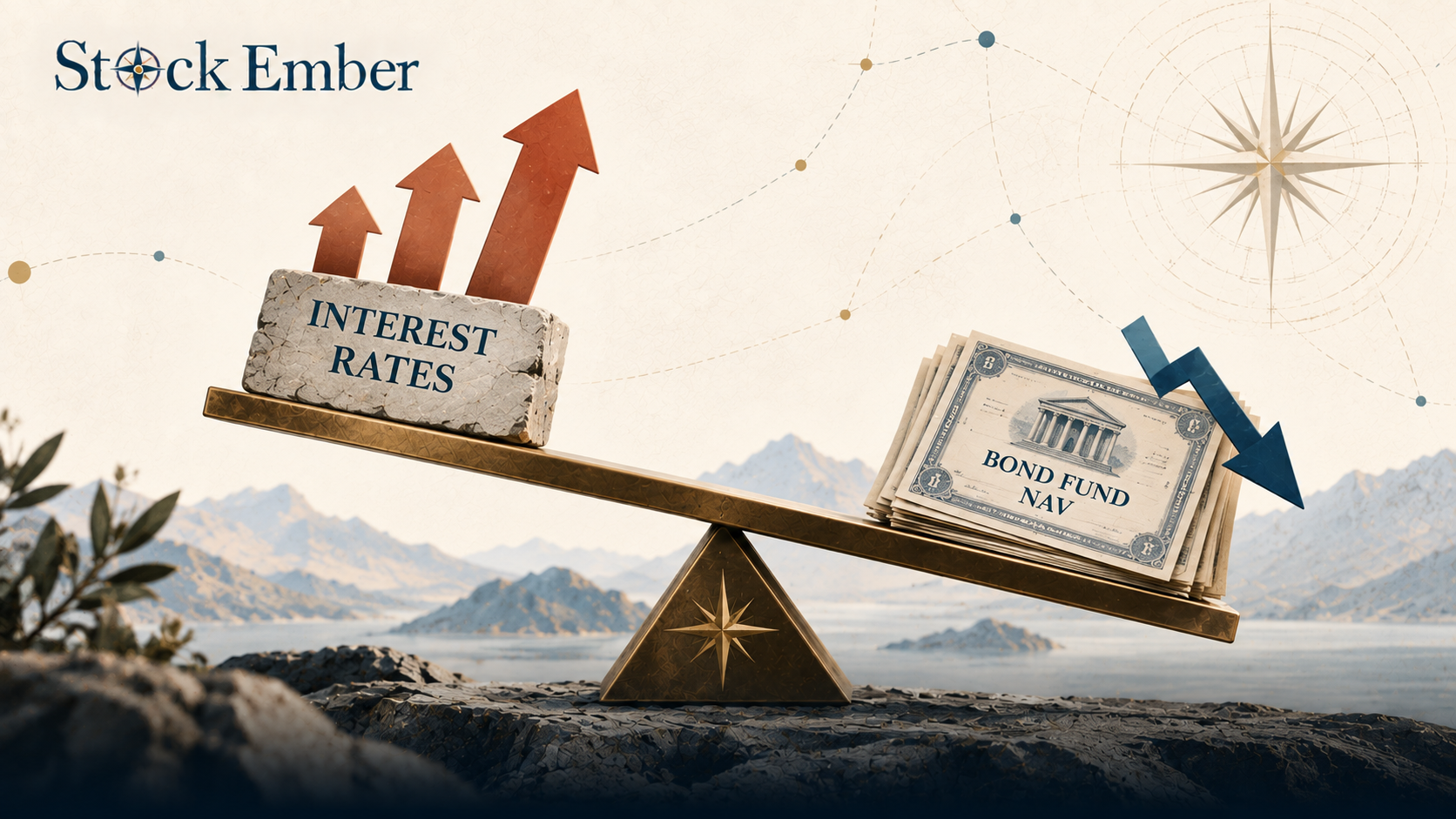
Diagram illustrating the inverse relationship between interest rates and bond fund NAV.
The most critical mechanic to understand is the inverse relationship between interest rates and bond fund values:
When interest rates rise: Newly issued bonds offer higher yield payouts. Existing bonds paying lower yields become less valuable, causing the bond fund's NAV price to fall.
When interest rates fall: Existing bonds with higher yields become more desirable, driving the bond fund's NAV price higher.
This price sensitivity is measured by duration, a number shown in years that estimates how much a fund's NAV will swing for every 1% shift in interest rates. For example, a bond fund with a five-year duration will lose roughly 5% of its NAV value if market interest rates increase by 1 percentage point.
Can you lose principal in a bond fund? Yes. While the fund collects steady interest payments, rising interest rates or corporate credit defaults can reduce the NAV below your purchase entry price.
Individual Bonds vs. Bond Funds
While both options provide fixed-income exposure, holding a single bond to maturity works differently than holding a perpetual bond fund.
Feature
Individual Bond
Bond Fund (Mutual Fund or ETF)
Maturity Date
Fixed date when full face value is repaid
No fixed maturity; operates continuously
Principal Value
Returned at par value if held to maturity
NAV fluctuates daily based on market rates
Yield & Payouts
Fixed coupon rate set at purchase
Monthly income distributions fluctuate
Diversification
Requires purchasing multiple issues
Instant access to hundreds of underlying bonds
Liquidity
Can be hard to sell before maturity
Easily traded daily at current NAV or market price
When you purchase an individual bond, you are locked in a specific yield-to-maturity (the total return earned if held until the final repayment date). As long as the issuer does not default, you receive your exact principal back when the bond matures.
A bond fund, by contrast, constantly replaces old maturing bonds with new issues to maintain its target duration. Because the portfolio is constantly rolling over, the fund never reaches a final maturity date where capital is returned in full.
The Role of Bond Funds in a 10-Year Portfolio
Over a ten-year holding period, stock markets undergo economic expansions and severe downturns. Adding broad bond funds provides portfolio ballast, smoothing total performance and reducing maximum drawdown losses when stock prices collapse.
Consider a ten-year asset allocation scenario:
Suppose an investor holds a 100% stock portfolio worth $100,000. During a severe bear market, equity prices drop by 30%, shrinking the total portfolio value to $70,000. The emotional stress often leads investors to sell at the bottom.
If that same investor holds an 80/20 allocation $80,000 in equities and $20,000 in an intermediate aggregate bond fund, the outcome looks much more stable:
Stock holdings drop 30% ($80,000 decreases to $56,000).
High-quality government bond funds often hold their value or rise during equity panics as investors seek safety.
Assuming the bond portion holds steady at $20,000, the overall portfolio drops to $76,000 a milder 24% decline.
More importantly, the bond fund acts as liquid capital for systematic rebalancing. The investor can sell $4,000 of the stable bond fund to buy discounted index stock shares, compounding growth over the remaining ten-year recovery.
In practice, many long-term index investors find that holding intermediate-term bond funds through automated monthly contributions removes the urge to guess interest rate directions. The steady monthly distributions are automatically reinvested into new shares, slowly lowering the average purchase cost over standard market cycles.
Common Pitfalls: Interest Rate & Inflation Traps
Investors often treat fixed-income allocations as completely safe, falling into predictable cognitive traps:
Confusing Distribution Yield with Guaranteed Return: A fund displaying a 5% distribution yield does not promise a 5% total return. If interest rate hikes reduce the fund's NAV by 4% during the year, your actual total return is only 1%.
Ignoring Inflation Risk: If a bond fund yields 3% while inflation runs at 4%, your real purchasing power shrinks over time. Long-term buy-and-hold portfolios need growth assets like stocks to stay ahead of living costs.
Reaching for High Yield in Bad Credit: Chasing higher monthly yield through low-rated junk bond funds increases default risk. During economic recessions, high-yield corporate bonds often drop in tandem with stocks, failing to act as reliable portfolio ballast.
Guidance from regulatory institutions like the US Securities and Exchange Commission emphasizes that investors must evaluate duration and interest rate risks before relying on fixed-income funds for stability.
Conclusion
Bond funds offer essential income, instant diversification, and valuable liquidity for rebalancing long-term portfolios. While individual bonds return principal on a set maturity date, bond fund share prices adjust daily to prevailing interest rate movements. Using low-cost bond funds as steady portfolio ballast allows investors to control overall equity risk without trading individual debt papers.
When you are ready to evaluate broad fixed-income index options for your portfolio, exploring dedicated ETF reviews provides a clear path toward efficient allocation. Because all bond fund investments carry risk of loss and past income payouts never guarantee future performance, use these concepts to guide your independent research.
FAQ
5 questions
Can you lose principal money in a bond fund?
Yes, you can lose principal in a bond fund. When market interest rates rise, the values of existing lower-yielding bonds held by the fund fall, driving down the fund's Net Asset Value (NAV). If you sell your shares when the NAV is below your purchase entry price, you realize a capital loss.
What is the main difference between an individual bond and a bond fund?
An individual bond has a fixed maturity date when the issuer repays the full principal par value, assuming no default. A bond fund operates continuously without a fixed maturity date, holding a rolling portfolio of debt securities whose overall Net Asset Value fluctuates daily with market interest rates.
How do bond funds pay income to investors?
Bond funds collect coupon interest payments from all underlying debt securities in their portfolio. After deducting operating expenses and management fees, the fund distributes this accumulated interest income to shareholders, typically as monthly cash payments.
What happens to a bond fund when market interest rates rise?
When market interest rates rise, existing bonds paying lower coupon rates become less valuable compared to newly issued bonds offering higher yields. Consequently, the market prices of the fund's existing holdings decline, causing the bond fund's Net Asset Value (NAV) per share to drop.
Why do long-term buy-and-hold investors hold bond funds?
Long-term investors hold bond funds as portfolio ballast to reduce overall drawdown volatility during severe stock market downturns. Additionally, bond funds provide steady monthly distributions and serve as liquid capital for systematic rebalancing into equity index funds during market drops.
Disclaimer
This guide was written with AI assistance and reviewed by the StockEmber editorial team for accuracy. StockEmber provides independent education, not personal financial advice. Some links may support our work at no additional cost to you.
The StockEmber Team is our in-house desk of independent research writers. We test brokerage platforms, read the fine print on fees and custody, and cover ETFs and long-horizon investing for people who plan to hold for decades — not days.