A transfer on death (TOD) account is an investment registration that names designated beneficiaries to automatically receive account assets when the owner dies. This setup allows stocks, bonds, and funds to pass directly to heirs without going through probate court. While the account owner remains alive, beneficiaries have no ownership, withdrawal, or management rights over the assets.
A transfer on death (TOD) account is a brokerage registration that automatically passes your investments to named beneficiaries when you die, completely bypassing probate court.
For long-term investors, the months spent waiting for a court to clear an estate can be stressful and expensive for heirs. By naming a beneficiary directly on the account, you make sure your portfolio transfers smoothly and stays invested. This guide covers how these accounts work, how they differ from bank rules, and the legal limits you need to watch.
Quick Takeaways
01A TOD account transfers stocks and funds directly to heirs without the delays and costs of probate court.
02Beneficiaries have zero access, ownership, or control over the money while the account owner is alive.
03A valid TOD form legally overrides conflicting instructions written in a standard will.
04Setting up a TOD avoids probate, but it does not shield the money from estate taxes or unpaid debts.
What Is a Transfer on Death Account?
To answer what is a transfer on death account, you just have to look at the legal paperwork. It is a standard brokerage account with a specific legal add-on. This form names exactly who will receive the stocks, bonds, or funds when the owner passes away.
Keep in mind, this is a one-way street during your lifetime. The people you name as beneficiaries have zero rights to the money. They cannot make trades, they cannot see your account balance, and they cannot withdraw cash. You stay in full control and can change or cancel the form at any time.
How a TOD Account Works in Practice
Setting up the process requires filling out a beneficiary form with your investment firm. You can name one person, multiple people, or even a charity, and assign a specific percentage to each.
When the owner dies, the transfer is not instant. The heirs must provide a certified death certificate to the firm. The firm then freezes the original account, opens new accounts for the heirs, and moves the assets over. In modern markets, stock trades finalize fast under T+1 settlement. Keeping the assets within the brokerage system lets heirs take control and manage the portfolio quickly, without being forced to sell everything for cash.
TOD vs. POD: Investment vs. Bank Accounts
People often mix up investment terminology with bank terminology, especially when looking for a transfer on death bank account. In the banking world, this is actually called a payable on death (POD) account.
While they do the exact same job—keeping your money out of probate court—the names depend on what is inside. When you fill out a payable on death form, you use it for cash at a bank or credit union. A TOD form applies strictly to securities like stocks and ETFs.
Feature
Transfer on Death (TOD)
Payable on Death (POD)
Account Type
Investment and brokerage accounts
Bank deposit and savings accounts
Asset Type
Stocks, bonds, ETFs, mutual funds
Cash deposits
Primary Goal
Bypass probate court
Bypass probate court
A payable on death bank account is the cash equivalent to your investment TOD, and both are easy to set up for free.
Why TOD Designations Matter for Long-Term Investors
Bypassing probate saves both time and legal fees. Probate is the legal process of validating a will. It is slow, public, and often expensive. If an estate takes six months to settle, heirs cannot manage the portfolio during a market drop. A TOD setup skips this delay entirely.
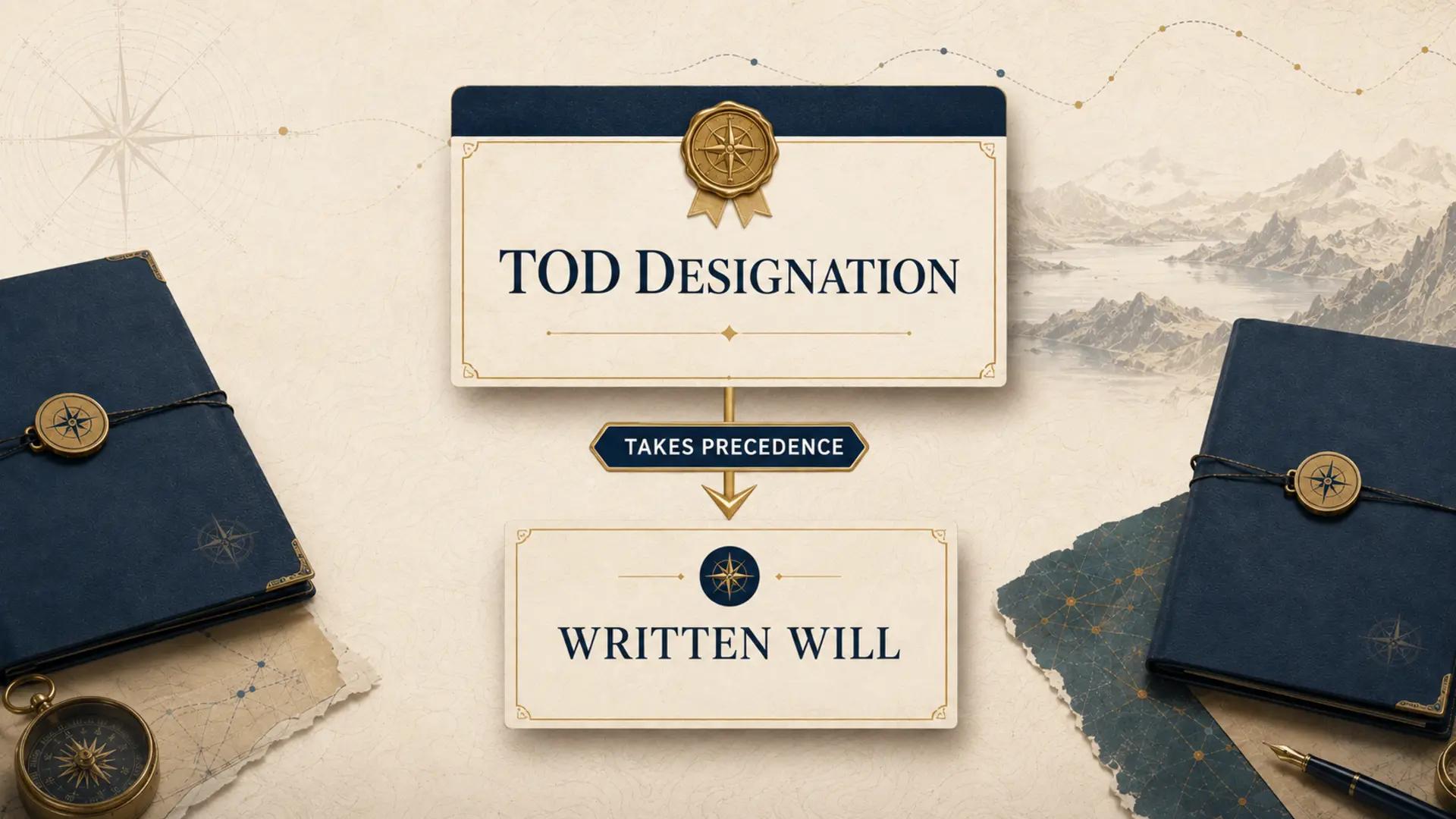
Chart showing that a transfer on death designation legally overrides a written will.
It also preserves portfolio continuity. Instead of the estate selling off stocks and causing a tax event, the shares transfer to the heirs exactly as they are. From a long-term cost view, avoiding legal probate fees keeps more of your compounding money in the family.
Additionally, the inherited shares generally receive a "step-up" in cost basis. This means the tax value resets to the price on the day the owner died, wiping out the tax on past gains.
Common Pitfalls and Legal Limitations
A TOD form avoids probate, but it does not avoid taxes or debt collectors. Many investors mistakenly think a TOD designation acts as a tax shield. It does not. The assets transferred still count as part of your total estate for federal and state tax limits. Also, if you leave behind unpaid debts, creditors can still make a legal claim against the transferred money.
The biggest pitfall is failing to update your choices. As FINRA rules outline, a valid beneficiary designation on an account generally overrides a written will. If your will leaves everything to a new spouse, but your old TOD form still names an ex-spouse, the money goes to the ex-spouse.
Conclusion
A transfer on death account designation is a simple, zero-cost way to make sure your investments pass smoothly to the right people. It keeps your portfolio out of probate court and gives your heirs faster access to the assets. When you are ready to choose where to hold your investments, our broker reviews & rankings are the place to start.
Investing always puts your money at risk, and account rules vary by legal jurisdiction, so treat this as an educational starting point, not formal estate advice.
FAQ
4 questions
What is a Transfer-on-Death (TOD) account designation?
A TOD designation allows a brokerage account owner to name specific beneficiaries who will automatically inherit the account assets upon the owner's death, bypassing the lengthy and costly probate court process.
Does a TOD designation override instructions written in a will?
Yes. Assets with a named TOD beneficiary transfer directly to the named individual upon death, taking legal precedence over conflicting instructions in a last will and testament.
Can I change or remove a TOD beneficiary after setting it up?
Yes. You retain full ownership and control over the account during your lifetime, including the right to change, update, or revoke beneficiary designations at any time without needing the beneficiary's consent.
Are TOD beneficiaries personally responsible for the deceased owner's debts?
Beneficiaries do not directly inherit personal debt. However, creditors may still make legal claims against estate assets—including TOD accounts—if the remaining probate estate lacks sufficient funds to settle unpaid debts.
Disclaimer
This guide was written with AI assistance and reviewed by the StockEmber editorial team for accuracy. StockEmber provides independent education, not personal financial advice. Some links may support our work at no additional cost to you.
The StockEmber Team is our in-house desk of independent research writers. We test brokerage platforms, read the fine print on fees and custody, and cover ETFs and long-horizon investing for people who plan to hold for decades — not days.