T+1 settlement is a financial trade rule where cash transfer and legal security ownership complete officially one business day after an order executes. Replacing the previous T+2 cycle across major markets, it gives sellers faster access to settled capital while requiring buyers to have funds available immediately.
T+1 settlement is a financial rule where cash and share ownership transfer officially one business day after a trade executes. It replaced the older T+2 cycle across major US asset markets.
When you sell a stock on Monday, waiting days for funds to clear can delay your next financial move. Shortening this window improves liquidity, but it also alters how you manage cash balances before placing new orders. This guide explains how T+1 trade settlement works, what changed for everyday investors, and how to avoid account timing pitfalls.
Quick Takeaways
01Trade date (T) is when your order fills, while settlement date (T+1) is when money and legal ownership change hands.
02Selling shares gives you available settled cash in one business day instead of two.
03Cash accounts require settled funds to buy new shares without triggering trading restrictions.
04Long-term investors benefit from faster portfolio rebalancing and lower counterparty exposure.
What Is T+1 Settlement?
T+1 settlement means that trade settlement takes place exactly one business day after an order executes. If you ask what is t+1 settlement in practical terms, it is the standard timeline for delivering payment to the seller and transferring stock certificates to the buyer. The letter "T" stands for trade date—the moment your buy or sell order gets filled in your brokerage account. The "+1" signifies the single business day required to complete final clearing.
This cycle applies to individual stocks, exchange-traded funds (ETFs), corporate bonds, and municipal bonds across US financial exchanges. On May 28, 2024, the US Securities and Exchange Commission (SEC) shortened the standard US market cycle from T+2 to T+1. Whether referenced as t 1 settlement or the single-day settlement standard, the rule ensures that cash and securities swap legal ownership far faster than in previous market eras.
How the T+1 Settlement Cycle Works
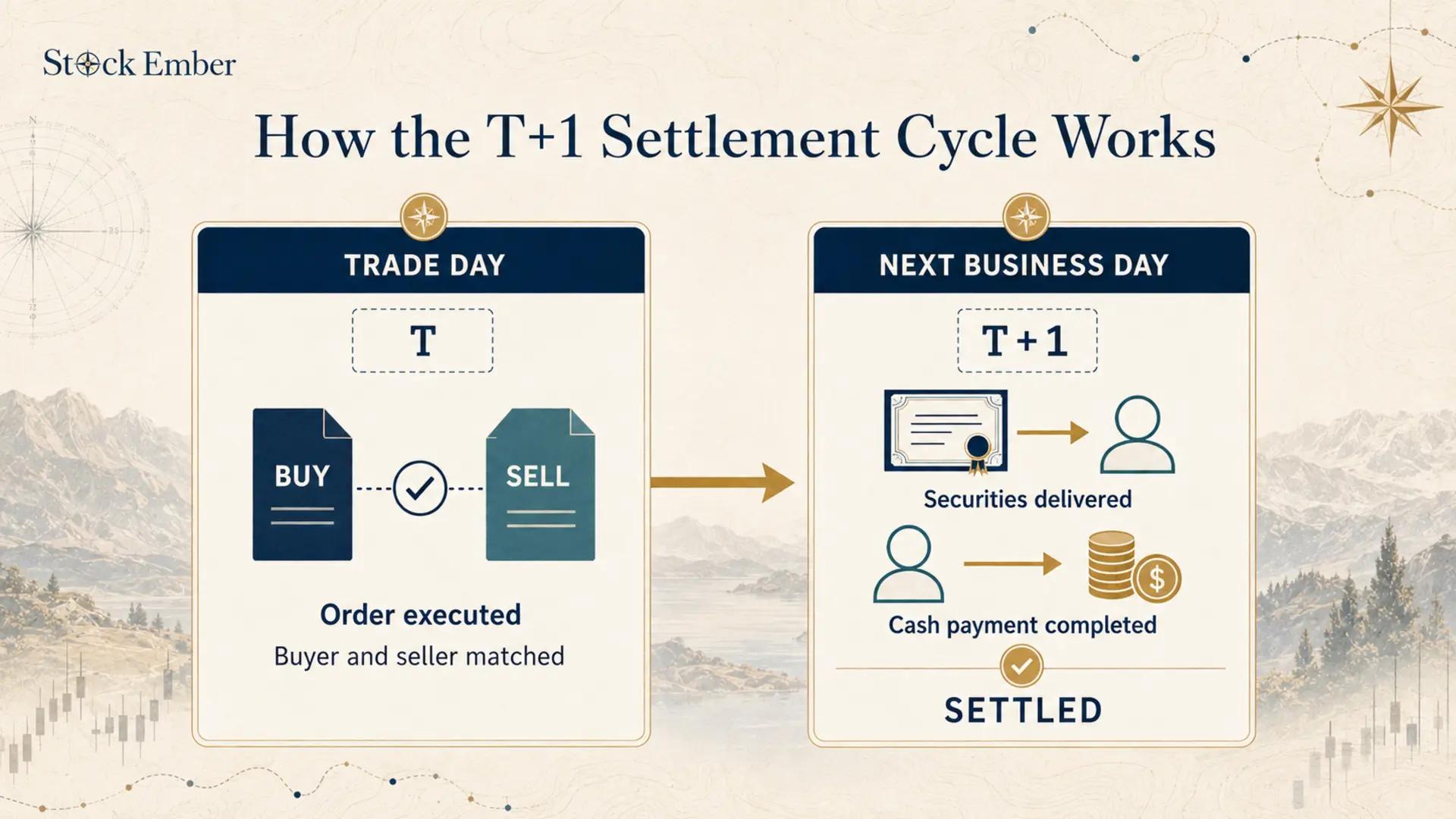
The t+1 settlement cycle functions through centralized clearinghouses that process transactions behind the scenes after market hours. When your brokerage order matches with a seller, execution happens instantly on your screen, but the actual transfer of money and title takes 24 business hours.
Diagram illustrating trade execution on trade date T and settlement completing on day T plus 1.
During this 24-hour window, clearing agencies match buy and sell records across participating institutions. Cash shifts from the buyer's broker to the seller's broker, while legal ownership updates in central repositories.
Business days control this calendar strictly:
Market Days: Standard business days (Monday through Friday) count toward the 24-hour settlement timeline.
Weekends and Holidays: Stock exchange holidays and weekends pause the clock. A trade executed on Friday afternoon settles on Monday morning, assuming Monday is not an exchange holiday.
What the T+1 Settlement Change Means for Investors
The t+1 settlement change offers distinct operational advantages for buy-and-hold investors without requiring complex daily tracking. Getting cash one day earlier after selling an asset reduces the time funds sit inactive between investments.
Faster settlement improves cash flow when rebalancing a long-horizon portfolio. For example, if you conduct strategy shifts like direct indexing tax loss harvesting, you can sell underperforming shares and reallocate those funds into target index funds one day faster. Shorter settlement times also decrease market counterparty risk—the chance that a clearing participant fails to deliver cash or shares before final settlement completes.
A Concrete T+1 Settlement Example
To understand this mechanism, review a simple t+1 settlement example showing trade timing across a typical week:
Step
Day & Time
Action / Status
Trade Execution (T)
Monday, 10:00 AM
You sell 50 shares of an equity holding in your account. The order fills immediately.
Clearing Processing
Monday Night
Central clearinghouses reconcile trade records between brokerages.
Final Settlement (T+1)
Tuesday, Market Open
Shares exit your account, legal cash ownership transfers, and settled cash is ready.
If you sell on Monday morning, your cash becomes fully settled by Tuesday morning. You can use these settled funds to buy another stock on Tuesday without waiting until Wednesday. However, if you plan to transfer that money out to your bank account, your broker may still require an extra day for electronic bank ACH processing.
Common Pitfalls and Operational Considerations
While faster trade completion provides faster access to capital, investors must mind cash account rules:
Good Faith Violations: In cash accounts, buying a stock with unsettled proceeds from a recent sale and then selling that new stock before the original sale settles triggers a regulatory rule breach known as a good faith violation.
Funding Timing Mismatches: Because settlement moves faster, buying shares requires settled cash in your account right away. Initiating a bank transfer on the day you place a buy order might cause a payment failure if bank processing lags behind trade settlement.
Cross-Border Exchange Lags: Investors buying international stocks or converting foreign currency must align currency conversion schedules with local market settlement cycles, which may still operate on differing timelines.
Conclusion
The shift to t+1 settlement streamlines market infrastructure, giving buy-and-hold investors quicker access to capital and reducing operational exposure across markets. While execution speed remains distinct from asset delivery, holding a clear grasp of trade dates versus settlement dates helps you manage cash transfers smoothly.
When you are ready to evaluate brokerages that support efficient trade clearing and account management, our Broker reviews & rankings offer a helpful starting point. Investing always involves market risk and past performance does not assure future results, so use this operational guide to inform your portfolio management rather than as individual financial advice.
FAQ
4 questions
What does T+1 settlement mean for retail stock investors?
T+1 stands for "Trade Date plus one business day." It means that official ownership transfer and cash settlement occur one business day after a trade is executed.
How does T+1 settlement benefit individual investors?
Faster settlement reduces credit and market risk across the financial system and gives investors quicker access to cash after selling securities.
Can I withdraw cash immediately after selling a stock under T+1?
You must wait one full business day for the cash to officially settle in your account before you can transfer those funds out to a bank.
Do weekends and public holidays count toward T+1 settlement?
No. T+1 counts business days only. If you sell a stock on Friday, the transaction settles on Monday, assuming Monday is not a market holiday.
Disclaimer
This guide was written with AI assistance and reviewed by the StockEmber editorial team for accuracy. StockEmber provides independent education, not personal financial advice. Some links may support our work at no additional cost to you.
The StockEmber Team is our in-house desk of independent research writers. We test brokerage platforms, read the fine print on fees and custody, and cover ETFs and long-horizon investing for people who plan to hold for decades — not days.