A stock transfer agent is a financial institution appointed by a public corporation to track official shareholder records, issue and cancel share certificates, and distribute dividends. They act as the official registrar for the issuing company, maintaining the master registry of legal security holders.
A transfer agent is a financial institution appointed by a public corporation to maintain its official ownership records, issue or cancel share certificates, and handle distributions to shareholders.
When you buy shares online, you rarely interact with the company issuing the stock. Instead, your broker handles trades behind the scenes. Understanding what a stock transfer agent does helps you see how shareholder records work, how legal stock ownership is tracked, and how direct share registration differs from typical brokerage accounts.
Quick Takeaways
01It maintains a corporation's official register of legal shareholders.
02They handle administrative tasks like dividend payments, stock splits, and proxy voting materials.
03Holding shares directly with a transfer agent grants legal title, whereas brokers hold shares in "street name".
04Transfer agents focus on recordkeeping for issuing companies, not fast trading execution for retail investors.
What Is a Stock Transfer Agent?
A transfer agent is a third-party bank, trust company, or specialized service provider hired by a publicly traded company. Its core job is to keep precise records of who owns the company’s stock at any given moment.
If you wonder what a stock transfer agent is from a legal standpoint, think of it as the company's official registrar. The agent maintains the official master security holder file, tracking every individual or institutional investor who holds legal title to the company’s equity. Under regulations managed by the U.S. Securities and Exchange Commission (SEC), these institutions ensure that the total number of issued shares matches official corporate filings exactly.
It is important to note a key distinction: a transfer agent acts on behalf of the corporation that issues the stock. In contrast, a stockbroker works on behalf of you, the individual investor.
Core Functions: What Does a Transfer Agent Do?
While retail investors rarely talk to a transfer agent daily, these institutions manage essential corporate transactions behind the scenes. Their core responsibilities include:
Maintaining Ownership Registers: They track legal owners, addresses, tax identification, and share balances in electronic book-entry format.
Issuing and Canceling Certificates: When shares are bought, sold, or gifted, the agent records the ownership change and cancels old stock certificates or updates digital books.
Distributing Dividends and Interest: Issuing corporations send funds to their transfer agent, who then sends dividend payouts directly to registered owners.
Managing Proxy Materials: They send annual reports, voting ballots, and corporate governance materials to eligible shareholders before annual meetings.
Processing Corporate Actions: During stock splits, spinoffs, or corporate mergers, the agent adjusts share counts across all accounts on the master register.
Direct Registration (DRS) vs. Holding in "Street Name"
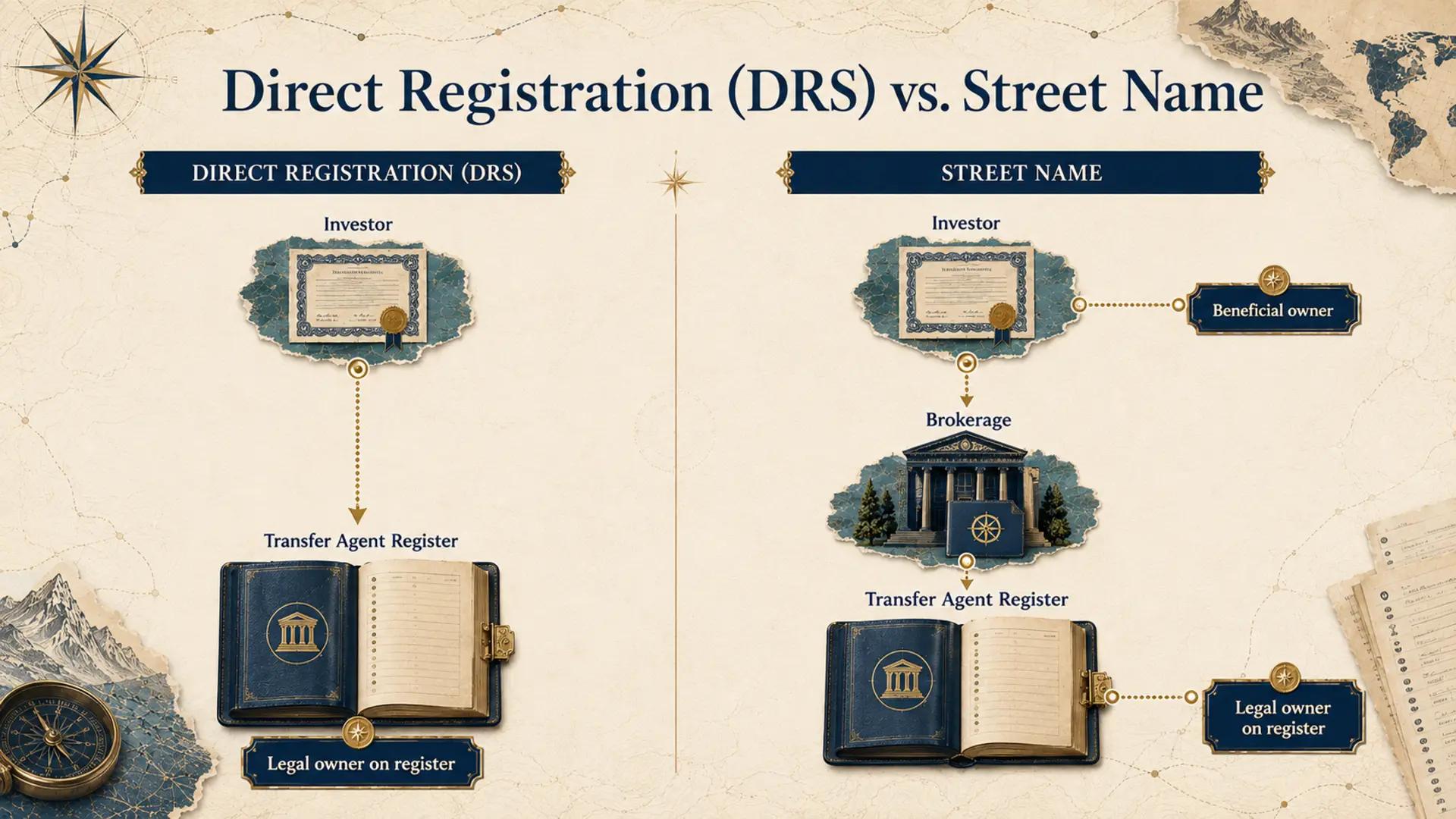
To understand how stock records work, you must look at how your shares are held. Most retail investors buy stock through a standard brokerage account. When you hold shares in a brokerage, the broker holds them in "street name". This means the broker's name appears on the transfer agent’s official book, while you remain the beneficial owner on your broker’s internal records.
Alternatively, you can hold shares directly through the Direct Registration System (DRS). Under DRS, your name is listed directly on the issuer’s master registry maintained by the transfer agent.
Comparison diagram of transfer agent direct registration versus brokerage street name holding
Direct legal ownership on the issuing corporation's books
Transferring Shares Between Transfer Agents and Brokers
Moving your stock between a brokerage and an official registry is a routine administrative process. If you want to move shares from your broker to an official registry, you request a DRS transfer. Your broker communicates electronically with the issuer's transfer agent to move the legal title into your name.
If you later decide to sell those shares quickly on an exchange, you can move them back. You can request an ACATS transfer (Automated Customer Account Transfer Service) or a DRS withdrawal through your broker to return the securities to street name status. This electronic link ensures direct movement between official registries and active trading accounts.
Trade-Offs for Long-Term Investors
Holding shares directly with a transfer agent comes with clear operational trade-offs compared to holding them in a brokerage account.
Trading Speed and Execution: Selling shares registered with a transfer agent is often slower. Orders may be batched once a day or processed over several business days, creating execution delay risk during volatile markets.
Fee Structures: While holding shares is usually free, selling or transferring shares through a transfer agent can incur direct transaction fees. Over ten years, paying individual transfer fees on small transactions can slowly erode portfolio returns.
Portfolio Convenience: If you own stocks in ten different companies, you might have to deal with three or four different transfer agents. A brokerage account consolidates all your holdings onto a single dashboard.
Conclusion
A transfer agent serves as the legal foundation for equity ownership, ensuring corporate share registers stay accurate and secure. While street-name holding at a broker fits the needs of most buy-and-hold investors due to trading speed and consolidated account views, knowing how transfer agents operate gives you full visibility into your rights as a shareholder.
When you are ready to compare account structures and trading access, our Broker reviews & rankings offer a practical place to start your research. Keep in mind that investing always carries the risk of loss and past returns never promise future performance, so treat this guide as an educational foundation for your own portfolio decisions.
FAQ
4 questions
What is a stock transfer agent and what do they do?
A transfer agent is a third-party organization hired by a corporation to maintain official records of shareholder ownership, issue share certificates, and distribute dividends.
How does a transfer agent differ from a stock brokerage?
A broker holds shares on your behalf in "street name" for quick trading. A transfer agent records your ownership directly on the issuing company's official books.
What is the Direct Registration System (DRS)?
DRS is an electronic system that allows investors to hold securities directly on the books of the transfer agent in their own name, without needing paper certificates.
Can you buy stock directly from a company through a transfer agent?
Yes, if the company offers a Direct Stock Purchase Plan (DSPP) or Dividend Reinvestment Plan (DRIP) managed by its transfer agent.
Disclaimer
This guide was written with AI assistance and reviewed by the StockEmber editorial team for accuracy. StockEmber provides independent education, not personal financial advice. Some links may support our work at no additional cost to you.
The StockEmber Team is our in-house desk of independent research writers. We test brokerage platforms, read the fine print on fees and custody, and cover ETFs and long-horizon investing for people who plan to hold for decades — not days.