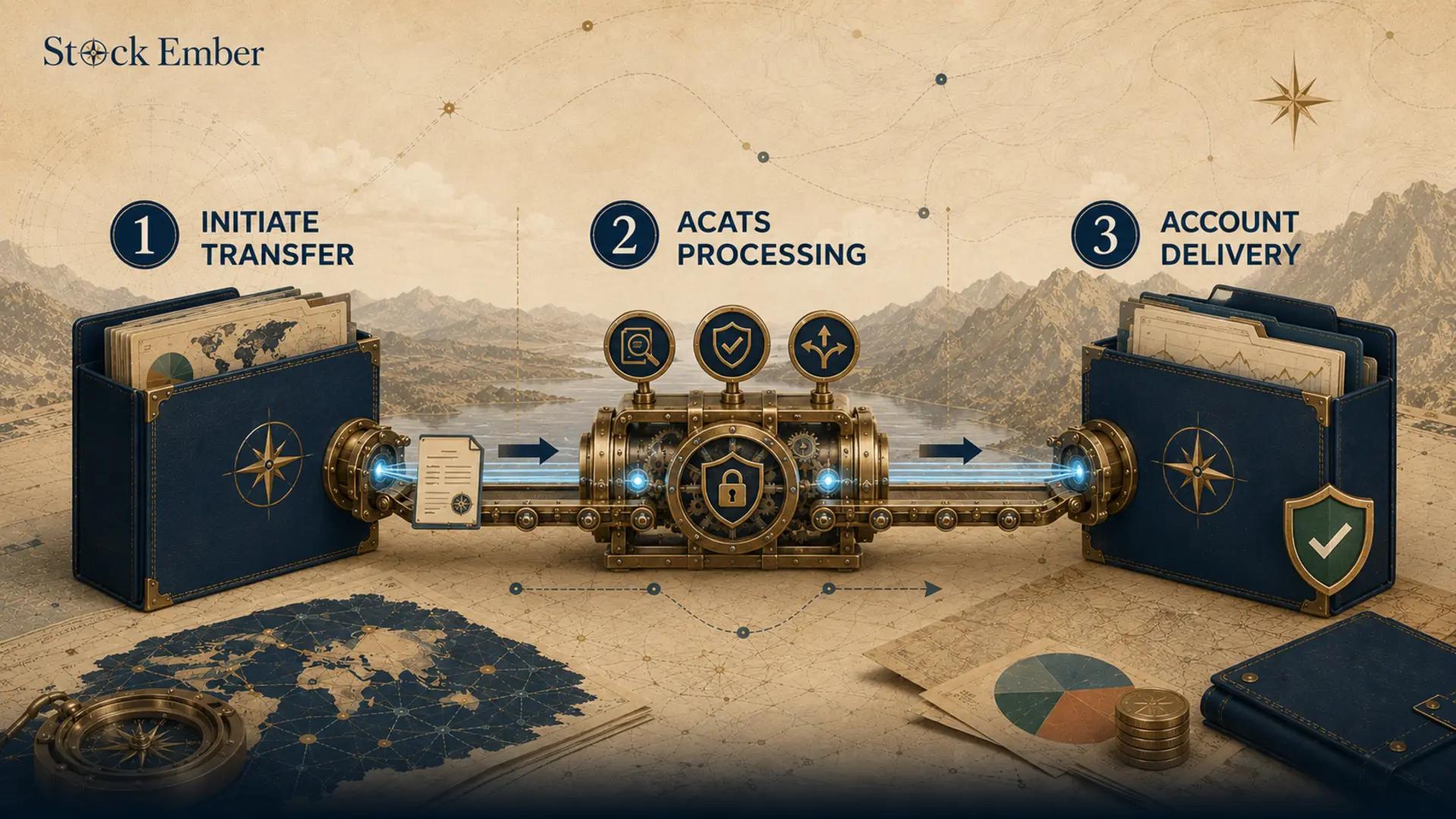
An ACATS transfer (Automated Customer Account Transfer Service) is an automated system managed by the NSCC that transfers investment positions and cash directly between US brokerages. By moving assets in-kind, investors maintain their original cost basis and avoid realizing taxable capital gains. Most standard full account transfers complete within three to six business days under FINRA Rule 11870.
An ACATS transfer (Automated Customer Account Transfer Service) is a standardized electronic system that moves stocks, ETFs, mutual funds, and cash directly from one US brokerage to another without selling your investments.
Switching investment platforms often raises concerns about paying taxes or missing market days. Liquidating positions creates capital gains taxes that drag down compound growth over decades. Understanding how an ACATS transfer works helps you consolidate portfolio holdings safely, preserving cost basis while switching providers. This guide explains how automated transfers work, expected fees, and how to avoid processing delays.
Quick Takeaways
01ACATS transfers move investments directly between brokerages without liquidating them.
02Moving assets in-kind preserves your original cost basis and avoids triggering capital gains taxes.
03Most standard portfolio transfers take three to six business days to complete.
04Outgoing broker fees average $50 to $100, though receiving brokers often offer fee reimbursements.
What Is an ACATS Transfer?
The Automated Customer Account Transfer Service, commonly shortened to ACATS, is a centralized system operated by the National Securities Clearing Corporation (NSCC). Built to standardize asset handoffs across US financial institutions, the system allows investors to relocate full or partial portfolios between regulated brokers.
Diagram showing an automated account transfer between two brokerages
When you initiate a transfer through the ACATS network, the clearing house coordinates asset delivery behind the scenes. Rather than selling your holdings, conversion occurs electronically at the custodian level. This automated clearing network handles equities, exchange-traded funds, mutual funds, options, corporate bonds, and uninvested cash reserves across member firms.
How the ACATS Process Works Step-by-Step
Initiating an asset transfer always begins at the firm receiving your money. You open a new brokerage account with your chosen provider and request an incoming transfer rather than contacting your old firm.
To start the request, you submit a Transfer Initiation Form (TIF) alongside a recent statement from your delivering account. The receiving broker submits this electronic request directly to the NSCC clearing system.
Under FINRA Rule 11870, delivering brokers must validate or reject transfer requests within one business day. Once validated, the delivering firm completes asset delivery within three additional business days. The entire sequence usually takes three to six business days from start to finish.
In-Kind Transfer vs. Forced Cash Liquidation
The main advantage of an ACATS move is executing an in-kind transfer. Moving assets in-kind shifts ownership records for every stock or ETF share directly to your new account without closing positions. Because no assets are sold, you avoid triggering capital gains tax realization events.
Your original cost basis records move with each security, retaining historical purchase prices for future tax calculations. Every stock identified by its unique ticker symbol lands safely in your new ledger intact.
However, certain assets cannot move via in-kind processing:
Fractional Shares: Most firms liquidate fractional share balances into cash before completing the handoff.
Proprietary Mutual Funds: Brokerage-specific funds often cannot exist on external platforms and require selling.
Unsupported Assets: Cryptocurrencies, physical metals, and over-the-counter assets must remain behind or be sold.
Timelines, Outgoing Fees, and Account Freezes
While receiving brokers usually charge zero incoming fees, delivering brokers frequently charge an outgoing transfer fee — commonly cited by FINRA-member firms as ranging from $50 to $100 — though this varies by broker.
A $75 transfer fee might look modest on paper. But for a $10,000 account, taking $75 out of invested principal removes compounding power over time. Assuming a 7% average annual growth rate, that single $75 fee removes roughly $147 from your total portfolio balance over a 10-year horizon. Many receiving platforms offer fee reimbursement programs to offset this cost drag—always check if your new broker offers to cover outgoing charges.
Common ACATS Pitfalls and Residual Sweeps
Transfer requests fail or face delays when account details do not match perfectly across institutions. The main causes for rejection include:
Name, Social Security number, or account type mismatches between delivering and receiving accounts.
Unsettled trades or pending cash deposits inside the delivering account.
Outstanding margin loans or unresolved options assignments.
If dividends, interest payments, or proxy settlement checks arrive at your old firm after the transfer completes, you do not need to submit a new request. Per NSCC's ACATS residual-asset procedures, clearing systems automatically run periodic sweep cycles for up to six months after the transfer, moving late-arriving cash balances to your new account without additional fees.
Conclusion
Executing a full acats transfer remains one of the most tax-efficient strategies for consolidating investment accounts, since it avoids unnecessary income taxes. By preserving original cost basis data and avoiding forced market liquidations, buy-and-hold investors maintain long-term compounding momentum while switching custodians.
When you are ready to evaluate platforms, our Broker reviews & rankings offer clear comparisons on fee reimbursements and platform features. Investing always carries risk of loss and past returns do not guarantee future growth, so treat this educational guide as part of your broader financial research.
FAQ
3 questions
Does moving assets through an ACATS transfer trigger capital gains taxes?
No. Because assets move "in-kind" (as shares rather than cash), you do not sell your positions, meaning no taxable capital gains event is created.
How long does an ACATS account transfer usually take?
An ACATS transfer typically completes within 3 to 6 business days, depending on the response speed of the delivering brokerage firm.
Are there fees for using an ACATS transfer to switch brokers?
The brokerage you leave often charges an outgoing transfer fee, but many receiving brokerages offer to reimburse this fee when you move your portfolio to them.
Disclaimer
This guide was written with AI assistance and reviewed by the StockEmber editorial team for accuracy. StockEmber provides independent education, not personal financial advice. Some links may support our work at no additional cost to you.
The StockEmber Team is our in-house desk of independent research writers. We test brokerage platforms, read the fine print on fees and custody, and cover ETFs and long-horizon investing for people who plan to hold for decades — not days.