Retained earnings represent the cumulative net profits a company keeps after paying out cash dividends to shareholders. Recorded under shareholders' equity on the balance sheet, this figure reflects historical earnings reinvested back into expanding operations or paying down corporate debt.
Retained earnings represent the cumulative net profits a company keeps after paying out cash dividends to its shareholders. It reflects historical profits reinvested back into the business over time.
When evaluating companies, investors often look at top-line earnings, but how a company manages its accumulated profit determines long-term value creation. A business that holds onto its earnings must deploy that capital efficiently to expand operations, pay down debt, or upgrade equipment. This guide explains what this figure means, where they sit on the balance sheet, how to calculate them, and why they matter for long-term investors.
Quick Takeaways
01This running total measures the running total of all profits a business has saved since its founding, minus all dividend distributions paid to owners.
02This balance sits on the balance sheet under shareholders' equity, reflecting an accounting claim rather than cash in a bank account.
03A negative retained earnings balance is called an accumulated deficit, indicating multi-year net operational losses or excessive dividend payouts.
04Long-term investors monitor this figure to evaluate whether management generates more than $1.00 of market value for every dollar kept in the business.
What Are Retained Earnings? Definition & Balance Sheet Role
In corporate accounting, the retained earnings definition refers to the portion of cumulative net profits that a company chooses to retain rather than distribute as dividends. Understanding the retained earnings meaning goes beyond a definition, it requires recognizing that every dollar of profit earned by a business faces a fundamental choice.
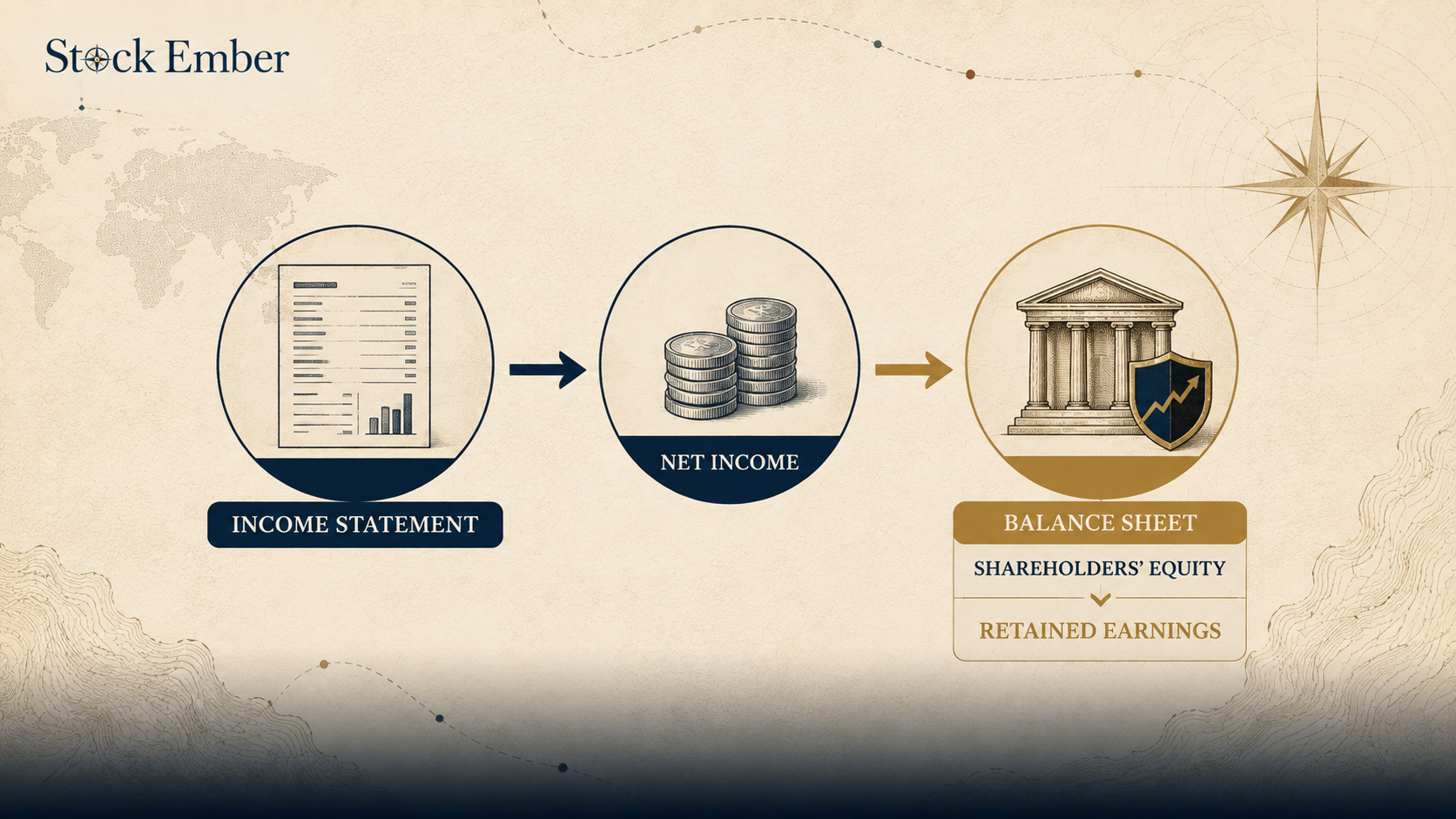
When asking what is retained earnings on a balance sheet, you can find this figure listed under the shareholders' equity section, alongside common stock and additional paid-in capital. It connects the income statement (which measures single-period net profit) to the balance sheet (which tracks cumulative asset and equity claims over time).
For anyone building foundational knowledge when investing in stocks, tracking this metric helps clarify how a business accumulates wealth over many years. It shows how growth can happen without relying entirely on outside bank loans or issuing new equity shares.
Diagram illustrating net income flowing into retained earnings under shareholders' equity.
Is Retained Earnings an Asset? Clearing Up the Myth
Addressing whether retained earnings are an asset requires clearing up one of the most common misconceptions in fundamental financial analysis: they are not an asset, nor is it cash sitting in a corporate bank account.
This equity account records the historical origin of the company's net worth. When a company earns $1 million in profit, its cash asset account increases, and its corresponding equity account increases by the same amount. However, over time, that cash is often spent on inventory, office property, or research expenses. Consequently, a company can report billions of dollars here on paper while holding very little liquid cash in its bank account.
How to Calculate Retained Earnings: The Formula
Companies calculate this ending balance at the close of every reporting period by adding current net profit to the beginning retained balance and subtracting all dividend distributions.
The standard formula is written as:
Ending Retained Earnings = Beginning Retained Earnings + Net Income − Cash Dividends
To illustrate how this works, consider a simple balance sheet walk-through:
Beginning Balance: Suppose a company starts the year with $500,000 in this account.
Net Income Addition: During the year, the business earns $150,000 in net profit on its income statement.
Dividend Subtraction: The board of directors approves a $40,000 cash dividend payout to shareholders.
Using the formula, the ending balance equals $610,000 ($500,000 + $150,000 − $40,000). If the company suffered a net loss of $50,000 instead of earning a profit, that loss would reduce the ending balance to $410,000 ($500,000 − $50,000 − $40,000).
Why Retained Earnings Matter for Buy-and-Hold Investors
For long-term buy-and-hold investors, evaluating this trend reveals how effectively management acts as a capital allocator over a ten-year horizon.
When a business generates high profit margins such as a strong gross margin, it retains substantial capital that can be used to drive self-funded expansion. According to general accounting guidelines outlined by the SEC, shareholders' equity reflects the cumulative owner value built up within the firm over successive operating periods.
Over a ten-year holding period, a successful business should create more than $1.00 of market value for every $1.00 of profits it retains. If a company retains $10 million in earnings over ten years but its market value or overall earnings power fails to grow, management may be wasting capital on unprofitable projects rather than returning cash to shareholders through dividends.
In practice, many long-term investors compare a company's ten-year growth in this figure against its return on capital. This comparison provides a clear picture of whether management is building lasting enterprise value or holding cash inefficiently.
Common Retained Earnings Red Flags
Tracking multi-year balance sheet trends helps highlight capital management issues before they impact share price performance:
Accumulated Deficit: A negative balance here means cumulative historical losses exceed total profits. While common for early-stage technology or biotech startups spending heavily on development, an accumulated deficit in a mature company indicates chronic unprofitability.
Debt-Funded Dividend Payouts: If a company pays out cash dividends that exceed its current net income, it drains its accumulated reserve. Continuing this pattern while taking on debt to sustain dividend levels often leads to sudden payout cuts.
Stagnant Profit Growth despite Profit Retention: When a firm continuously accumulates earnings without generating higher future sales or earnings per share, management may be holding idle capital rather than deploying it effectively.
Red Flag
What It May Signal
Accumulated Deficit
Persistent historical losses or prolonged unprofitability
Debt-Funded Dividend Payouts
Dividend levels may be difficult to sustain
Stagnant Profit Growth despite Profit Retention
Retained capital may not be generating stronger future earnings
Conclusion
This measure reflects the total historical profit a business has chosen to save and reinvest rather than pay out to shareholders. While listed under shareholders' equity on the balance sheet, they represent an ownership claim on assets rather than a liquid cash pile.
By tracking how this balance grows alongside long-term net profits, you can evaluate whether a company successfully compounds capital over time. When you are ready to choose an investment platform to build your equity portfolio, our broker reviewsoffer a clear breakdown of account options and trading platforms. Always remember that past performance does not guarantee future results, and all stock investments involve the risk of capital loss.
FAQ
5 questions
What are retained earnings?
Retained earnings are the cumulative net profits a business retains over time rather than distributing to owners as dividends. They represent internal capital available to fund ongoing corporate growth, debt reduction, or asset upgrades.
Is retained earnings an asset?
No, retained earnings is an equity account on the balance sheet, not a cash asset or bank account. While net profits increase cash when earned, those funds are frequently spent on equipment, inventory, or operational costs over time.
What is retained earnings on a balance sheet?
On a balance sheet, retained earnings are listed under the shareholders' equity section. It acts as an accounting link connecting historical net income from the income statement to the overall net worth of the company.
How do you calculate retained earnings?
Retained earnings are calculated using the formula: Ending Retained Earnings = Beginning Retained Earnings + Net Income − Cash Dividends. A net loss during the reporting period reduces the ending balance.
What does a negative retained earnings balance mean?
A negative retained earnings balance is known as an accumulated deficit. It occurs when a company's cumulative historical losses exceed its total lifetime earnings, which is common in early-stage growth companies.
Disclaimer
This guide was written with AI assistance and reviewed by the StockEmber editorial team for accuracy. StockEmber provides independent education, not personal financial advice. Some links may support our work at no additional cost to you.
The StockEmber Team is our in-house desk of independent research writers. We test brokerage platforms, read the fine print on fees and custody, and cover ETFs and long-horizon investing for people who plan to hold for decades — not days.