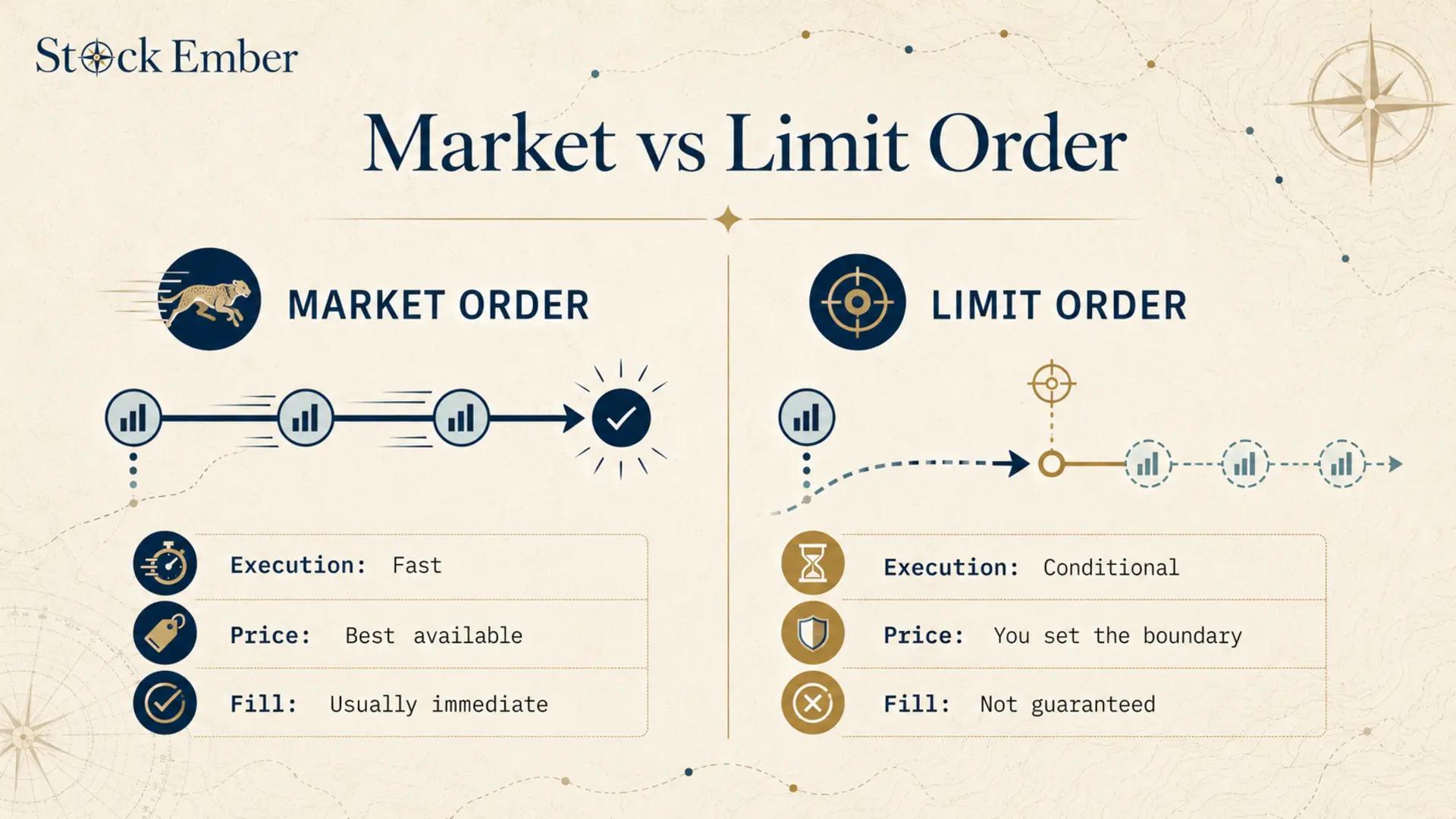
A market order executes a stock or ETF trade immediately at the best current available price, prioritizing execution speed. In contrast, a limit order sets a maximum purchase price or minimum sale price, prioritizing price control but risking non-execution if market prices move away.
A market order buys or sells an asset immediately at current market prices, while a limit order buys or sells only at a specific price or better. The core difference is execution speed versus price control.
When you set up your portfolio, choosing the right trade setting determines how your trades execute. Choosing an order type can feel confusing when prices move fast during open trading hours. Picking the wrong option can cause unexpected costs or leave your trade unexecuted. This guide compares how both order types work, their trade-offs, and when long-horizon investors use each.
Quick Takeaways
01Market orders prioritize speed, filling your trade right away at the best price available in the market.
02Limit orders prioritize price control, setting a strict cap on what you pay or a floor on what you receive.
03A market order does not guarantee a specific price, while a limit order does not guarantee execution.
04Long-term index investors usually prefer market orders for broad ETFs during normal trading hours due to high market liquidity.
What Is a Market Order?
A market order is an instruction to buy or sell a security immediately at the current market price. This order type prioritizes speed over exact pricing, ensuring that your order fills as quickly as possible during market hours.
When you send a market order, your broker sends it to an exchange where it matches against existing offers. You accept whatever price sellers are asking (if you are buying) or whatever price buyers are offering (if you are selling). In liquid markets—such as major U.S. index funds—your trade fills almost instantly.
However, the price you see on your screen when placing the order is not locked in. Market conditions can shift in milliseconds. The difference between the expected price and the actual execution price is called slippage. Slippage happens most often during fast market swings, near market open, or when trading low-volume single stocks with a wide bid-ask spread (the gap between buying and selling prices).
What Is a Limit Order?
A limit order is an instruction to buy or sell a security at a specified price or better. This order type prioritizes price control over execution speed, protecting you from paying more than your target price.
A buy limit order sets the maximum price you are willing to pay per share. A sell limit order sets the minimum price you are willing to accept. According to official trading rules from the U.S. Securities and Exchange Commission, your trade will only execute if the market price reaches your specified threshold or better.
The trade-off for price protection is non-execution risk. If the stock price moves away from your limit price, your order stays unexecuted. For long-term investors, an unfilled limit order on an upward-trending fund can lead to cash drag, where uninvested cash sits idle while market prices rise.
Diagram showing how market orders fill immediately while limit orders wait for a target price.
Market vs Limit Order: Key Differences Compared
Comparing a limit vs market order comes down to balancing execution certainty against price control. Selecting an order type market vs limit depends on whether speed or price precision matters more for your trade.
When you open a brokerage account to build wealth over decades, keeping trades simple helps maintain consistency. While setting up your account, adding a beneficiary designation secures your asset transfers, but managing trade execution protects your everyday purchase costs.
Feature
Market Order
Limit Order
Primary Goal
Immediate execution speed
Strict price control
Fill Certainty
Filled promptly (during open market hours)
Filled only if price target is met
Price Certainty
None; subject to slippage
Price is capped or better
Key Risk
Slippage in volatile markets
Unfilled or partial fill orders
Best Used For
Highly liquid stocks and ETFs
Volatile stocks, off-hours, illiquid assets
When to Use Each Order Type as a Long-Term Investor
Long-term buy-and-hold investors face different trading conditions than short-term traders. Understanding how execution dynamics match your strategy prevents unnecessary trading friction.
Use a Market Order When:
You hold broad market ETFs: Popular index funds trade millions of shares daily with penny-wide spreads, making slippage minimal.
Execution certainty matters: If you deposit monthly funds to dollar-cost average, getting your cash invested immediately is often more important than saving two cents per share.
Trading during regular hours: Placing orders mid-day avoids the opening and closing market volatility where prices jump rapidly.
Use a Limit Order When:
Trading volatile or illiquid assets: Small-cap stocks or low-volume funds can have wide bid-ask spreads where a market order could fill at a bad price.
Placing trades outside regular hours: Pre-market and after-hours trading have fewer buyers and sellers, increasing price swings.
Setting strict buy targets: If you only want to purchase a stock if it dips to a specific valuation, a limit order enforces your discipline.
Conclusion
Choosing between a market vs limit order depends on whether your priority is immediate entry or price protection. Market orders ensure your money gets invested without delay, while limit orders give you firm boundaries on what you pay. For most buy-and-hold investors buying liquid ETFs, market orders offer a practical way to keep your contribution plan on track. When you are ready to evaluate platforms for your holdings, our broker reviews & rankings can help you compare account features and execution tools. Remember that every trade carries risk, so treat this education as a baseline for your own research before placing orders.
FAQ
4 questions
What is the main difference between a market order and a limit order?
A market order prioritizes speed by executing immediately at the best current price. A limit order prioritizes price control by setting a maximum buy or minimum sell price.
When should a long-term investor use a limit order?
Limit orders are helpful when trading volatile stocks, buying less liquid ETFs, or placing orders outside regular market hours when price spreads widen.
Is a limit order guaranteed to execute?
No. If the stock price does not reach your specified limit price, your order will remain unfilled and eventually expire.
Do market orders cost more in trading commissions than limit orders?
Most modern online brokers charge zero commissions for both order types. However, market orders carry the risk of price slippage during volatile periods.
Disclaimer
This guide was written with AI assistance and reviewed by the StockEmber editorial team for accuracy. StockEmber provides independent education, not personal financial advice. Some links may support our work at no additional cost to you.
The StockEmber Team is our in-house desk of independent research writers. We test brokerage platforms, read the fine print on fees and custody, and cover ETFs and long-horizon investing for people who plan to hold for decades — not days.