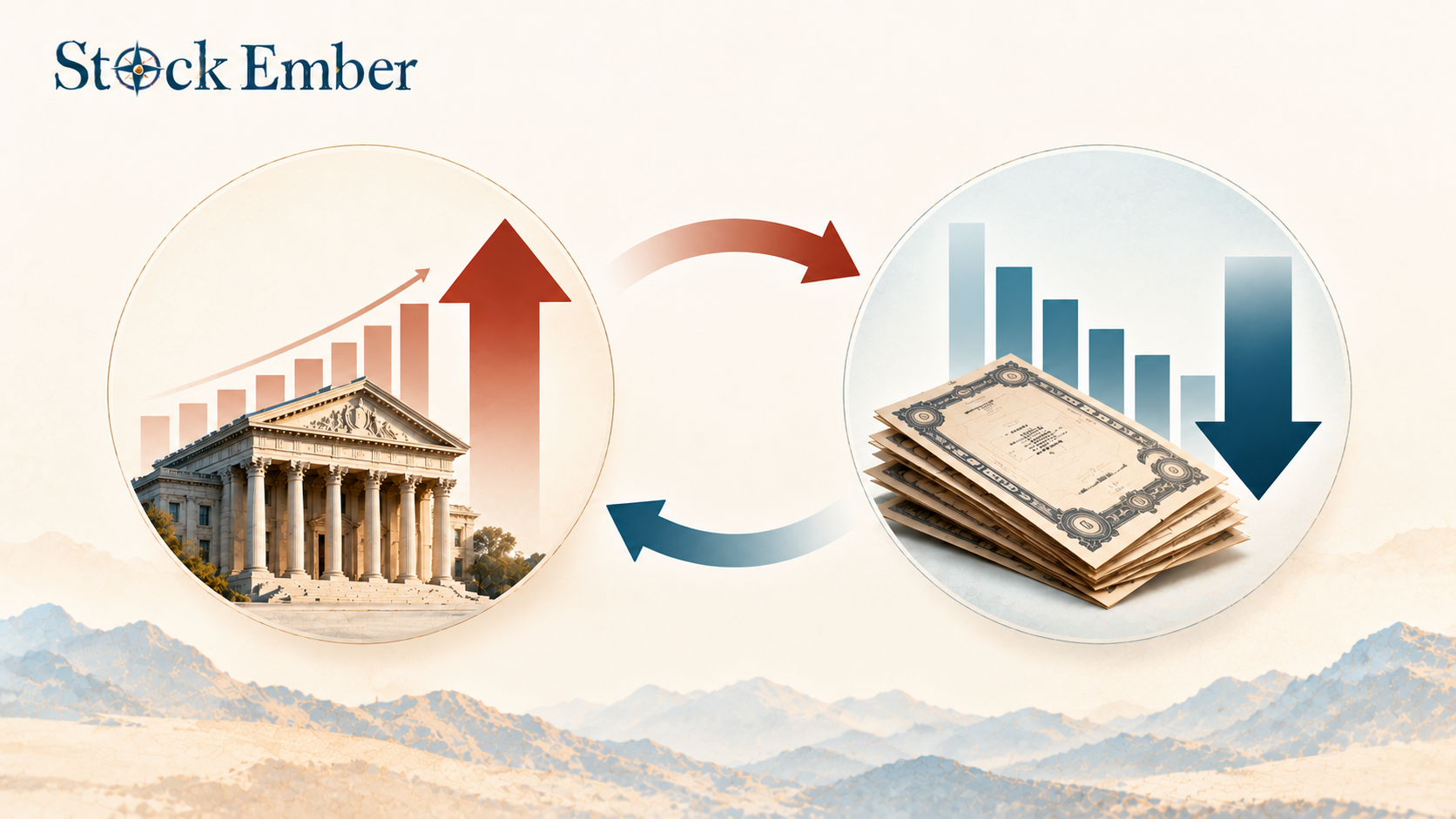
Interest rate risk is the potential for bond values or fixed-income investment returns to decline due to increases in market interest rates. When interest rates rise, existing bond prices fall because newer bonds offer higher yields. Over long horizons, higher yields allow reinvested cash flows to eventually offset initial price drawdowns.
This risk primarily impacts fixed-income securities like bonds and bond funds, where rising rates cause existing market prices to decline.
When interest rates rise unexpectedly, broad markets often experience temporary volatility that leaves conservative investors confused about their fixed-income holdings. For long-term investors holding balanced portfolios, understanding this price-yield mechanism is essential for evaluating short-term portfolio drawdowns against multi-year cash flow gains.
This guide explains how interest rate sensitivity works, how duration measures your exposure, and how to manage rate changes within a diversified index strategy.
Quick Takeaways
01Bond prices and interest rates move in opposite directions; when market rates rise, current bond market values fall.
02Duration measures how sensitive a bond portfolio is to changes in interest rates, expressed in years.
03Rising interest rates lower immediate fund valuations but allow future cash payouts to be reinvested at higher yields.
04Trying to time central bank rate changes usually backfires; buy-and-hold investors benefit from maintaining a disciplined asset allocation.
What Is Interest Rate Risk?
To understand what interest rate riskis, it helps to look at how fixed income assets are structured. By standard interest rate risk definition standards, it is the probability that shifts in central bank policies or broader economic conditions will alter market interest rates, thereby driving down the market value of existing fixed-income holdings.
When you purchase an individual bond or a bond ETF, that asset promises a fixed rate of return based on current market yield expectations set by monetary authorities like the Federal Reserve. If broader market rates rise after your purchase, newly issued bonds will offer higher coupon payouts than your existing ones. Consequently, the secondary market value of your lower-yielding bond drops because buyers will only purchase it at a discount.
This paper loss does not mean your fixed income asset has defaulted or failed. If an individual bond is held until maturity, the investor still receives the full original face value along with scheduled interest payments. However, for investors holding pooled instruments like index funds or fixed-income ETFs, fluctuating interest rates directly alter the fund's net asset value (NAV) on a daily basis.
How Interest Rate Risk Works: The Inverse Relationship
The core mechanism behind this rate risk exposure is straightforward: bond prices and interest rates move in opposite directions. When prevailing rates rise, existing bond prices fall. Conversely, when rates decline, bond prices increase.
Market Interest Rates Rise ---> Existing Bond Market Values Fall
Market Interest Rates Fall ---> Existing Bond Market Values Rise
Diagram depicting the inverse relationship between market interest rates and bond fund prices.
To see why this occurs, imagine you buy a 10-year bond paying a fixed 3% annual yield. A year later, economic conditions change and central banks raise benchmark interest rates. Newly issued 10-year bonds now pay a 5% yield. If you want to sell your 3% bond in the open market, no buyer will pay the original face value when they can buy a new bond paying 5%. To attract a buyer, you must lower your selling price until the effective return matches the current market rate of 5%.
Measuring Sensitivity with Duration
Not all fixed-income assets respond to this dynamic with the same intensity. The primary metric used to calculate this sensitivity is duration, which measures how much a bond fund's price will fluctuate in response to a 1% change in market rates.
A fund with a 3-year duration will fall roughly 3% if interest rates rise by 1 percentage point.
A fund with a 10-year duration will fall roughly 10% if interest rates rise by 1 percentage point.
Short-term bond funds carry lower duration, making them less volatile when rates fluctuate. Long-term bond funds carry higher duration, making them significantly more sensitive to interest rate policy shifts.
Why Interest Rate Risk Matters for Portfolio Allocation
For investors following a strategy rooted in passive investing, fixed income plays a critical role in dampening overall portfolio volatility. While equities provide capital growth, fixed income traditionally acts as a stabilizer during broad equity market downturns.
When central banks raise rates rapidly, fixed-income allocations face valuation pressure alongside equities. This can lead to unexpected portfolio drawdowns that test an investor's discipline. Understanding that rate-driven declines are a valuation adjustment rather than a credit default helps prevent emotional decision-making.
In practice, many long-term investors find that watching a bond ETF drop during a rate-hiking cycle feels alarming because bonds are viewed as the "safe" side of a portfolio. Recognizing that duration drives this decline allows investors to stay focused on total portfolio structure rather than reacting to short-term market noise.
Interest Rate Risk vs. Reinvestment Risk
Interest rate shifts introduce two opposing forces that affect fixed-income portfolios over time: price risk and reinvestment risk.
Risk Type
What Happens When Rates Rise
What Happens When Rates Fall
Price Risk
Current market value of existing holdings drops.
Current market value of existing holdings increases.
Reinvestment Risk
New coupon payments are reinvested at higher yields.
New coupon payments are reinvested at lower yields.
While higher interest rates create short-term price declines, they benefit buy-and-hold investors over long-horizon timeframes. As existing bonds inside an index fund mature, the fund manager purchases newly issued bonds paying higher yield rates.
Over a multi-year investment horizon, the increased income generated from reinvesting cash flows at higher yields gradually offsets the initial capital drawdown. This trade-off means that rising rates, while painful in the short term, eventually enhance total returns for patient investors holding funds beyond their target duration.
Effective interest rate risk management does not require forecasting central bank decisions or jumping in and out of bond funds. Instead, it involves aligning duration with your planned investment timeframe.
1. Matching Duration to Your Investment Horizon
If you need cash in two years, holding a long-term bond fund with a 10-year duration exposes you to unnecessary price volatility. Matching your bond fund's average duration to your goal horizon reduces the likelihood of being forced to sell holdings at a loss.
2. Utilizing Laddered or Target-Maturity Funds
A bond ladder spreads fixed-income allocations across short, intermediate, and long maturities. As short-term bonds mature, the proceeds are reinvested into newer bonds at current market yields, smoothing out interest rate cycles.
3. Monitoring Overall Portfolio Drawdown Limits
Understanding duration exposure helps set realistic expectations for a portfolio's maximum drawdown during monetary tightening cycles, preventing panic sales when fixed-income valuations adjust.
Common Pitfalls: Market Timing and Panic Selling
The most frequent mistake investors make during interest rate movements is attempting to time central bank rate changes. Market interest rates usually move ahead of official central bank announcements, meaning rate hikes or cuts are often priced into bond values long before news headlines appear.
Another common error is panic-selling bond ETFs during rate hikes to move into cash. Liquidating fixed-income funds during a yield adjustment locks in temporary price declines and forfeits the higher reinvestment yields that rebuild fund values over the following years.
Conclusion
Interest rate risk is an inherent characteristic of fixed-income investing, driven by the inverse relationship between market rates and bond prices. While rising rates create temporary price declines in bond funds, duration provides a predictable metric for estimating sensitivity, and long-term reinvestment eventually turns higher yields into an advantage.
Managing rate exposure requires aligning duration with your target timeline rather than attempting to predict central bank decisions. When you are ready to evaluate how different bond fund durations fit into your overall allocation, exploring our ETF reviews provides a practical next step.
Investing always involves risk, including the potential loss of principal, and past market performance does not guarantee future results. Treat this guide as educational material to inform your portfolio planning, not personalized financial advice.
FAQ
5 questions
What is interest rate risk in simple terms?
In simple terms, this exposure is the chance that rising interest rates will cause the market value of your existing bonds or bond ETFs to drop. Because newly issued bonds offer higher payouts when rates rise, existing lower-yielding bonds become less attractive, forcing their market price down until their returns match the new market rate.
How does bond duration measure interest rate risk?
Duration measures how sensitive a bond fund is to changes in interest rates, expressed in years. As a general rule of thumb, for every 1% increase or decrease in benchmark interest rates, a bond fund's price will shift in the opposite direction by approximately 1% for every year of duration.
What is the difference between interest rate risk and reinvestment risk?
Price risk refers to the short-term drop in a bond's market value when interest rates rise. Reinvestment risk is the opposite issue: when interest rates drop, incoming coupon payouts or maturing principal must be reinvested at lower yields, reducing future income potential over long periods.
Do stock portfolios face interest rate risk?
Yes, stock portfolios face indirect rate-driven volatility. Higher interest rates increase borrowing costs for businesses, potentially lowering corporate profitability. Additionally, higher yields on fixed-income investments make safer cash and bond yields more attractive relative to equities, which can compress stock valuation multiples across broad markets.
How can long-term investors manage interest rate risk?
Long-term investors can manage this risk by matching their bond fund duration to their investment timeline, utilizing bond laddering strategies, and maintaining a disciplined rebalancing schedule. Avoid panic-selling during rate hikes, as higher reinvestment yields help rebuild portfolio returns over subsequent years.
Disclaimer
This guide was written with AI assistance and reviewed by the StockEmber editorial team for accuracy. StockEmber provides independent education, not personal financial advice. Investing puts your capital at risk: the value of investments can go down as well as up, you may get back less than you invest, and past performance doesn’t guarantee future results. Some links may support our work at no additional cost to you.
The StockEmber Team is our in-house desk of independent research writers. We test brokerage platforms, read the fine print on fees and custody, and cover ETFs and long-horizon investing for people who plan to hold for decades — not days.