Free cash flow shows how much cash remains after a company generates cash from operations and accounts for capital expenditures. It can help investors assess the cash available for uses such as debt reduction, share repurchases, dividends, or business investment.
Free cash flow represents the net liquid cash a company generates from its daily business operations after deducting all capital expenditures required to maintain or expand its physical assets.
While reported net income can be influenced by accounting adjustments and non-cash items, tracking actual cash flow reveals whether a company truly generates surplus funds. Long-term investors evaluate cash generation to ensure a business can fund growth without taking on heavy debt. This guide explains how it works, how to calculate it, and why it matters.
Quick Takeaways
01It measures the actual discretionary cash remaining after paying for operating expenses and physical investments.
02The basic formula subtracts capital expenditures from operating cash flow.
03Unlike net income, it focuses purely on physical cash moving into and out of corporate accounts.
04Companies with consistent cash generation can pay dividends, pay down debt, or fund expansion without issuing new shares.
What Is Free Cash Flow? Definition & Core Concept
This metric is frequently referenced through its free cash flow definition, or simply as what is free cash flow, the cash a business holds after paying routine operating bills and buying necessary physical equipment.
When a business sells products, it earns revenue and collects cash from customers. However, keeping the business running requires buying inventory, paying employee salaries, servicing facilities, and replacing worn-out machinery. It measures the cash leftover after these essential cash outflows are settled.
This remaining cash is called "free" because corporate management and board members have complete discretion over how to spend it. They can distribute it directly to investors as cash dividends, buy back company stock, reduce long-term debt, or hold it in reserve for future opportunities.
As you build foundational knowledge for investing in stocks, evaluating cash generation helps you verify that corporate profits reflect real cash rather than paper accounting gains.
How to Calculate Free Cash Flow: The Formula
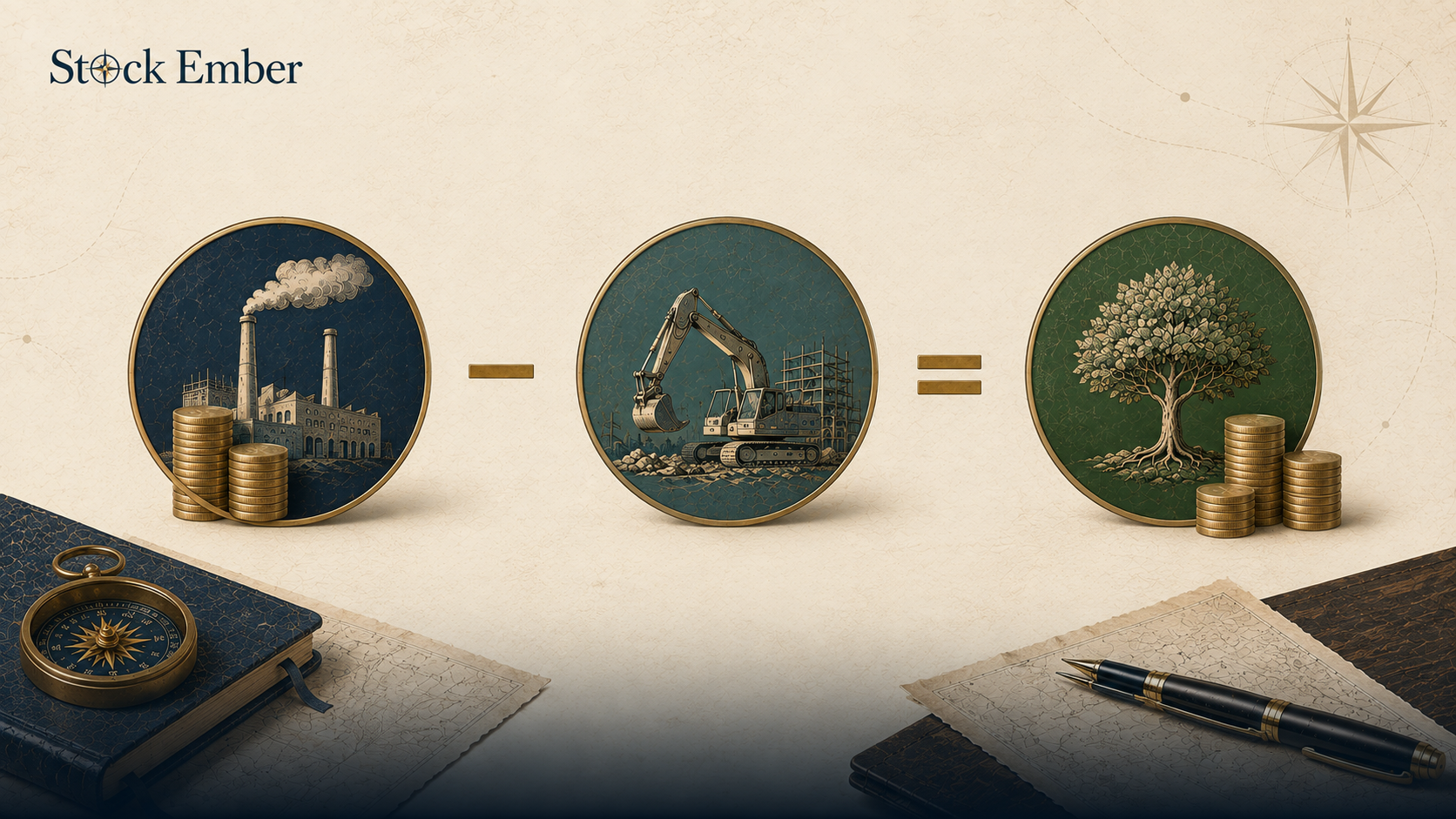
A common way to calculate it is to subtract capital expenditures from operating cash flow, using data from the company's cash flow statement.
Free Cash Flow = Operating Cash Flow − Capital Expenditures
To understand the formula, break down its two primary components:
Operating Cash Flow: The net cash provided by a company's operating activities, including cash collected from customers and cash paid to suppliers and employees.
Capital Expenditures (CapEx): Funds used to buy or improve long-term assets such as factories, computers, machinery, and delivery vehicles.
For example, if a firm generates $500,000 in operating cash flow and spends $150,000 on new manufacturing equipment during the year, the result is $350,000 ($500,000 − $150,000).
These outflows directly connect to a company's long-term assets. When evaluating a company's financial structure on a balance sheet, long-term equipment and property accounts can reflect past capital spending over time.
According to financial reporting guidance published by the SEC, reviewing the cash flow statement alongside the income statement and balance sheet provides a more complete picture of a company's financial performance and cash flows.
Diagram illustrating operating cash flow minus capital expenditures to find free cash flow.
Free Cash Flow vs. Net Income: Cash Reality vs. Paper Profit
The primary difference between the two figures is that net income relies on accrual accounting rules, whereas this metric measures actual liquid cash.
Aspect
Net Income
Free Cash Flow
Accounting Basis
Accrual accounting
Cash-based measure
Includes Non-Cash Items
Yes, such as depreciation
Adjusts for non-cash items
Capital Expenditures
Not directly deducted
Deducted in the calculation
Cash Generation
May differ from actual cash generated
More directly reflects cash generated after capital spending
Net income appears at the bottom of the income statement and includes non-cash items, such as depreciation charges and revenue earned on credit before cash is collected. A company can report a large net income profit while simultaneously running low on bank cash if its customers delay paying invoices.
Conversely, it strips away non-cash accounting adjustments. It accounts for changes in working capital and physical capital investments, presenting an accurate picture of cash liquidity. Over multi-year periods, companies with strong earnings quality show cash trends that closely match reported net income growth.
Why Free Cash Flow Matters for Buy-and-Hold Investors
This metric matters to you as a long-term investor because consistent cash generation gives a business the financial flexibility to compound shareholder wealth over a ten-year holding period.
When a company generates consistent surplus cash, management can deploy that capital to enhance long-term value:
Paying Cash Dividends: Returning cash directly to shareholders without reducing operational capacity.
Repurchasing Shares: Buying back company shares on open markets, which increases the ownership percentage of remaining shares.
Reducing Corporate Debt: Paying off long-term bank debt or bonds to lower future interest obligations.
Self-Funding Expansion: Opening new locations or launching products using existing cash rather than borrowing at high interest rates.
During economic downturns, businesses with a positive figure can continue operations without seeking emergency funding or diluting equity holders.
In practice, you'll find that tracking multi-year cash conversion trends helps separate businesses with durable cash generation from those that rely on continuous debt issuance to stay afloat.
Common Free Cash Flow Red Flags
You should watch for operational red flags where short-term cash flow numbers distort long-term business health:
Deferred Capital Spending: Management can temporarily inflate this figure by cutting back on necessary equipment maintenance or research. While cash flow looks strong for a year or two, neglected physical assets eventually require costly repairs.
Working Capital Stretches: Delaying payments to suppliers or aggressively pushing for early customer collections can create temporary cash spikes that cannot be sustained indefinitely.
Persistent Cash Burn in Mature Businesses: If an established company consistently produces a negative figure despite rising sales, it may be spending capital inefficiently.
Conclusion
Free cash flow provides a realistic view of a company's financial health by measuring the net cash remaining after operational expenses and capital investments.
By tracking these cash trends alongside net income, long-term investors can evaluate earnings quality, verify financial independence, and avoid capital allocation traps.
When you are ready to choose an investment platform to build your equity portfolio, our broker reviewsoffer an objective analysis of trading platforms and account features. Always remember that fundamental cash flow analysis is one part of comprehensive research, and all stock investments carry the risk of market loss.
FAQ
5 questions
What is free cash flow?
Free cash flow is a financial metric that measures the actual liquid cash a business generates after paying for routine operational expenses and necessary capital expenditures. It represents the discretionary cash available to owners and management.
How do you calculate free cash flow?
You calculate it using the formula: Free Cash Flow = Operating Cash Flow − Capital Expenditures. Both figures are found on a company's cash flow statement under operating activities and investing activities.
What is the difference between free cash flow and net income?
Net income is an accounting figure calculated using accrual accounting, which includes non-cash expenses like depreciation and uncollected sales. Free cash flow measures actual liquid cash moving into and out of the business.
Can a company have positive net income and negative free cash flow?
Yes. A company can report positive accounting profit on its income statement while recording negative free cash flow if it spends heavily on machinery, facilities, inventory, or delays collecting cash payments from customers.
Is a higher free cash flow always better?
While higher cash generation generally reflects strong business health, management can temporarily boost short-term free cash flow by slashing necessary equipment maintenance, research, or development. Evaluating multi-year trends is essential.
Disclaimer
This guide was written with AI assistance and reviewed by the StockEmber editorial team for accuracy. StockEmber provides independent education, not personal financial advice. Some links may support our work at no additional cost to you.
The StockEmber Team is our in-house desk of independent research writers. We test brokerage platforms, read the fine print on fees and custody, and cover ETFs and long-horizon investing for people who plan to hold for decades — not days.