A balance sheet is a foundational financial statement that reports a company's total assets, total liabilities, and total shareholders' equity as of a specific date. It provides a financial snapshot of what a business owns versus what it owes to third parties. The statement operates on the core accounting equation: Assets = Liabilities + Shareholders' Equity.
A balance sheet is a core financial statement that provides a snapshot of a business's financial position at a specific point in time by detailing its assets, liabilities, and shareholders' equity.
When evaluating individual stocks, long-term investors examine balance sheet health to gauge financial leverage, liquidity, and solvency before committing capital. Understanding what is a balance sheet helps you distinguish resilient enterprises from debt-burdened risks. This guide breaks down essential components, valuation nuances, and why passive investors approach financial statements differently.
Quick Takeaways
01A balance sheet provides a financial "snapshot" of a business as of a single specific date.
02It operates on the foundational accounting equation: Assets = Liabilities + Shareholders' Equity
03Assets detail what a company owns, while liabilities reflect short-term and long-term debts owed to third parties.
04Balance sheet net asset value (book value) rarely equals a company's total stock market valuation.
05Broad-market index investors automatically reduce exposure to failing balance sheets without reading quarterly filings manually.
What Is a Balance Sheet?
A balance sheet is a foundational financial statement that reports a company's total assets, total liabilities, and total shareholders' equity as of a single specific calendar date. To understand what a balance sheet is in accounting, it helps to recognize that it provides a static financial photograph rather than a moving picture.
To answer the question “what is a balance sheet,” think of it as a core financial statement that provides a snapshot of a business's financial position at a specific point in time by detailing its assets, liabilities, and shareholders' equity.
The Accounting Snapshot Concept
Unlike an income statement or cash flow statement, which record financial activity over a period of time (such as a quarter or a year), a balance sheet reflects balances at one exact moment. Whether drafted on March 31 or December 31, it registers what the business holds and owes on that specific day. For investors evaluating what is a balance sheet for a business, this snapshot reveals the financial foundation supporting daily operations.
The Core Accounting Equation
Every balance sheet must balance according to a fundamental double-entry accounting rule:
Assets = Liabilities + Shareholders' Equity
This formula guarantees that every asset owned by a firm was purchased either by borrowing money (liabilities) or by utilizing capital provided by owners and accumulated operational profits (shareholders' equity).
What Is on a Balance Sheet? Key Components Breakdown
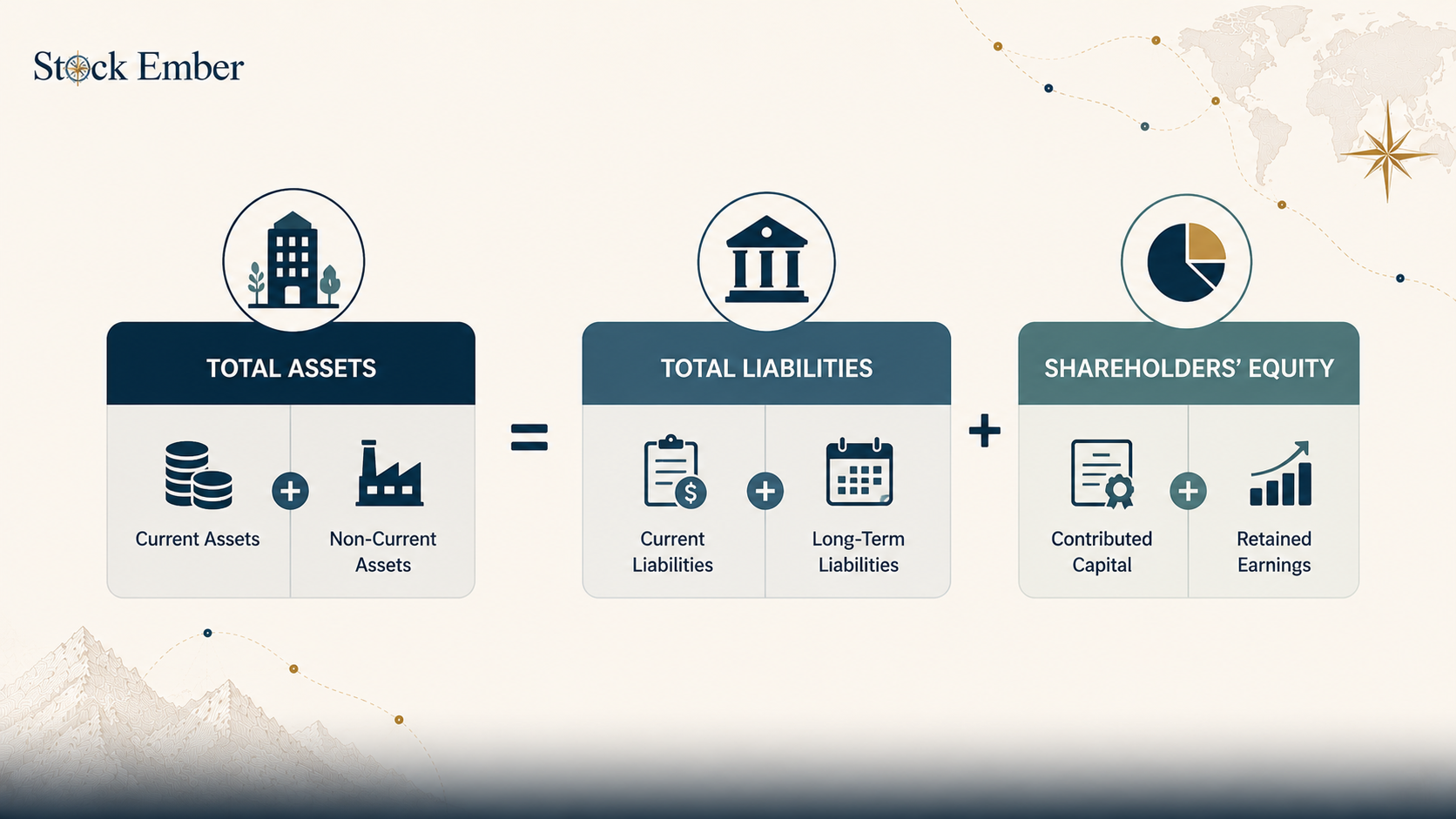
Knowing what is on a balance sheet requires organizing financial items into three distinct line-item categories: assets, liabilities, and equity.
Diagram showing the key components of a balance sheet, where total assets equal total liabilities plus shareholders' equity.
Assets (Current vs. Non-Current)
Assets represent economic resources owned or controlled by the business that are expected to generate future value.
Current Assets: Cash, short-term investments, accounts receivable, and physical inventory expected to be converted into cash within 12 months.
Non-Current Assets: Long-term assets such as factories, physical equipment, real estate, and intangible assets like patents.
Liabilities (Short-Term Debt vs. Long-Term Obligations)
Liabilities represent claims against the company's assets by external creditors and vendors.
Current Liabilities: Short-term obligations due within one year, including accounts payable, short-term debt, and accrued payroll.
Non-Current Liabilities: Long-term debt obligations, such as corporate bonds, long-term bank loans, and lease commitments extending beyond one year.
Shareholders' Equity and Retained Earnings
Shareholders' equity reflects the net residual ownership claim after subtracting total liabilities from total assets. It includes capital initially paid in by investors alongside retained earnings, which are cumulative profits reinvested in the business over time rather than paid out as cash dividends.
What Is the Purpose of a Balance Sheet?
The primary question for investors is what is the purpose of a balance sheet in evaluating overall stock quality and financial endurance.
Evaluating Corporate Solvency and Liquidity
A balance sheet allows investors to measure short-term liquidity by comparing current assets directly against current liabilities. If a sudden economic disruption occurs, a company with ample cash reserves can cover upcoming short-term bills without taking on expensive emergency financing or diluting existing shareholders.
Assessing Financial Leverage Over a 10-Year Horizon
Over a multi-year period, examining balance sheet leverage highlights corporate risk management. A firm carrying excessive long-term debt must dedicate a significant portion of its operating cash flow toward interest payments.
Consider a 10-year scenario: if a business carries $500,000,000 in long-term bonds at a 6% interest rate, it must pay $30,000,000 annually in interest alone. During economic downturns, that fixed debt burden can consume operating margins, whereas a conservative, low-debt competitor retains cash to expand market share.
In practice, many long-term investors find that inspecting the debt structure on a balance sheet reveals management's risk appetite far better than earnings presentations. Companies that over-leverage to fund aggressive buybacks often face severe capital stress when credit markets tighten or interest rates rise.
Balance Sheet vs. Valuation: Book Value vs. Market Value
Balance sheet net worth calculated as assets minus liabilities is known as book value, but it rarely matches what the stock market pays for a business.
Why Book Value Rarely Matches Market Capitalization
Many long-lived tangible assets are reported at historical cost less accumulated depreciation and impairment, while other assets may be measured under different accounting rules. Consequently, a company holding real estate purchased decades ago may carry those assets on its balance sheet at a fraction of their current market worth.
Modern Asset-Light Businesses and Intangible Limitations
Modern technology, media, and service companies may generate substantial value from intangible resources such as proprietary software, brands, and network effects, but balance sheets do not always fully capture internally generated intangibles, while some acquired intangible assets may still be recognized. When valuing complex businesses, analysts may compare enterprise value with earnings before interest, taxes, depreciation, and amortization using the EV/EBITDA multiple and review operating cash flow separately, rather than relying solely on book value.
How Balance Sheet Health Fits into a Long-Term Passive Strategy
Analyzing individual balance sheets provides stock pickers with valuable insights into financial health, but conducting thorough debt and liquidity checks across dozens of companies requires continuous accounting oversight.
When learning how to invest in stocks for long-term wealth accumulation, relying on single-stock balance sheet analysis introduces individual company risk. A firm that appears financially solid today can take on reckless debt or suffer sudden asset write-downs over a 10-year holding period.
Long-horizon investors often discover that broad-market index funds manage balance sheet risks structurally. Index funds automatically diversify across hundreds of corporate balance sheets, allowing strong market leaders to drive portfolio returns while systematically scaling down exposure to distressed companies facing insolvency.
A portfolio built around broad-market index holdings may provide diversified exposure to long-term economic growth and reduce the need to analyze every company individually, but it does not eliminate corporate default risk or broader market losses.
Conclusion
A balance sheet provides a vital snapshot of a business's financial health by detailing its assets, liabilities, and equity at a specific point in time. While reviewing balance sheet strength helps identify solvent, low-debt enterprises, it should be evaluated alongside broad market context and earnings performance.
For buy-and-hold investors, understanding financial statements provides context on corporate quality, but single-stock analysis does not need to consume your long-term plan. When you are ready to evaluate platforms to execute your investment strategy, our broker reviews offer a helpful next step.
FAQ
5 questions
What is a balance sheet in simple terms?
In simple terms, a balance sheet is a financial snapshot showing what a company owns (assets), what it owes to others (liabilities), and what is left over for owners (shareholders' equity) on a specific date. It reveals whether a business has enough cash and resources to cover its debts.
What is the main purpose of a balance sheet?
The main purpose of a balance sheet is to evaluate a company's financial stability, liquidity, and leverage. By comparing current assets directly against current liabilities and examining long-term debt loads, investors can assess whether a business can pay its short-term bills and withstand economic downturns without facing insolvency.
What are the three main components of a balance sheet?
The three main components are assets, liabilities, and shareholders' equity. Assets are economic resources owned by the firm (such as cash, inventory, and factories); liabilities are debts and obligations owed to external creditors; and shareholders' equity represents the net residual value belonging to company owners.
What is the difference between a balance sheet and an income statement?
A balance sheet is a static "snapshot" showing what a company owns and owes at a single specific moment in time (such as December 31). An income statement, on the other hand, measures financial performance over a period of time, such as a quarter or a full fiscal year, by reporting revenue, operating expenses, and net profit.
Why does a balance sheet always have to balance?
A balance sheet must balance because every asset a business acquires is funded either by borrowing money (liabilities) or using owner capital and accumulated profits (equity). Because total assets must always equal the sum of liabilities plus shareholders' equity, both sides of the accounting equation remain equal.
Disclaimer
This guide was written with AI assistance and reviewed by the StockEmber editorial team for accuracy. StockEmber provides independent education, not personal financial advice. Some links may support our work at no additional cost to you.
The StockEmber Team is our in-house desk of independent research writers. We test brokerage platforms, read the fine print on fees and custody, and cover ETFs and long-horizon investing for people who plan to hold for decades — not days.