After-hours trading allows investors to buy and sell stocks after standard US equity exchanges close at 4:00 PM Eastern Time. These trades execute through Electronic Communication Networks (ECNs) rather than central exchange order books, using limit orders to match buyers and sellers until 8:00 PM ET.
After-hours trading is the buying and selling of stocks after standard US equity exchanges close their regular daily trading session at 4:00 PM Eastern Time.
When companies release quarterly earnings reports shortly after the closing bell, stock prices often jump or fall sharply in late-day trading. Seeing these rapid price moves leads many stock market investors to wonder if they should trade outside normal operating hours. This guide covers how these extended sessions work, standard schedules, key execution risks, and why long-term investors rarely need to use them.
Quick Takeaways
01Standard US extended-hours sessions run from 4:00 PM to 8:00 PM Eastern Time.
02Trades execute through Electronic Communication Networks (ECNs) using strict limit orders.
03Thin market volume leads to wider bid-ask spreads, higher volatility, and unexecuted orders.
04Evening price moves frequently adjust before regular market opening bells the next morning.
05Long-term investors protect capital by waiting for regular market hours when liquidity is highest.
What Is After-Hours Trading?
This term refers to buying and selling stocks after standard stock exchange operating hours close at 4:00 PM Eastern Time.
To understand what is after hours trading, investors must look at how market access expands beyond standard operating windows. During standard hours (9:30 AM to 4:00 PM ET), US stock exchanges consolidate orders across major trading floors and central matching systems. Once the 4:00 PM bell rings, regular market trading stops, but stock market after hours trading begins.
Participating in after hours stock trading allows market participants to buy or sell shares in response to late-day breaking news. To trade stocks at any time of day, you first need an active brokerage account with a provider that supports extended sessions. However, trading outside main market hours functions under vastly different execution mechanics than daytime trading.
How After-Hours Trading Works: Schedule and ECNs
Trading after hours relies on electronic computer networks rather than physical exchange floors.
Instead of matching orders on a central exchange floor, late sessions process trades through Electronic Communication Networks (ECNs). ECNs are automated digital systems that directly pair buy and sell orders from different market participants.
Standard after hours trading hours run from 4:00 PM to 8:00 PM ET. Investors often ask what time does after hours trading end; while major ECN networks operate until 8:00 PM ET, individual brokerage firms may set earlier closing limits for their clients.
Order rules also change when trading outside regular hours:
Limit orders only: Most brokers require limit orders during extended sessions. A limit order sets the exact maximum price you will pay to buy or the minimum price you will accept to sell.
No market orders: Market orders, which execute immediately at the current available price, are generally barred after hours because prices can jump wildly between quotes.
Session-specific validity: Orders entered during evening sessions typically expire at 8:00 PM ET and do not roll over into the next day's morning pre-market session.
Key Risks: Liquidity, Spreads, and Execution Limits
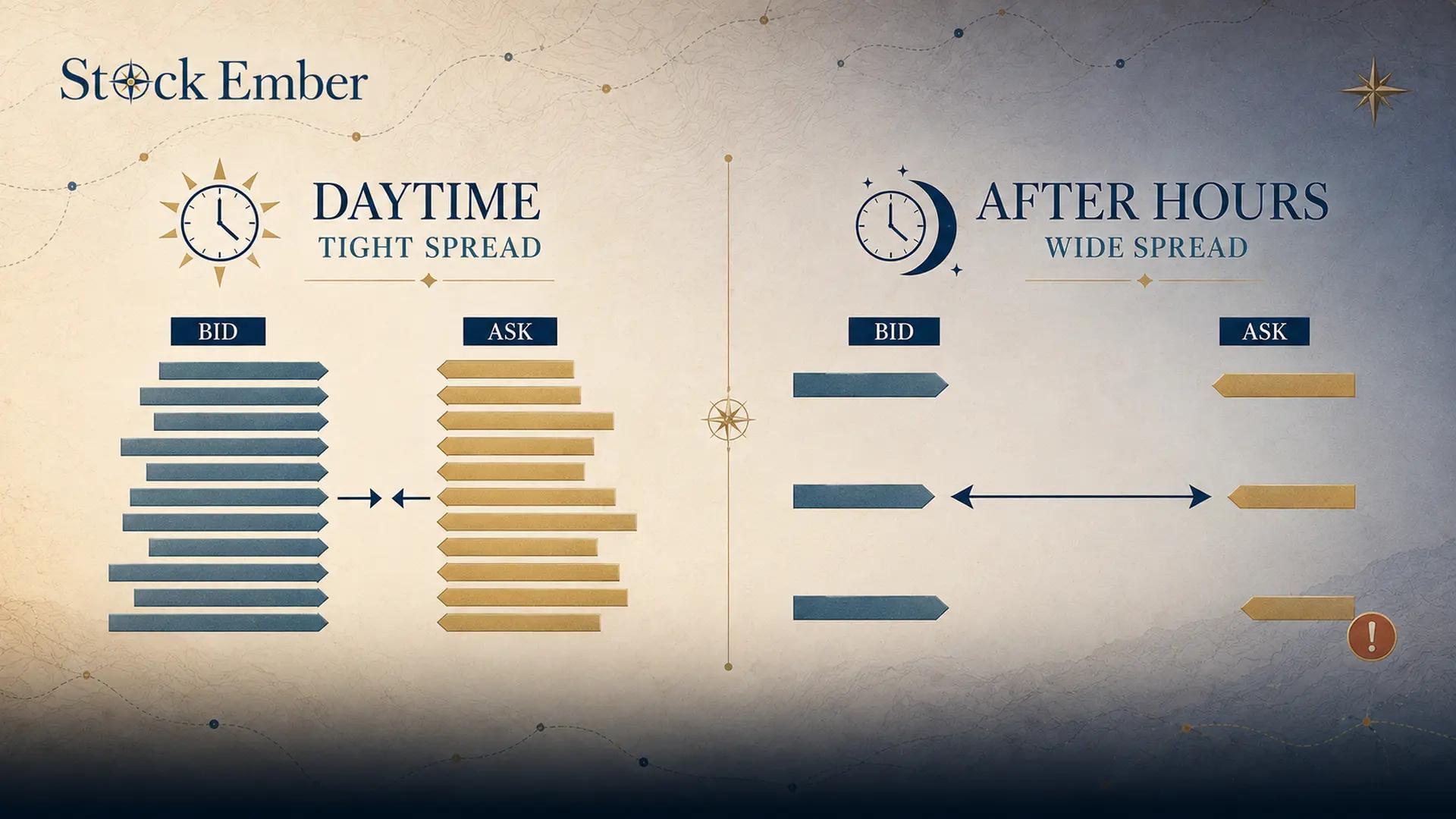
The primary risks of trading during these extended sessions stem from lower transaction volumes and reduced market participation.
The US Securities and Exchange Commission warns that extended-hours trading carries unique execution risks that do not exist during regular trading sessions. When standard market floors close, the number of active buyers and sellers drops sharply.
This drop in liquidity creates three major hurdles for individual investors:
Wider bid-ask spreads: The bid-ask spread is the difference between the highest price a buyer offers and the lowest price a seller accepts. In thin evening markets, spreads widen significantly. A stock with a $0.02 spread during the day might see a $0.50 spread after 4:00 PM, creating instant transaction friction.
Extreme price volatility: With fewer total shares trading hands, even small institutional or retail orders can cause dramatic price jumps up or down.
Unexecuted limit orders: Because prices jump around and few orders exist, your limit order may never match with a counterparty, leaving your trade unfulfilled.
Why Extended Hours Rarely Matter for Buy-and-Hold Investors
Extended trading sessions rarely affect long-term portfolio growth because short-term evening price swings often smooth out over multi-year horizons.
For investors building wealth over a 10-year horizon, evening price swings represent short-term noise rather than true structural change. When a company reports earnings at 4:05 PM, evening stock prices often react wildly on initial headline figures. By 9:30 AM the following morning, institutional analysts have read the full quarterly report, and opening prices frequently pull back toward baseline valuations.
Trading in thin evening sessions exposes investors to higher hidden transaction costs from wide spreads. Over ten years, paying extra bid-ask spread friction on trades quietly erodes portfolio compounding.
Common Pitfalls to Avoid Outside Standard Market Hours
The most common mistakes during evening trading sessions involve using improper order types and reacting emotionally to late-day news.
Investors trading in these extended sessions should watch out for these frequent mistakes:
Assuming evening prices set morning open prices: An after-hours stock price jump does not guarantee the stock will open at that same price the next morning. Morning pre-market sessions and institutional opening orders frequently re-reset market pricing.
Chasing earnings spikes: Buying a stock during an evening price rally often means paying peak spread prices right before liquidity normalizes the next day.
Ignoring account administration: While adjusting trading settings, investors should also make sure to complete their beneficiary designation so that their account assets pass cleanly to intended heirs.
Conclusion
Understanding these extended-hours mechanics helps investors avoid costly execution mistakes when quarterly earnings news breaks. Extended sessions between 4:00 PM and 8:00 PM ET offer market access, but reduced liquidity and wide bid-ask spreads increase execution costs. For buy-and-hold investors focusing on long-horizon wealth accumulation, waiting for standard market hours provides better order execution and protects portfolio compounding.
When you are ready to evaluate platforms that offer fair trading features and transparent fee structures, our Broker reviews & rankings provide a helpful starting point. All investing carries risk of capital loss and past market behavior does not guarantee future results, so use this guide as educational context for your own research.
FAQ
4 questions
What is after-hours trading?
After-hours trading refers to buying and selling securities after the major stock exchanges close their regular daily trading session (typically after 4:00 PM Eastern Time in the US).
What are the main risks of trading after hours?
Extended trading sessions have lower trading volume, reduced liquidity, wider bid-ask spreads, and higher price volatility compared to standard market hours.
What types of orders are allowed during after-hours sessions?
Most brokerages only permit limit orders during after-hours trading to protect investors from executing trades at unexpected prices due to low market liquidity.
Why do stock prices move rapidly during after-hours trading?
Major corporate announcements, such as quarterly earnings reports and major news updates, are usually released right after the market closes, triggering swift price reactions.
Disclaimer
This guide was written with AI assistance and reviewed by the StockEmber editorial team for accuracy. StockEmber provides independent education, not personal financial advice. Some links may support our work at no additional cost to you.
The StockEmber Team is our in-house desk of independent research writers. We test brokerage platforms, read the fine print on fees and custody, and cover ETFs and long-horizon investing for people who plan to hold for decades — not days.