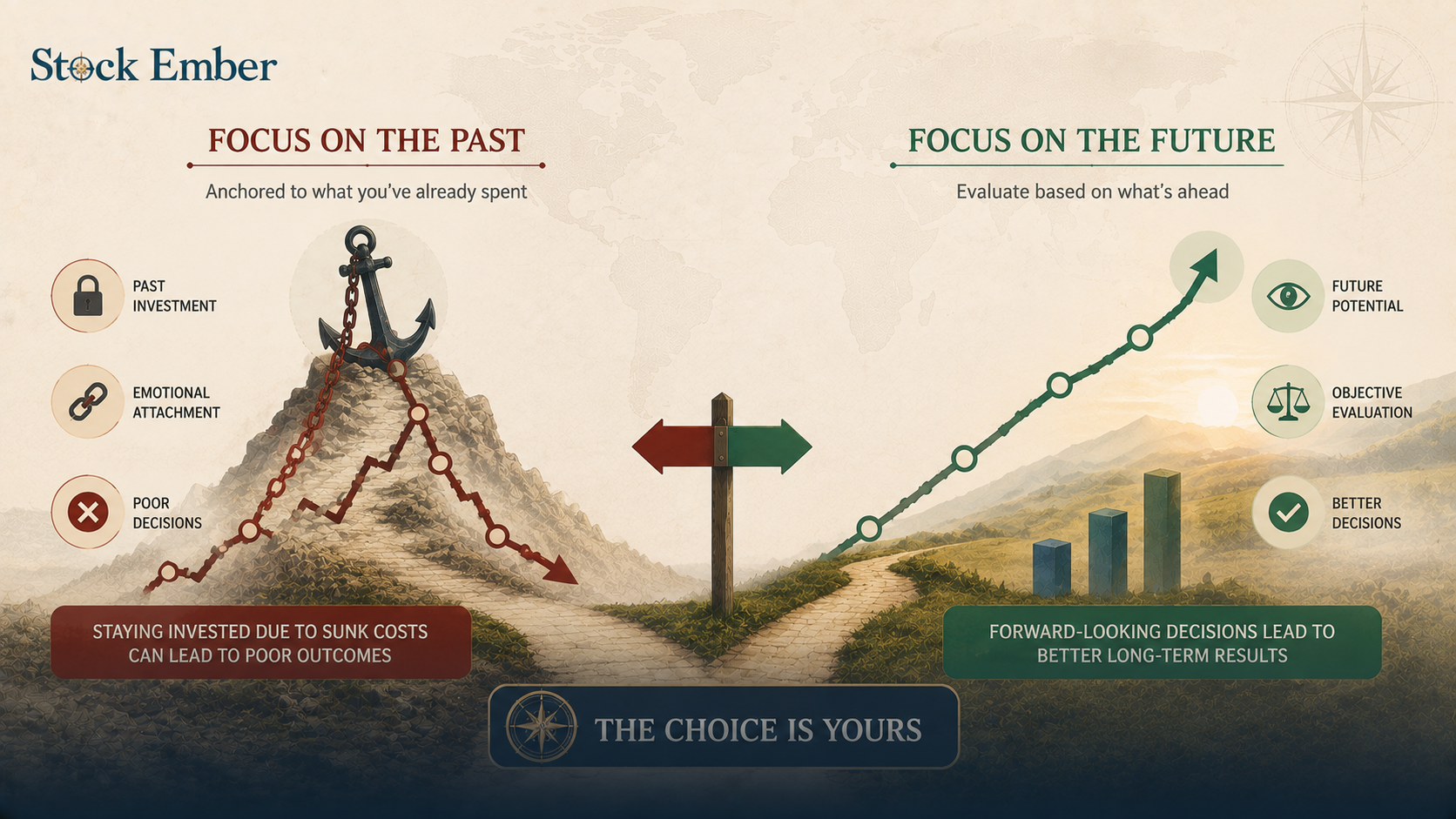
The sunk cost fallacy is a cognitive bias where an investor continues allocation to a losing asset because of money, time, or capital already spent, rather than its future potential. Rational asset allocation dictates evaluating holdings solely on expected future performance, as unrecoverable past costs have zero impact on future market movements.
The sunk cost fallacy is a cognitive bias where an investor continues allocation to a losing asset because of money, time, or capital already spent, rather than its future potential.
Many investors have held an underperforming stock simply to avoid locking in a loss, waiting for the price to return to what they paid. Refusing to sell an asset with broken fundamentals locks capital into unproductive investments. This guide explains how this bias works, how it harms compound returns over a decade, and how to make forward-looking choices.
Quick Takeaways
01The sunk cost fallacy occurs when past unrecoverable capital dictates future investment decisions.
02Loss aversion drives investors to hold deteriorating assets to avoid the emotional pain of realizing a loss.
03Holding unproductive assets creates a heavy 10-year opportunity cost by preventing capital from compounding elsewhere.
04Broad market drawdowns in index funds are cyclical, whereas holding an asset with broken fundamentals represents a sunk cost trap.
What Is the Sunk Cost Fallacy?
The sunk cost fallacy definition describes the mental trap of allowing unrecoverable past costs to drive future financial decisions. In economics, a sunk cost is money, time, or energy already spent that cannot be recovered under any circumstances.
Because those past resources are gone, rational decision-making dictates that only future costs and expected future returns should determine whether you hold, sell, or buy an asset. When evaluating an asset in your portfolio, the entry price you paid months or years ago has zero effect on what the market will do tomorrow.
The study of behavioral finance demonstrates that human minds naturally struggle to treat past expenditures as irrecoverable. Investors often feel that liquidating an asset below its purchase price transforms a paper loss into a permanent failure.
However, market prices reflect current supply, demand, and future earnings potential, completely disconnected from your personal trade history. Recognizing the sunk cost fallacy meaning allows you to separate emotional history from rational asset allocation. Standard investor education materials from regulators like the U.S. Securities and Exchange Commission highlight behavioral patterns that can undermine investment performance.
Psychological Drivers: Loss Aversion and Regret Avoidance
Psychological drivers such as loss aversion and regret avoidance force investors into sunk cost behavior. Prospect Theory research by behavioral economists Daniel Kahneman and Amos Tversky found that humans feel the emotional pain of a financial loss about twice as intensely as the joy of an equivalent gain.
This emotional asymmetry creates a strong cognitive bias: investors hold onto declining assets simply to keep the hope of breaking even alive. Selling the asset forces an investor to admit an error, while holding it allows them to maintain the illusion that the investment might recover.
Many investors wonder how the sunk cost fallacy differs from general loss aversion. Loss aversion is the overarching emotional preference to avoid losses rather than seek equivalent gains. The sunk cost fallacy is the specific behavior of committing fresh time or capital into a failing endeavor strictly because of past unrecoverable commitments.
In practice, many long-term investors find that their most expensive mistakes came from holding a deteriorating asset for years to recover a small initial drawdown, only to watch the remaining capital erode further.
Real-World Sunk Cost Fallacy Examples in Portfolios
Portfolio management offers many clear examples of what is the sunk cost fallacy in action, where anchoring to past costs harms long-term wealth.
One common pattern occurs when a company's underlying business model degrades due to technological changes or shifting consumer demand. An investor who bought shares at $100 might watch the stock drop to $40. Even as revenue declines and competitive advantages vanish, the investor holds the position, insisting they will sell only when the stock recovers to $100. The market has no memory of the original $100 price tag, yet the investor treats that entry point as a personal benchmark.
Another example involves holding onto poorly constructed actively managed funds simply because the investor spent dozens of hours researching them. When evaluating portfolio performance, focusing only on past winners while ignoring assets that failed and were liquidated can create survivorship bias. Similarly, holding onto failed positions out of sentimentality ignores how portfolio growth is built.
Portfolio chart contrasting entry price anchoring with forward-looking capital reallocation
The Hidden 10-Year Opportunity Cost of Dead Capital
Anchoring capital in a stagnant investment creates a silent 10-year opportunity cost that hampers portfolio growth.
When you hold a non-viable asset hoping to recover a loss, your money sits as "dead capital." The true damage is not just the initial decline, but the compounding gains your money fails to earn elsewhere during that time.
Consider an illustrative hypothetical example. Suppose you hold $10,000 in an asset that drops to $7,000 due to permanent structural shifts in its business. If you keep the remaining $7,000 anchored in that stagnant position for 10 years, earning 0% net return while waiting to "get back to even," your balance remains $7,000.
If instead you reallocate that $7,000 into a broad market index fund earning a hypothetical 7% annual return after inflation, that $7,000 would grow to approximately $13,770 over 10 years, though this projection is illustrative only, and actual market returns are never guaranteed and can turn negative in any given year. By holding out for your original $10,000 entry price, you miss out on over $6,700 of potential compound growth. Past capital is unrecoverable, but future compounding depends entirely on where your money stays invested today.
Distinguishing Fundamental Failure from Cyclical Drawdowns
Distinguishing fundamental business failure from standard cyclical drawdowns is essential to avoid misapplying sunk cost principles.
Investors often ask whether holding a broad market ETF during a market downturn constitutes a sunk cost trap. The answer depends on the underlying asset. Broad-based market index funds represent hundreds or thousands of profitable companies across global economies. During broad market declines, price drops are driven by macro economic cycles, not the structural collapse of the underlying holdings.
Holding a diversified index fund through market volatility is standard long-term strategy, as historical markets have consistently recovered over multi-year horizons. Conversely, holding an individual stock or sector fund whose core business model is permanently broken is a classic sunk cost trap. The key is evaluating whether the original investment thesis remains sound.
How to Overcome Sunk Cost Bias in Your Portfolio
Overcoming sunk cost bias requires shifting your mindset from past expenditures to forward-looking capital allocation.
To eliminate emotional bias from your decisions, consider these structured evaluation practices:
Perform Zero-Based Portfolio Checks: Periodically ask yourself: "If I were holding 100% cash today, would I buy this specific asset at its current price?" If the answer is no, holding it simply because you owned it yesterday is an emotional choice rather than a rational strategy.
Evaluate the Forward Thesis: Base your decision on expected earnings, competitive strengths, and management quality over the next 5 to 10 years, independent of your trade history.
Automate Rebalancing: Set clear rules for rebalancing your portfolio. Systematic rebalancing forces you to realign assets based on targeted allocations rather than emotional attachments.
Conclusion
Ultimately, what is the sunk cost fallacy? It boils down to letting past expenditures govern your future portfolio decisions. Capital already lost cannot be recovered by holding an asset with broken fundamentals. By evaluating assets on forward potential rather than past costs, long-term investors protect their capital from stagnant performance and capture multi-year compound growth.
When you are ready to evaluate diversified foundational holdings for your portfolio, exploring our ETF reviews offers a practical next step. Remember that rebalancing or liquidating investments involves market risk and does not guarantee future positive returns, making independent analysis essential for every portfolio decision.
FAQ
5 questions
What is a simple example of the sunk cost fallacy in investing?
A classic example occurs when an investor holds a stock whose core business model has permanently degraded, refusing to sell simply because the current share price is below their original purchase price. The investor anchors to their entry point, keeping capital locked in a declining asset rather than reallocating it to productive investments with better forward growth potential.
What is the main psychological cause of the sunk cost fallacy?
The primary psychological driver of the sunk cost fallacy is loss aversion, combined with regret avoidance. Behavioral economics shows that people feel the emotional pain of a financial loss about twice as intensely as the pleasure of an equal gain. Consequently, investors hold onto failing assets to avoid realizing a paper loss and confronting a past error.
How does the sunk cost fallacy differ from loss aversion?
Loss aversion is the broad psychological preference to avoid losses rather than achieve equivalent gains. The sunk cost fallacy is a specific behavioral pattern where an investor continues committing capital, time, or emotional energy to an underperforming asset strictly because of past, unrecoverable investments made into that position.
Is holding a broad market index fund during a downturn a sunk cost fallacy?
No, holding a broad market ETF or index fund during a market drawdown is generally not a sunk cost trap. Broad index funds hold hundreds of profitable companies across the economy, and market downturns are usually cyclical macro events. The sunk cost fallacy specifically applies when an individual asset's fundamental investment thesis is permanently broken.
How can investors overcome sunk cost bias when rebalancing?
Investors can overcome sunk cost bias by conducting zero-based portfolio reviews. Ask yourself whether you would buy the asset today at its current market price if you were holding 100% cash. If the answer is no, holding it simply because of past ownership is emotional. Setting automated, rules-based rebalancing schedules also removes past cost bias.
Disclaimer
This guide was written with AI assistance and reviewed by the StockEmber editorial team for accuracy. StockEmber provides independent education, not personal financial advice. Some links may support our work at no additional cost to you.
The StockEmber Team is our in-house desk of independent research writers. We test brokerage platforms, read the fine print on fees and custody, and cover ETFs and long-horizon investing for people who plan to hold for decades — not days.