A qualified dividend is a corporate distribution that meets specific IRS criteria to be taxed at capital gains rates (0%, 15%, or 20%) instead of higher ordinary income rates. To qualify, the shares must be issued by a domestic or eligible foreign corporation and held unhedged for more than 60 days within a specific 121-day window.
A qualified dividend is a type of corporate payout taxed at preferential long-term capital gains rates rather than standard, higher ordinary income rates.
For a long-horizon investor, this distinction is critical. Over a decade, paying ordinary income tax on your distributions quietly siphons away capital that would otherwise compound. This guide details the strict rules required to secure qualified status, the holding-period mechanics, and how to protect your portfolio from unnecessary tax drag.
Quick Takeaways
01Qualified dividends are taxed at lower long-term capital gains rates (0%, 15%, or 20%) rather than ordinary income brackets.
02To qualify, a stock must be held unhedged for more than 60 days within a specific 121-day window around the ex-dividend date.
03The compounding difference between ordinary and qualified tax treatment can significantly alter a portfolio's net return over 10 years.
04Certain assets, such as REITs and master limited partnerships, distribute income that fundamentally cannot achieve qualified status.
How the IRS Defines a Qualified Dividend
A qualified dividend is a standard corporate distribution that meets specific statutory requirements set by the Internal Revenue Service (IRS) to receive favorable tax treatment. For a payout to earn this classification, it must be issued by a domestic U.S. corporation or a qualified foreign corporation operating in a country with an eligible tax treaty.
It is important to understand that a dividend is not classified as qualified simply because a company possesses a large market capitalization or a stable balance sheet. The label depends strictly on compliance with federal tax codes, meaning that the exact same payout from the exact same company can be qualified for one investor and ordinary for another, depending entirely on how long the shares were held before and after the distribution. When you look at what is a dividend in its simplest form, it is merely a share of profits; the "qualified" designation determines how much of that profit you actually keep.
Qualified vs. Ordinary Dividends: The Tax Difference
So, what is a qualified dividend in practical terms? It is simply a standard corporate distribution that meets specific statutory requirements set by the Internal Revenue Service (IRS) to receive favorable tax treatment.
The difference between qualified and ordinary dividends comes down to how your total dividend income is categorized and taxed at the end of the year. When evaluating what is dividend income, every dollar you receive must be sorted into one of these two structural tax buckets on your annual returns.
Ordinary dividends are treated exactly like standard labor wages or interest from a savings account, exposing them to your marginal income tax bracket. Qualified dividends, by contrast, skip these steep brackets and are taxed at long-term capital gains rates instead.
Dividend Type
Tax Treatment
Rate Range
Ordinary Dividend
Marginal income tax bracket
Up to 37%
Qualified Dividend
Long-term capital gains rate
0%, 15%, or 20%
The 60-Day Rule: How a Dividend Becomes Qualified
A dividend becomes qualified when you fulfill the strict holding period requirement set out by the IRS, which dictates that you must hold the stock unhedged for more than 60 days. This holding time must occur within a specific 121-day window that begins 60 days before the ex-dividend date and ends 60 days after it, as defined under IRS rules for qualified dividend treatment
To count these days correctly, you cannot include the day you purchase the stock, but you can include the day you sell it. Furthermore, your position must remain exposed to market risk; if you protect your shares by buying put options or entering short positions during this window, the IRS pauses the day-count clock.
Example Math: If a company declares an ex-dividend date of July 1, you must look at the 121-day window stretching from May 2 to August 30. Within that specific block of time, your shares must be held for a total of at least 61 consecutive or non-consecutive days without any risk-mitigating hedges. Failure to meet this threshold automatically converts the payout into an ordinary dividend, exposing it to your higher marginal income tax rate.
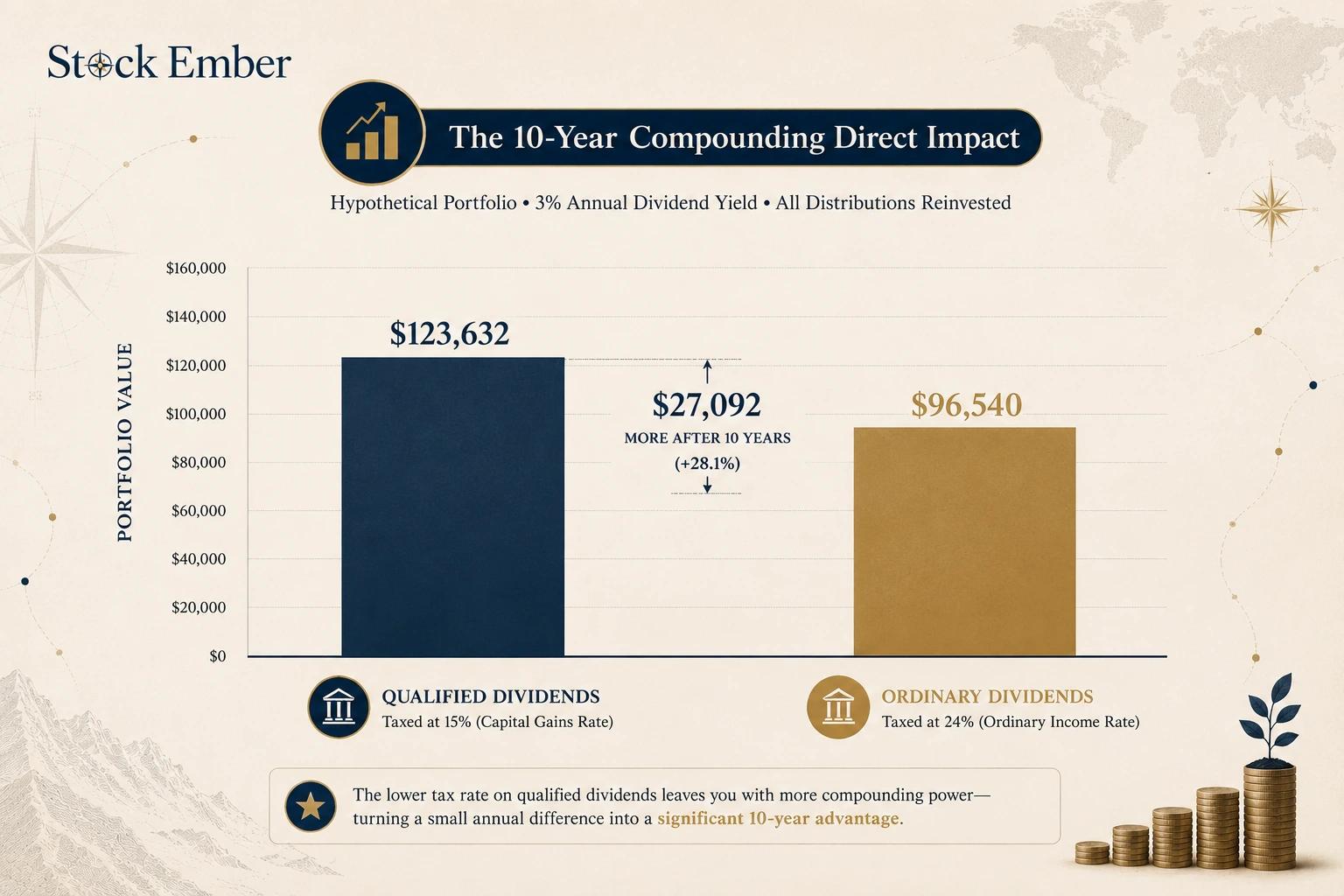
The 10-Year Compounding Direct Impact
The tax difference between ordinary and qualified rates might look small on a single quarterly payout, but when measured across a decade, it transforms into a significant structural drag. Fees and taxes compound against your net worth in the exact same manner that investment returns compound for it.
Consider a hypothetical portfolio yielding 3% annually in distributions. If those payouts are treated as ordinary income and taxed at a marginal rate of 24%, nearly a quarter of your yield is chopped away every single year before it can be reinvested. If those same dividends are qualified and taxed at a capital gains rate of 15%, you retain an extra 9% of your cash flow each season. Over 10 years, this structural tax savings quietly compounds, leaving you with a visibly larger portfolio asset base simply because less money was surrendered to annual tax friction.
The 10-Year Compounding Direct Impact
Common Pitfalls: Payouts That Never Qualify
Not all market payouts are capable of achieving qualified status, regardless of how long you hold the underlying asset. A common mistake is assuming that any distribution from a major publicly traded entity qualifies for lower tax rates.
Certain corporate structures are intentionally designed to pass profits directly to investors without paying corporate-level taxes. Because these entities skip the corporate tax layer, the IRS rules that their distributions cannot be qualified.
Real Estate Investment Trusts (REITs): Under IRS rules governing REIT qualification (see IRS Topic No. 404), these structures must distribute at least 90% of taxable income to shareholders, resulting in payouts that are almost always taxed as ordinary income.
Master Limited Partnerships (MLPs): These issue partnership distributions rather than corporate dividends, carrying distinct tax reporting rules.
Shorted Shares: If you manufacture a dividend because you hold a short position on a stock during its distribution date, that payment is structurally ordinary.
Additionally, long-horizon investors must beware of the classic "dividend trap." Chasing an exceptionally high yield from a fundamentally weak business often results in capital losses that completely wipe out any structural tax advantages. A low tax rate on a dividend provides no benefit if the underlying stock price depreciates severely due to failing operations.
Conclusion
Qualified dividends serve as a powerful tool for enhancing the long-term tax efficiency of a portfolio, but they should never serve as the sole reason to buy an individual stock. True wealth accumulation relies on a balanced evaluation of total return, corporate fundamentals, and broad diversification. When you are ready to evaluate diversified baskets that automatically track these assets while managing holding periods efficiently at scale, exploring institutional ETF reviews is a natural next step.
FAQ
4 questions
What specific holding period is required for a dividend to be classified as qualified?
To qualify for lower long-term capital gains tax rates in the US, you must hold the underlying stock for more than 60 days during a 121-day window that starts 60 days before the ex-dividend date.
Are foreign company dividends eligible for US qualified dividend tax rates?
Yes, provided the foreign corporation is eligible for benefits under a comprehensive US income tax treaty or its underlying stock/ADR is readily tradable on an established US securities market.
How are non-qualified ordinary dividends taxed compared to qualified dividends?
Non-qualified (ordinary) dividends are taxed as regular income at standard marginal tax rates (up to 37%), whereas qualified dividends are taxed at preferential long-term capital gains rates (0%, 15%, or 20%).
Do dividends from REITs and money market funds count as qualified dividends?
Generally, no. Dividends paid by Real Estate Investment Trusts (REITs) and money market funds are typically derived from operational rental income or interest earnings, making them taxable as non-qualified ordinary income.
Disclaimer
This guide was written with AI assistance and reviewed by the StockEmber editorial team for accuracy. StockEmber provides independent education, not personal financial advice. Some links may support our work at no additional cost to you.
The StockEmber Team is our in-house desk of independent research writers. We test brokerage platforms, read the fine print on fees and custody, and cover ETFs and long-horizon investing for people who plan to hold for decades — not days.