Dividend stocks are publicly traded corporations that regularly distribute a portion of their corporate earnings directly to shareholders. These payouts are typically managed on a reliable quarterly cycle by mature companies with stable, long-term cash flows. However, these cash distributions are entirely discretionary and are not legally binding obligations of the corporation.
Publicly traded corporations that share a portion of their corporate earnings directly with investors are known as dividend stocks and understanding what are dividend stocks starts with recognizing how these equities distribute cash dynamically based on corporate policy, shifting a portfolio's return engine from pure price speculation to a blend of current income and structural equity growth.
For long-horizon investors, these assets form a core pillar of a buy-and-hold strategy. Rather than forcing you to liquidate shares to generate cash, dividend-paying equities distribute capital while your underlying share count remains intact. This guide explores how these payouts function, the mathematical realities of share price adjustments on the exchange, tax classifications, and the critical structural risks of yield-chasing.
Quick Takeaways
01Dividend stocks are mature companies that distribute a portion of profits directly to shareholders rather than reinvesting all earnings into growth.
02On the ex-dividend date, the exchange adjusts the stock's opening reference price downward by the amount of the cash payout, all else being equal.
03Long-term compounding relies heavily on reinvesting these distributions over a multi-decade horizon to accelerate share accumulation.
04High dividend yields can be value traps, where a spiking percentage reflects a collapsing stock price rather than corporate health.
05Corporate boards have zero legal obligation to pay common dividends and can cut or eliminate them instantly during operational stress.
What Is a Dividend Stock?
When evaluating equity markets, understanding what is a dividend stock comes down to the operational maturity and capital allocation choices of a corporation. Corporations generate profit, and their boards of directors face a fundamental choice: reinvest every dollar back into research, development, and expansion, or return a portion of that cash directly to the owners.
Firms that choose the latter path are classified as dividend stocks. These are typically established businesses operating in predictable industries with stable cash flows—such as utilities, consumer staples, and mature financial institutions. Because these enterprises no longer require massive capital injections to achieve double-digit growth, returning cash is often the most efficient way to deliver shareholder value.
For the long-term investor, owning a dividend stock means you become a direct participant in the company's recurring profitability, establishing a baseline of cash returns that do not depend solely on the whims of stock market valuations.
How Dividend Payouts Work in Practice
The journey of a corporate distribution follows a strict, state-regulated timeline governed by the board of directors. Once a board approves a payout, it declares the specific distribution amount, the record date, and the payment date. However, the most critical date for a buy-and-hold portfolio is the ex-dividend date.
A fundamental equity mechanic that general market commentary frequently glosses over is the structural price adjustment on the exchange.
On the ex-dividend date, the stock exchange automatically adjusts the stock price downward by the exact amount of the upcoming payout.
If a stock closes at $100 the night before its ex-dividend date and owes a $2 distribution, its opening reference price is adjusted to $98 — although the actual market price may open higher or lower depending on trading activity. The cash does not appear out of thin air; it is a structural transfer of value from the company’s balance sheet to the investor's ledger.
These distributions are typically normalized around reliable frequency schedules. Most American corporations distribute cash on a quarterly cadence, whereas semi-annual or annual schedules are more prevalent across European and Asian equity markets. Regardless of the cycle, understanding what is a dividend requires viewing it as an intentional subtraction from corporate cash reserves, not a magical bonus added to your shares.
Why Dividend-Paying Equities Matter to Buy-and-Hold Portfolios
When measuring the performance of an equity portfolio over a 10-year horizon, your true metric of success is total return. Total return is the absolute combination of capital gains (price appreciation) and distributed cash. According to S&P Dow Jones Indices' published research on long-run total returns, reinvested cash dividends have historically accounted for a meaningful share of overall equity market total returns, acting as a powerful compounding engine over multi-decade holding periods.
To understand the mechanics of compounding over 10 years, look at how distributed cash behaves when systematically fed back into the market. A 1% or 2% annual distribution might appear negligible over a single quarter. However, if you run a portfolio for a decade and systematically use those distributions to buy more shares via a Dividend Reinvestment Plan (DRIP), the math changes completely.
Those new shares immediately begin earning their own dividends, accelerating your total share accumulation without requiring you to inject fresh external capital. Over a 10-year stretch, this cycle quietly builds structural resilience, transforming nominal returns into an expanded asset base.
Furthermore, these equities provide structural volatility mitigation. During prolonged market downturns or flat macro cycles where stock prices remain stagnant, the consistent cash flow from mature value stocks provides a tangible return. This structural stability contrasts sharply with aggressive capital-growth styles, which offer zero cash returns if the underlying stock price declines.
Qualified vs. Non-Qualified Distributions
Not all cash distributions receive identical treatment under the tax code. Long-term investors must carefully differentiate between distributions based on asset locations and holding periods, as taxes can quietly erode your net 10-year returns.
In the United States, distributions are split into two primary buckets:
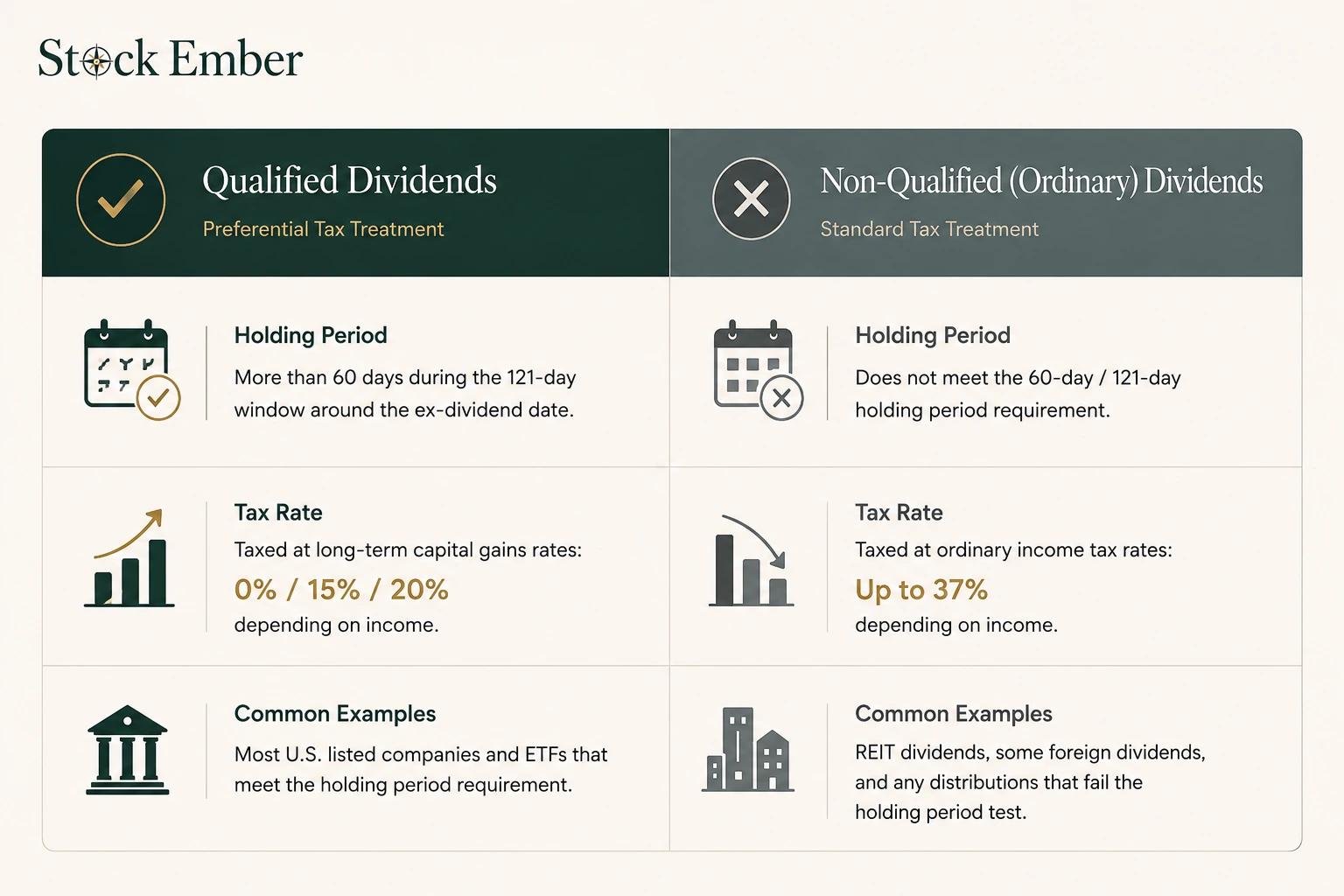
Qualified vs. Non-Qualified Distributions
Qualified Dividends: These distributions are eligible for preferential tax treatment, matching the lower long-term capital gains tax rates (typically 0%, 15%, or 20% depending on income, per Internal Revenue Service (IRS) guidance as of 2026). To achieve this status, the underlying equity must be held for more than 60 days during the 121-day window surrounding the ex-dividend date, as defined in IRS Publication 550. Understanding what is a qualified dividend is essential for maximizing the efficiency of taxable brokerage accounts.
Non-Qualified (Ordinary) Dividends: These payouts do not meet the strict statutory holding periods or stem from specific entities like Real Estate Investment Trusts (REITs). They are taxed at standard ordinary income tax brackets, which can climb significantly higher than capital gains rates, dragging down the net compounding speed of your portfolio.
Structural Risks: High-Yield Value Traps and Dividend Cuts
While the appeal of steady cash distributions is clear, behavioral biases frequently lead ungrounded investors into severe capital preservation traps. The most dangerous of these is chasing absolute high trailing yields.
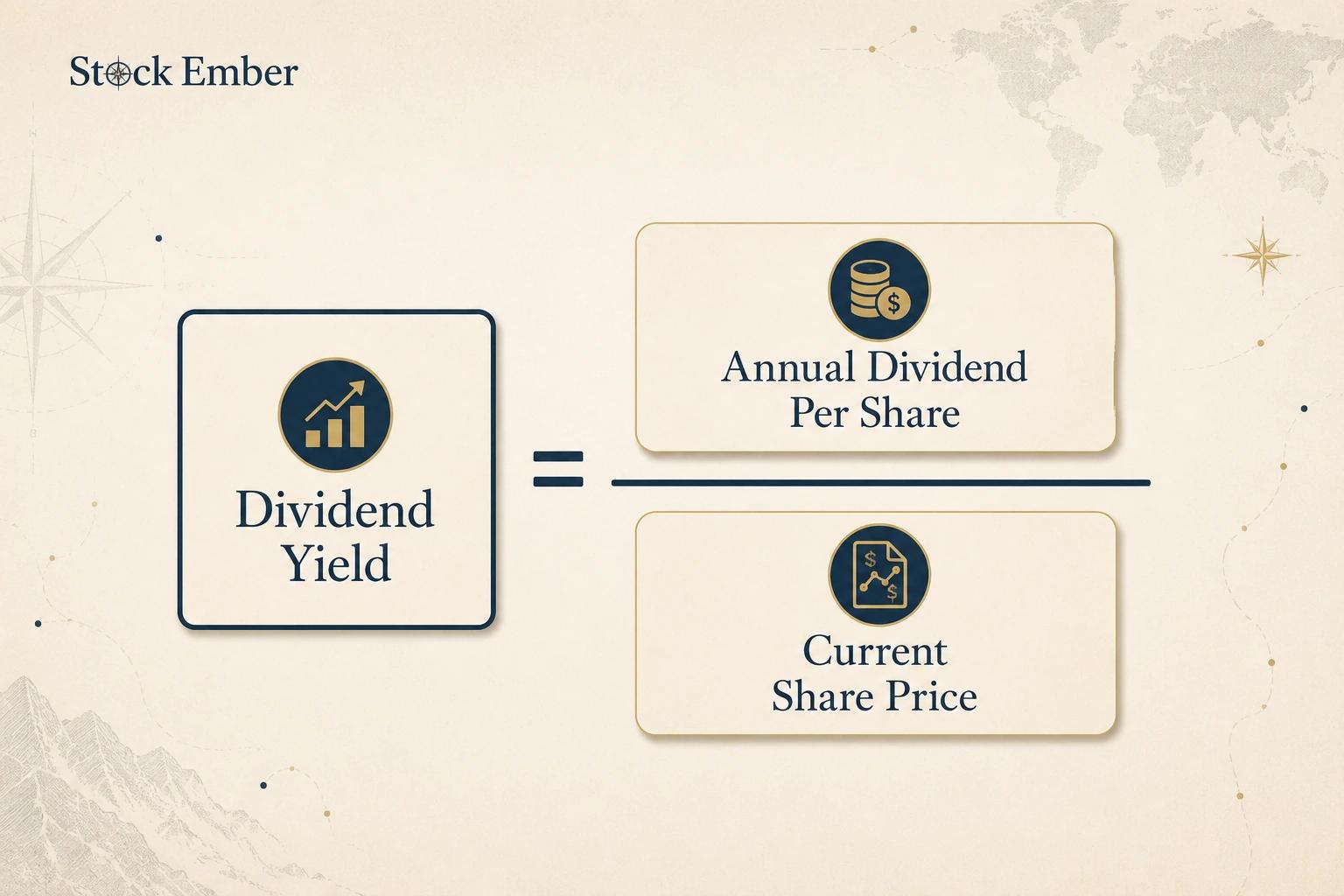
A stock's dividend yield is a dynamic mathematical equation:
A dynamic mathematical equation
Because the current share price rests in the denominator, a crashing stock price artificially inflates the trailing yield percentage. If a company paying a $4 annual dividend drops from $100 a share down to $20 due to structural business failure or massive debt, its trailing yield spikes from a reasonable 4% to an eye-catching 20%.
Investors must always remember that common stock distributions are entirely subject to board discretion. Corporate boards possess absolute legal freedom to slash, suspend, or permanently eliminate payouts instantly during periods of operational strain or liquidity crises. When a distressed firm cuts its distribution to preserve cash, yield-chasing investors face a double loss: the cash flow vanishes, and the underlying stock price typically collapses further as the market reacts to the negative signal.
Conclusion
Dividend stocks have long served as durable instruments for periodic cash generation and structural compounding, although payout levels always remain subject to board discretion. They offer a tangible method to extract value from mature corporate earnings over a multi-decade timeline. However, they are not magical wealth accelerators, nor are they immune to structural corporate decay.
A disciplined buy-and-hold strategy requires looking past the nominal yield percentage to rigorously evaluate a corporation's balance sheet health, payout ratios, and cash flow durability. Rather than viewing distributions as isolated "passive income," they should be treated as one component of a holistic total-return plan tailored to your specific horizon and risk tolerance.
FAQ
4 questions
Are dividend-paying stocks safer than growth stocks during market downturns?
Dividend stocks are often issued by mature, cash-generative businesses, which can offer price stability during market declines. However, they remain equity investments subject to market volatility, and payouts can be cut if underlying cash flow falls.
What is the risk of buying high-yield dividend stocks without examining fundamentals?
Extremely high yields often stem from a plummeting share price caused by deteriorating business health. If cash flow cannot sustain the dividend, management may slash the payout, resulting in capital losses.
How does dividend reinvestment contribute to total return over a 10-year period?
Reinvesting dividends automatically purchases additional shares, accelerating compound growth. Over long horizons, dividend reinvestment has historically accounted for a substantial portion of total stock market equity returns.
Can a company cut or eliminate its dividend during economic recessions?
Yes. Unlike bond interest payments, common stock dividends are paid at the board of directors' discretion. If earnings or free cash flow decline sharply, management can reduce or pause payouts to conserve capital.
Disclaimer
This guide was written with AI assistance and reviewed by the StockEmber editorial team for accuracy. StockEmber provides independent education, not personal financial advice. Some links may support our work at no additional cost to you.
The StockEmber Team is our in-house desk of independent research writers. We test brokerage platforms, read the fine print on fees and custody, and cover ETFs and long-horizon investing for people who plan to hold for decades — not days.