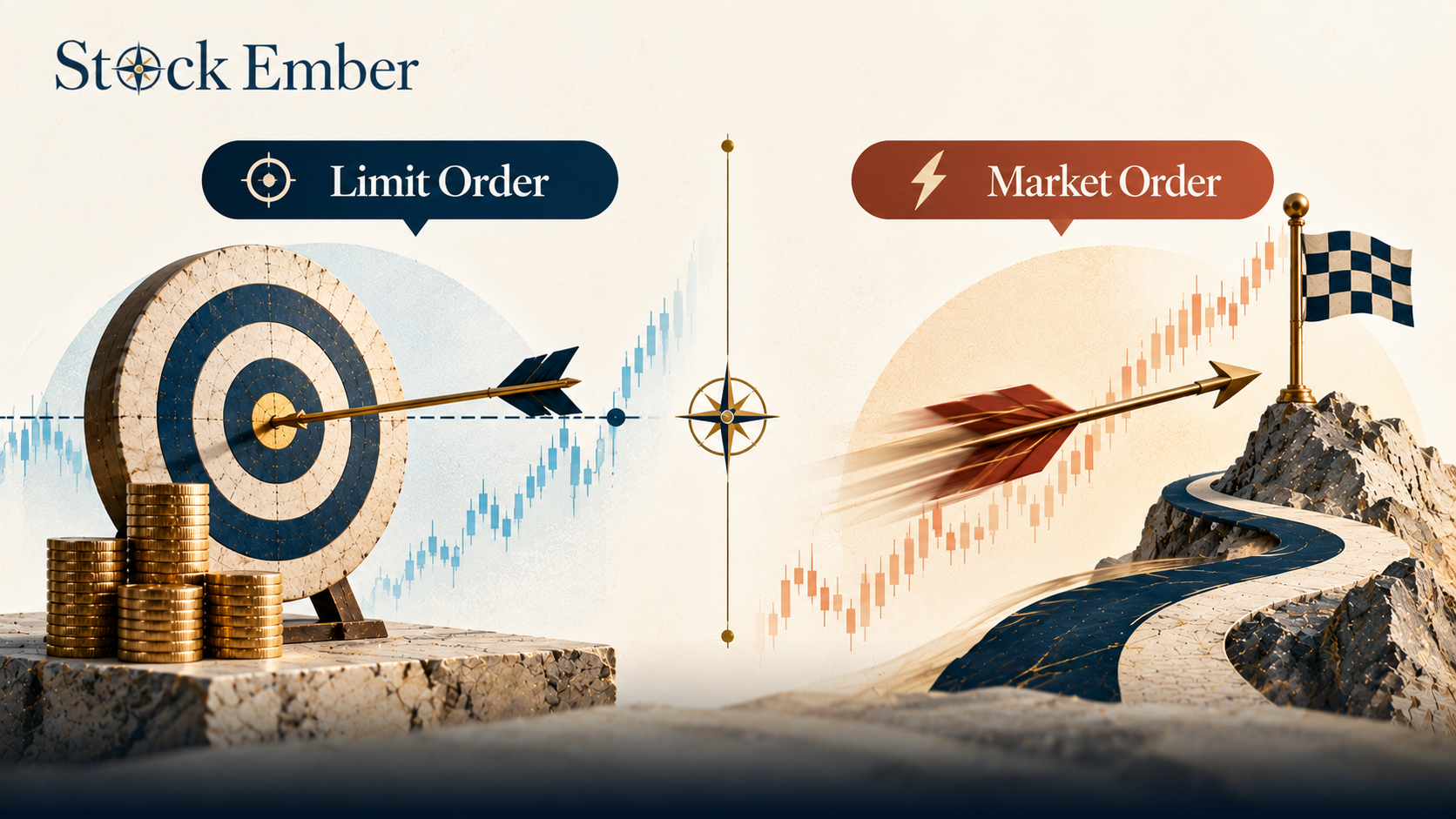
A limit order is a conditional instruction to buy or sell a security at a specified price or better, rather than accepting the prevailing market rate. Buy limits establish a maximum price ceiling for purchases, while sell limits set a minimum price floor for sales. While this order type guarantees that an investor will never pay more than intended, it does not guarantee that the trade will actually execute.
A limit order is an instruction to buy or sell a security at a specified price or better. It gives investors complete control over their execution price by setting a maximum ceiling for purchases and a minimum floor for sales.
When you place a trade, watching share prices move by several pennies or dollars in seconds can feel unsettling. While controlling your entry or exit price prevents unexpected trading costs, holding out for an exact price introduces the risk that your order may never execute at all.
This guide explains the mechanics of limit orders, how order books match buyers with sellers, and how patient buy-and-hold investors balance price control against execution certainty.
Quick Takeaways
01A buy limit order executes only at your specified limit price or lower, while a sell limit order executes only at your limit price or higher.
02Limit orders guarantee your execution price or a better one, but they do not guarantee that the trade will actually fill.
03Attempting to save small amounts on share purchases can cause investors to miss multi-year market gains if the price moves away.
04Good-’Til-Canceled orders require active monitoring to prevent old, forgotten instructions from filling after market conditions change.
What Is a Limit Order? (Definition and Meaning)
A limit order is a conditional trade order that tells your broker to execute a trade only if the market reaches your designated price. In trading terminology, the limit order definition describes an order that prioritizes price protection over transaction speed. The broader limit order meaning centers on setting strict financial boundaries before entering the market.
As established by the U.S. SEC, a buy limit order can only be executed at the limit price or lower, and a sell limit order can only be executed at the limit price or higher.
To see how this works in practice, consider the two directions an investor can take:
Buy Limit Order: Sets a price ceiling. If an exchange-traded fund (ETF) trades at $102 per share, you can set a buy limit at $100. Your broker will only execute the trade if sellers are willing to transact at $100 or less. If the price drops to $99.90, your order fills at that improved price. If the price never falls to $100, the trade does not occur.
Sell Limit Order: Sets a price floor. If you own shares currently valued at $50 and wish to sell, you might place a sell limit at $55. Your broker will execute the order only if a buyer pays $55 or more. If the market price remains at $53, your shares remain in your portfolio.
How a Limit Order Works: Order Books and Execution Rules
The process behind limit order explained simply relies on an exchange's electronic order book. An order book is a real-time ledger listing all open buy orders (bids) and sell orders (asks) organized by price and arrival time.
When you submit an order through your brokerage account, your broker routes the request to an exchange. If your limit price does not match any current seller or buyer, your order rests in the order book. It remains queued behind other orders placed earlier at that same price level. Most U.S. exchanges rank resting orders by price first and then by time of arrival (price-time priority), though each exchange sets its own priority rules.
For example, displayed orders typically rank ahead of hidden orders at the same price. Every limit order also includes a time-in-force condition that determines how long the instruction stays active:
Day Order: Remains open only until the regular trading session closes for the day. If unfilled by the closing bell, the order cancels automatically.
Good-’Til-Canceled (GTC): Remains open across multiple trading days until it fills, until you manually cancel it, or until the brokerage’s maximum duration window expires. This limit varies by brokerage, commonly around 60 to 90 calendar days, so check your broker’s policy.
Limit Orders vs. Market Orders: Price Certainty vs. Execution Speed
The primary difference between a limit order and a market order comes down to choosing between price control and execution speed.
A market order instructs your broker to buy or sell immediately at the best available current market price. It guarantees rapid execution, but leaves you vulnerable to slippage, the difference between the quoted price on your screen and the actual price where the trade fills.
In contrast, a limit order guarantees price certainty while accepting the risk of non-execution. Investors often evaluate limit orders alongside conditional stop orders, which trigger market orders only after a security crosses a specific price threshold.
Diagram comparing limit order price control with market order execution speed
Feature / Attribute
Limit Order
Market Order
Execution Speed
Slower; waits for matching price
Immediate during open market hours
Price Guarantee
Guaranteed at limit price or better
No price guarantee; takes current ask/bid
Execution Certainty
Low; order may remain unfilled
Very high; fills as long as volume exists
Slippage Risk
Zero price slippage beyond limit
Vulnerable to sudden price spikes
Best Used For
Volatile stocks, wide spreads, patient entry
Highly liquid funds, urgent execution
For highly liquid index funds and broad-market ETFs with penny-wide spreads, market orders during standard trading hours often fill cleanly. However, during market openings or when trading less liquid securities, limit orders protect investors from sudden price swings.
The 10-Year Cost of "Penny Pinching": Non-Execution and Opportunity Cost
While price protection is valuable, the biggest risk for long-term investors using limit orders is non-execution caused by attempting to save small sums on entry prices.
Suppose an investor decides to purchase $10,000 worth of a broad-market index fund currently trading at $100 per share. Hoping to get a bargain, the investor sets a buy limit order at $99.50, trying to save $0.50 per share (a 0.5% discount).
The fund dips to $99.60 before reversing course and climbing steadily. Because the price never hit $99.50, the trade never executed. Over the following 10 years, if that broad market index delivers an illustrative 7% average annual return, a hypothetical figure, not a guarantee, since actual returns can be lower or negative in any given year, that original $10,000 allocation would have grown to roughly $19,670.
By attempting to save $50 on the initial trade, the investor would have missed out on nearly $9,670 in potential, non-guaranteed wealth accumulation because the cash sat on the sidelines. For a buy-and-hold investor planning to hold assets for a decade or more, missing market participation over a few pennies of spread is far more expensive than paying the prevailing market price.
Common Pitfalls: Stale Orders and Partial Fills
Using limit orders effectively requires understanding two frequent operational pitfalls:
Stale Orders: When you set a Good-’Til-Canceled order and forget about it, market realities can shift over several weeks. If an underlying company suffers structural damage, a loss of key contracts, or management fraud, its stock price may plunge. An open buy limit order placed two months prior will gladly fill at your target price, buying you shares in an enterprise whose investment thesis has broken.
Partial Fills: If you place a limit order to purchase 200 shares at $50, but only 50 shares are available at that price before the market moves upward, your broker will execute a partial fill. Depending on your broker's fee structure, partial executions filled across different trading days may incur separate commission fees or leave you holding an odd lot of shares.
In practice, many long-term investors find that when buying core index holdings, setting a "marketable limit order" placing a buy limit a few pennies above the current ask price, offers the best balance. It protects against unexpected price spikes while ensuring the order fills promptly without stranding your capital.
Conclusion
A limit order provides complete control over your trade execution price, protecting you from unexpected slippage and wide bid-ask spreads during periods of market volatility. By setting explicit price ceilings for purchases and floors for sales, you ensure that transactions only take place on terms you find acceptable.
However, price control always comes at the expense of execution certainty. For long-horizon investors, the opportunity cost of an unfilled order often outweighs the modest savings of bidding below the market price. When you are ready to evaluate trading platforms and account features, our broker reviews provide detailed comparisons of execution quality, fee structures, and tools.
Trade order types control price mechanics, but they do not eliminate market risk. All equity investments carry the risk of capital loss, and maintaining a disciplined, diversified plan remains the foundation of long-term financial success.
FAQ
5 questions
Does a limit order guarantee execution?
No. A limit order guarantees your execution price or a better one, but it does not guarantee that the trade will execute. If the security's market price never reaches your specified limit price, or if there is not enough trading volume available at that price level before the market moves away, your order will remain unfilled and your cash or shares will stay in your account.
Can a limit order result in a partial fill?
Yes. A partial fill occurs when the market reaches your limit price, but there are fewer shares available at that price than you requested. For example, if you place an order to buy 100 shares at $50, but only 40 shares are offered at that price, your broker will purchase those 40 shares. The remaining 60 shares stay active on the order book until filled or canceled.
How long does a limit order stay active?
How long a limit order stays active depends on the time-in-force instruction you select when placing the trade. A standard Day order expires automatically when regular trading hours close for the session. In contrast, a Good-'Til-Canceled (GTC) order stays open across multiple trading days until it fills, until you manually cancel it, or until the brokerage's maximum duration window expires, which typically ranges from 60 to 90 days.
Can you cancel or modify a limit order after placing it?
Yes. You can cancel or modify a limit order at any time, provided that the order has not yet been filled or executed by an exchange. Most online trading platforms allow investors to edit the limit price, adjust the number of shares, or cancel the order entirely through their open orders dashboard with a single confirmation, without incurring extra cancellation penalties.
Do brokers charge fees for limit orders that do not execute?
Major online brokers generally do not charge commission or cancellation fees for limit orders that go unfilled or expire. Because electronic exchanges only process transaction fees when an order successfully clears and settles, an unfilled order costs you nothing directly in platform fees. However, keeping cash tied up in an unfilled order can carry an indirect opportunity cost if other buying opportunities pass.
Disclaimer
This guide was written with AI assistance and reviewed by the StockEmber editorial team for accuracy. StockEmber provides independent education, not personal financial advice. Some links may support our work at no additional cost to you.
The StockEmber Team is our in-house desk of independent research writers. We test brokerage platforms, read the fine print on fees and custody, and cover ETFs and long-horizon investing for people who plan to hold for decades — not days.