A CUSIP number is a nine-character alphanumeric code used to identify financial securities across the United States and Canada. Managed by CUSIP Global Services, it standardizes trade clearing, settlement, and recordkeeping for stocks, bonds, ETFs, and mutual funds. While retail investors trade using ticker symbols, back-office financial systems rely on CUSIP numbers to track legal ownership and corporate actions.
A CUSIP number is a unique nine-character alphanumeric identifier assigned to stocks, bonds, ETFs, and mutual funds issued in the United States and Canada. It standardizes security identification across financial markets, allowing clearinghouses, custodian institutions, and trading networks to track trades accurately.
You'll usually buy assets using familiar ticker symbols, but back-office clearing systems rely entirely on CUSIP numbers to track legal ownership. When corporate mergers, stock splits, or name changes occur, this underlying code ensures your holdings remain accurately accounted for on tax forms and account statements. Understanding how this system works helps you decipher portfolio records with complete confidence.
Quick Takeaways
01A CUSIP number is a nine-character code used to track U.S. and Canadian financial securities during trade clearing and settlement.
02The nine characters represent three distinct components: the issuer code, the specific issue code, and a computational check digit.
03While ticker symbols can change during exchange transfers or corporate rebranding, CUSIP numbers preserve the exact identity of an asset throughout its lifecycle.
04Fixed-income investments like corporate and municipal bonds lack simple ticker symbols, making CUSIP numbers the primary identifier for debt instruments.
What Is a CUSIP Number?
A CUSIP number—short for Committee on Uniform Securities Identification Procedures—is the standard identifier used to track financial assets throughout the U.S. and Canadian financial systems. Developed in 1964 and formally adopted in 1968, the system was created to eliminate operational chaos during high-volume trading eras when paper certificates were processed manually.
The system is owned by the American Bankers Association (ABA) and managed by CUSIP Global Services (CGS), an organization operated by FactSet Research Systems. CGS assigns unique numbers to virtually every class of public financial instrument, including equities, exchange-traded funds (ETFs), mutual funds, municipal bonds, corporate debt, and U.S. Treasuries.
If you've ever asked yourself what is a CUSIP number when reviewing a dividend statement or trade confirmation, remember that it serves as an asset's permanent fingerprint. While retail platforms emphasize short ticker symbols for simple ordering, clearing systems use CUSIP numbers to transfer ownership seamlessly without ambiguity.
How a CUSIP Number Is Structured
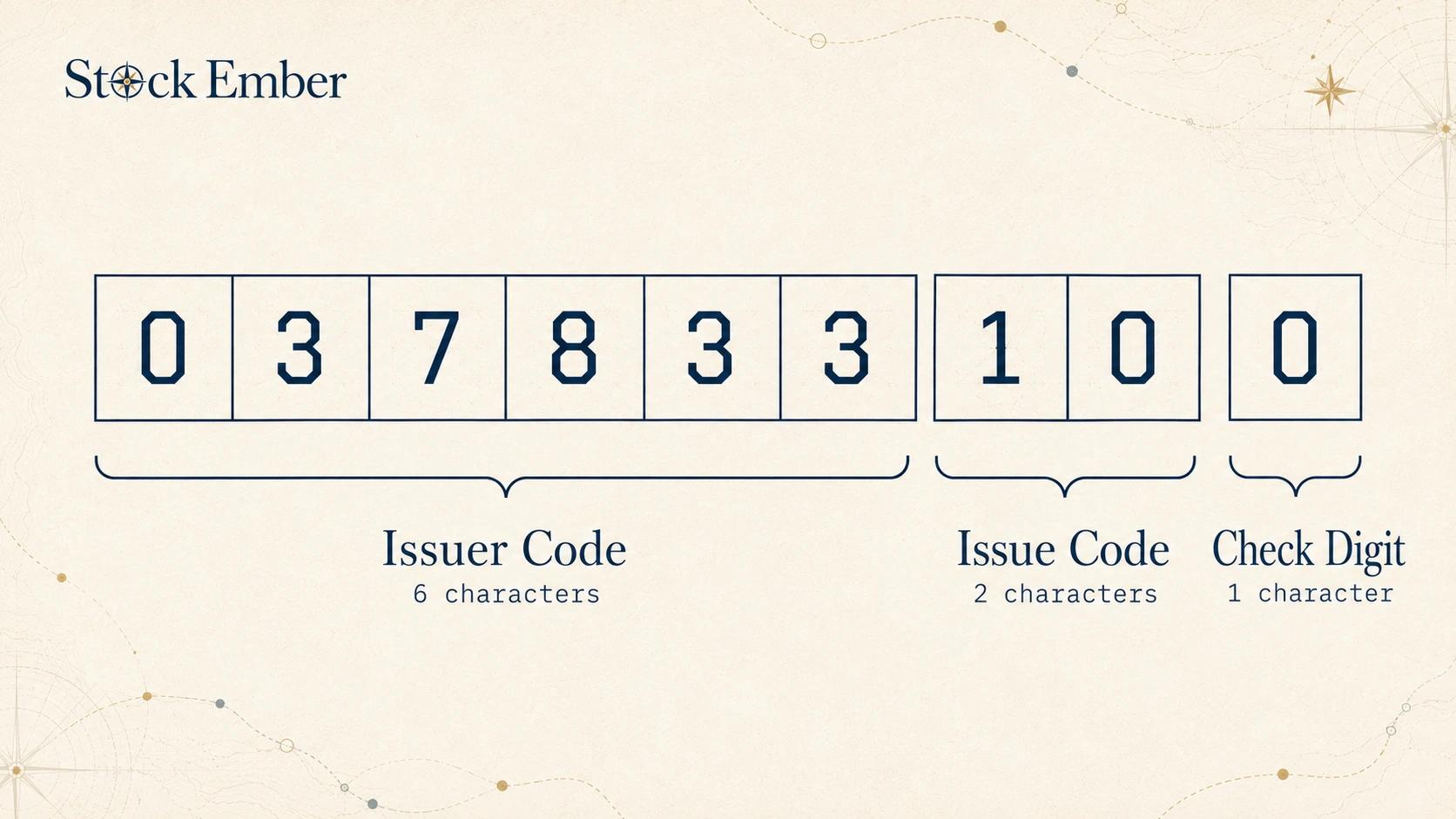
Every CUSIP number uses a strict nine-character formula divided into three distinct segments that specify the issuer, the asset type, and a computational check digit.
Diagram breaking down the nine-character structure of a CUSIP number
The nine characters follow a standardized format across all registered assets:
Characters 1–6 (Issuer Code): The first six characters—a combination of numbers and letters—identify the specific corporation, government body, or municipal authority that issued the security.
Characters 7–8 (Issue Code): The seventh and eighth characters define the exact type of asset being issued. For example, they distinguish between a company's common stock, preferred stock, or a specific bond tranche maturity date.
Character 9 (Check Digit): The final character is an automatically generated digit produced by a mathematical formula known as the Modulus 10 Double-Add-Double algorithm. Clearinghouse computers use this digit to detect typos or transmission errors instantly when orders process through financial networks.
By combining these three elements, two securities from the same company will never share identical identifiers. A firm's common stock and its corporate bond will share the same initial six characters but carry entirely different issue codes.
CUSIP vs. Ticker Symbol vs. ISIN: What’s the Difference?
Security identifiers differ primarily by their operational role: ticker symbols facilitate retail trading, CUSIP numbers handle regional back-office settlement, and ISINs manage international cross-border transactions.
Identifier Feature
Ticker Symbol
CUSIP Number
ISIN (International Securities Identification Number)
Length & Format
1–5 letters
9 alphanumeric characters
12 alphanumeric characters
Primary Region
Exchange-specific (U.S./Global)
United States and Canada
Global (180+ countries)
Primary Purpose
Fast retail trading execution
Settlement and recordkeeping
Cross-border trading & custody
Uniqueness
Can change or be reused
Permanent to the issue
Permanent globally
To turn a CUSIP number into an ISIN, international standards pad the U.S. or Canadian CUSIP with a two-letter country code (such as "US") at the front and a final validation digit at the end. This allows global clearing networks to recognize North American assets seamlessly.
Why CUSIP Numbers Matter for Long-Term Investors
While day-to-day portfolio management rarely requires memorizing identifiers, CUSIP numbers ensure your long-term ownership records remain intact through decades of market activity.
Over a 10-year holding period, a portfolio undergoes multiple subtle structural transformations. Companies issue stock dividends, split shares, execute corporate buyouts, or change their legal names. When these events occur, exchange ticker symbols often change or temporarily suspend trading. However, back-office clearing systems rely on the CUSIP number to maintain an unbroken record of your cost basis and unit ownership.
When your brokerage holds assets on your behalf, it coordinates with an underlying custodian bank. Custodian banks use CUSIP numbers to guarantee that your assets remain strictly segregated and verified, preventing legal confusion if a brokerage platform ever faces financial restructuring.
Additionally, if you hold individual municipal or corporate bonds, ticker symbols generally do not exist. Fixed-income securities are bought and sold almost exclusively by referencing their nine-character CUSIP number to pinpoint exact interest rates and maturity dates.
Where to Find a CUSIP Number on Your Statements
You can locate a security's CUSIP number on official financial paperwork, including transaction confirmation slips, year-end tax forms, and detailed brokerage statements.
When reviewing monthly performance summaries inside your what is a brokerage account dashboard, switching from "simple view" to "expanded transaction details" usually reveals the CUSIP code alongside your holdings.
You will also find CUSIP numbers prominently featured on key documents:
IRS Tax Forms: Forms 1099-B (Proceeds From Broker Transaction) and 1099-DIV list CUSIP numbers to identify securities involved in taxable sales or dividend distributions.
Trade Confirmations: Official trade notices sent after buying or selling a bond, ETF, or stock list the CUSIP to confirm exact execution details.
Fund Prospectuses: Official SEC filings for mutual funds and ETFs list the primary CUSIP on the cover or summary page.
Municipal Bond Portals: Public databases used to search local government bond issues index filings by CUSIP numbers.
Common Pitfalls and Misunderstandings
A common misconception is that a CUSIP number functions as a personal account identifier or a marker of financial stability. In reality, a CUSIP identifies the asset itself, never the individual holding it or the account where it resides.
Another frequent mistake is assuming that because a security holds an official CUSIP number, it carries regulatory endorsement or financial quality. CUSIP Global Services assigns numbers to valid legal issuances purely for administration; assigning a code does not reflect an assessment of an asset's risk or investment value.
Finally, when a public company experiences financial distress and gets delisted from major exchanges, its ticker symbol may disappear from main retail charts. However, the asset retains its CUSIP number so long as legal claims or liquidations are processed through clearing networks.
Conclusion
CUSIP numbers form the silent operational backbone of the North American financial system, ensuring every asset you acquire is accurately recorded, cleared, and settled. While ticker symbols make day-to-day investing intuitive, nine-character CUSIP codes protect long-term ownership, tracking your portfolio through corporate restructurings, tax reporting, and market changes.
When you are ready to evaluate platforms that handle seamlessly settled securities, our broker reviews provide an in-depth look at top institutions.
FAQ
4 questions
Does a CUSIP number change when a stock splits or changes its name?
A CUSIP number usually remains unchanged during a standard forward stock split. However, a new CUSIP number is assigned if the company undergoes a major corporate restructuring, a name change accompanied by a ticker update, a reverse stock split, or a corporate merger.
Where can individual investors look up a CUSIP number for free?
Investors can locate a security's CUSIP number on trade confirmation statements, official brokerage account statements, company SEC filings (such as Form 10-K or 10-Q), or through the official CUSIP Global Services database lookup tool.
What is the difference between a CUSIP number and an ISIN?
A CUSIP is a 9-character alphanumeric code used primarily to identify domestic securities in the United States and Canada. An ISIN (International Securities Identification Number) is a 12-character global code that incorporates the CUSIP number inside it alongside a two-letter country code prefix.
Can two different securities share the same CUSIP number?
No. Every distinct class of security issued by a entity receives its own unique CUSIP. For example, a company's common stock, preferred stock, and corporate bonds will each carry completely different CUSIP numbers to prevent trade execution errors.
Disclaimer
This guide was written with AI assistance and reviewed by the StockEmber editorial team for accuracy. StockEmber provides independent education, not personal financial advice. Some links may support our work at no additional cost to you.
The StockEmber Team is our in-house desk of independent research writers. We test brokerage platforms, read the fine print on fees and custody, and cover ETFs and long-horizon investing for people who plan to hold for decades — not days.