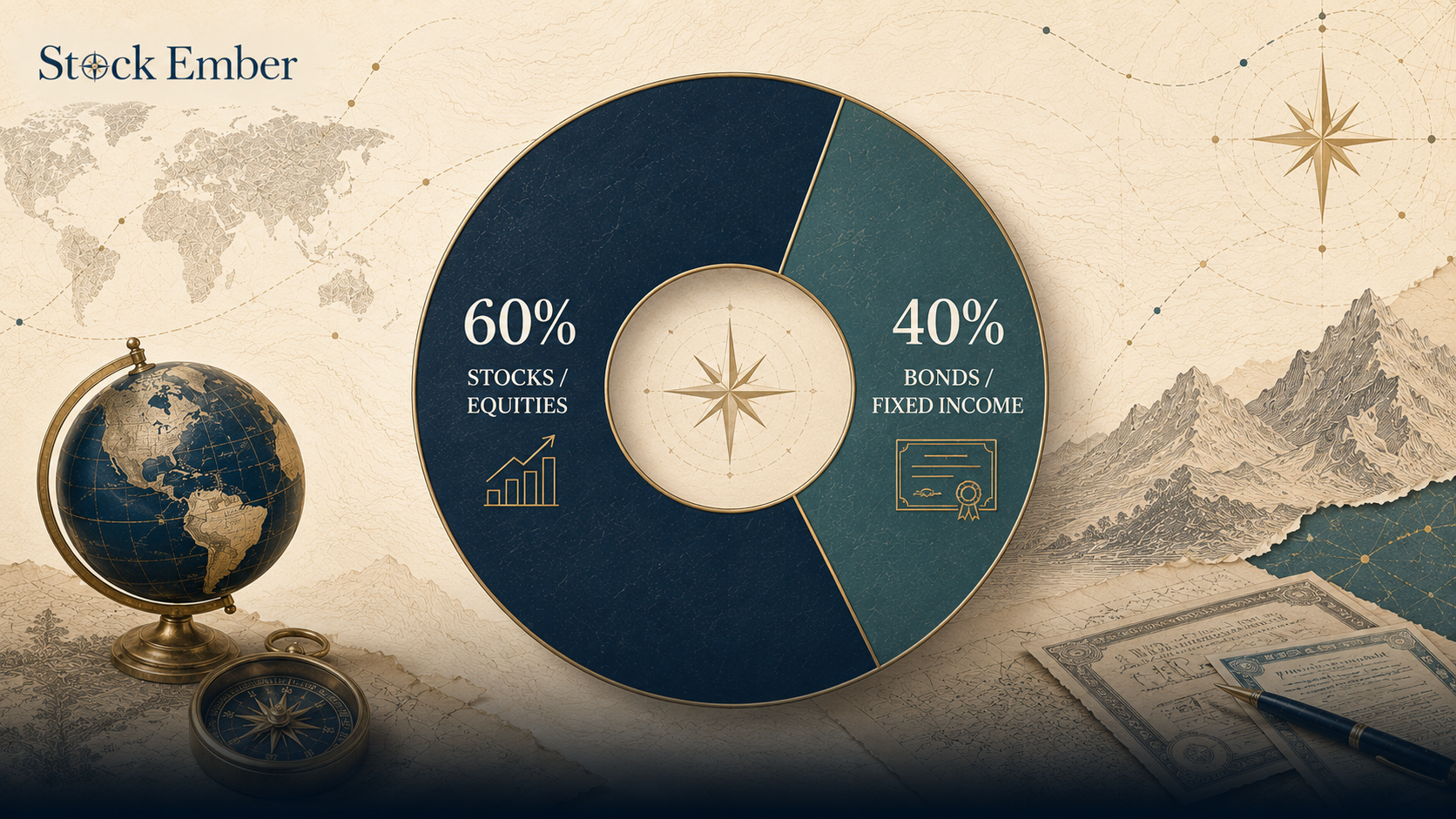
A 60/40 portfolio is a traditional multi-asset investment strategy that allocates 60% of capital to growth-oriented equities and 40% to defensive bonds or fixed income. By combining stocks for long-term compound growth with bonds for stability and yield, this strategy helps moderate overall portfolio drawdowns during broad stock market sell-offs.
A 60/40 portfolio is a classic asset allocation strategy that invests 60% of capital into equities for long-term growth and 40% into fixed income for capital preservation and steady income.
So, what is a 60/40 portfolio in practical terms? Navigating stock market downturns can be challenging for investors who want growth without enduring extreme portfolio swings. Combining growth-oriented equities with stabilizing bond assets offers a balanced framework designed to moderate market drawdowns.
Understanding how this traditional split balances growth, yield, and risk is essential for building a resilient, long-term portfolio strategy.
Quick Takeaways
01A 60/40 portfolio balances capital growth from equities with risk reduction and income from fixed income.
02Bonds historically act as a cushion during stock market downturns, smoothing out overall portfolio volatility.
03Rebalancing once or twice a year maintains the target ratio, systematically enforcing a buy-low, sell-high discipline.
04While a 60/40 allocation lowers downside risk, it surrenders a portion of the total long-term growth potential offered by an all-stock portfolio.
What Is a 60/40 Portfolio?
A 60/40 portfolio is a foundational multi-asset investment strategy that allocates 60% of an investor's total capital to growth-focused stocks and 40% to defensive bonds or fixed income.
Often referred to as a 60/40 portfolio, this balanced allocation serves as a standard benchmark for moderate-risk investors seeking a mix of capital appreciation and downside protection.
By combining two distinct asset classes, a 60/40 allocation aims to achieve competitive long-term compounding while dampening the sharp paper losses that occur during major stock market contractions. How much equity exposure you maintain depends heavily on your individual risk tolerance, as well as your investment horizon and liquidity needs.
How a 60/40 Portfolio Works: Stocks vs. Bonds
A 60/40 portfolio works by pairing high-growth equity assets, which drive long-term capital appreciation, with low-volatility fixed-income assets, which generate steady interest income and cushion portfolio falls.
The 60% equity portion, typically built using broad market index funds or Exchange-Traded Funds (ETFs), captures corporate earnings expansion and rising dividend payouts over time.
The 40% bond component holds high-quality government or corporate bonds, providing regular yield payments while acting as a shock absorber during stock sell-offs.
When you apply what are passive investing to this model, building and maintaining a 60/40 split becomes simple. Investors can hold two low-cost index ETFs, one tracking a broad stock index and one tracking a broad bond index to capture overall market returns without paying high active management fees.
Donut chart displaying a 60% stock and 40% bond asset allocation split.
The 10-Year Trade-off: Volatility vs. Compound Growth
The primary trade-off of a 60/40 portfolio over a 10-year horizon is lower total compound growth compared to a 100% equity allocation, in exchange for significantly reduced portfolio volatility and smaller drawdowns.
Including bonds can reduce a portfolio's overall volatility, but fixed-income securities generally offer lower long-term return potential than equities. Over a decade, this difference in compounding potential becomes noticeable.
Consider an illustrative $10,000 investment over 10 years, assuming the annualized returns:
100% Equity Portfolio (Illustrative 7.5% Annualized Return): Grows to approximately $20,613 over 10 years, but can experience significantly larger temporary market drawdowns during major downturns.
60/40 Portfolio (Illustrative 5.5% Annualized Return): Grows to approximately $17,081 over 10 years and has historically experienced lower volatility than an all-equity portfolio, although it can still suffer significant losses during market downturns.
By surrendering roughly $3,500 in potential 10-year compound growth, the 60/40 investor gains a smoother ride with smaller paper losses, making it easier to stay invested without panic selling. Furthermore, keeping expense ratios ultra-low on both stock and bond ETFs ensures that recurring management fees do not silently consume the yield generated by the 40% bond component.
Portfolio Strategy and Rebalancing Mechanics
Rebalancing a 60/40 portfolio strategy is the process of periodically adjusting asset weights back to their target 60% stock and 40% bond ratio as market price movements cause them to drift.
During strong stock market rallies, the equity share of your portfolio might naturally rise from 60% to 70% or more. If left unadjusted, your portfolio becomes increasingly risky and vulnerable to sudden stock market reversals.
A disciplined portfolio strategy involves rebalancing on a fixed schedule such as once per year or whenever an asset class drifts by more than 5% from its target. Rebalancing forces you to sell a small portion of the outperforming asset (selling high) and buy more of the underperforming asset (buying low), systematically preserving your target risk profile over multi-year horizons.
In practice, many long-term investors find that setting up an automated annual calendar reminder to rebalance takes the emotion out of asset allocation. Selling equities after a massive rally feels counterintuitive, but adhering to fixed allocation rules prevents overexposure right before market pullbacks.
Common Pitfalls and Changing Market Conditions
A 60/40 portfolio faces friction when macroeconomic conditions cause stocks and bonds to decline simultaneously, or when younger investors choose an overly conservative allocation for a decades-long horizon.
While the 60/40 model has a strong multi-decade track record, investors should watch out for three key pitfalls:
Assuming Stocks and Bonds Always Move in Opposite Directions: During periods of high inflation and aggressive interest rate hikes, stock and bond prices can decline at the same time. Bonds still provide income, but they may not offer complete price protection during inflationary shocks.
Choosing 60/40 Too Early in Life:Is a 60/40 portfolio still good for retirement? For retirees or near-retirees needing income and stability, it remains a standard choice. However, younger investors with a 20- to 30-year time horizon may prefer a higher equity allocation if they have the risk tolerance to pursue greater long-term growth.
Neglecting Systematic Rebalancing: Failing to rebalance transforms a balanced 60/40 allocation into a top-heavy stock portfolio during bull markets, exposing investors to unexpected downside volatility when market cycles turn.
Conclusion
In short, what is a 60/40 portfolio? It is a time-tested framework for balancing multi-year equity compounding with downside risk reduction. By combining broad stock funds with high-quality fixed income, investors can smooth out market volatility without abandoning capital growth. Maintaining this balance requires periodic rebalancing and a clear understanding of your personal time horizon and cash needs.
When you're ready to select the core funds for your portfolio, exploring our ETF reviews is a practical next step.
FAQ
5 questions
Is a 60/40 portfolio still good for retirement?
Yes, a 60/40 portfolio remains a standard baseline strategy for retirees and near-retirees seeking capital preservation and steady income. The 40% bond component generates regular yield and cushions against market drawdowns, helping reduce sequence-of-returns risk during retirement withdrawals while the 60% stock component provides essential inflation-hedging growth.
What is the main drawback of a 60/40 portfolio?
The primary trade-off of a 60/40 portfolio is lower long-term compound growth compared to a 100% equity portfolio. Additionally, during periods of rapid interest rate hikes or high inflation, stock and bond prices can decline simultaneously, temporarily reducing the diversification benefits that fixed income traditionally provides.
How often should you rebalance a 60/40 portfolio?
Rebalancing once or twice per year or whenever an asset class drifts by more than 5% from its target weight is generally recommended for a 60/40 strategy. Systematic rebalancing forces you to trim outperforming assets and buy underperforming assets, maintaining your desired risk profile over long horizons.
Can a 60/40 portfolio lose money?
Yes, a 60/40 portfolio can experience paper losses during broad market pullbacks or bond market corrections. While allocating 40% of capital to fixed income significantly moderates volatility relative to an all-equity portfolio, it does not offer guaranteed principal protection or eliminate overall market risk.
What is the difference between a 60/40 portfolio and a 100% stock portfolio?
A 100% stock portfolio maximizes multi-year compound growth potential but subjects the investor to sharp paper losses during market crashes. A 60/40 portfolio trades a portion of that total equity growth potential for a smoother return trajectory, smaller drawdowns, and regular income from bond yields.
Disclaimer
This guide was written with AI assistance and reviewed by the StockEmber editorial team for accuracy. StockEmber provides independent education, not personal financial advice. Some links may support our work at no additional cost to you.
The StockEmber Team is our in-house desk of independent research writers. We test brokerage platforms, read the fine print on fees and custody, and cover ETFs and long-horizon investing for people who plan to hold for decades — not days.