A Dividend Aristocrat is an S&P 500 constituent company that has successfully increased its regular base dividend payout for a minimum of 25 consecutive years. Beyond this timeline, the company must also satisfy strict float-adjusted market capitalization and liquidity requirements to maintain its inclusion in the index.
A Dividend Aristocrat is a high-quality, large-cap company within the S&P 500 index that has successfully increased its regular base dividend payout for a minimum of 25 consecutive years. This designation serves as an objective structural filter used by passive investors to identify mature businesses with historically stable corporate cash flows.
Quick Takeaways
01Inclusion in the S&P 500 Dividend Aristocrats index requires an unbroken 25-year track record of annual dividend increases, alongside strict size and liquidity floors.
02Dividend Aristocrats differ fundamentally from Dividend Kings, which require a minimum of 50 consecutive years of dividend growth.
03While these companies offer mature corporate durability, their heavy concentration in older industrial sectors means investors sacrifice high-growth technology exposure.
04Historical streaks do not insulate portfolios from modern business disruption; a company can cut or suspend its dividend at any moment.
05Accessing these stocks via specialized dividend ETFs incurs compounding management fees that quietly erode long-term returns compared to ultra-low-cost broad market index funds.
The Strict Criteria of the S&P 500 Dividend Aristocrats
To separate true corporate stability from temporary marketing claims, the S&P Dow Jones Indices maintains rigid, rule-based entry requirements. A company cannot simply buy or market its way onto the list.
To join the S&P 500 Dividend Aristocrats index, a firm must meet four core operational criteria simultaneously:
S&P 500 Membership: The company must be an active constituent of the standard S&P 500 index, anchoring it to large-cap US equities.
25 Consecutive Years of Increases: The company must have increased its base dividend per share every single year for at least 25 consecutive years. Maintaining a flat dividend from one year to the next disqualifies the company.
Market Capitalization: The company must maintain a minimum float-adjusted market capitalization, ensuring it remains a large-cap leader.
Liquidity Standards: The stock must meet strict average daily trading volume thresholds to ensure index fund managers can efficiently buy and sell shares without causing artificial price distortion.
Distinguishing Aristocrats from Dividend Kings
Long-term investors frequently confuse Aristocrats with another popular market term: Dividend Kings. While both terms denote dividend longevity, they belong to different classifications:
Dividend Aristocrat: Requires 25 consecutive years of increased payouts and mandatory inclusion within the S&P 500.
Dividend King: Requires a minimum of 50 consecutive years of annual dividend increases. Crucially, a Dividend King does not have to be a member of the S&P 500; it can be a mid-cap or small-cap stock, though many are large enough to sit in both camps.
The Mechanics: How a Company Sustains the Streak
To understand what is a dividend in the context of an Aristocrat, you must look at the underlying corporate accounting. Increasing cash distributions every calendar year for a quarter-century requires the company to navigate recessions, high-inflation environments, and shifting consumer landscapes.
A healthy Aristocrat achieves this balance by maintaining a conservative payout ratio—the percentage of total net income paid out to shareholders as dividends.If a company earns $10 per share and pays out $4 in dividends, its payout ratio is 40%. This leaves a substantial cushion to protect the dividend if earnings temporarily drop during an economic downturn.
If the payout ratio creeps above 70% or 80% over a prolonged period, the company risks running out of operational breathing room, forcing it to choose between underfunding its own business operations or cutting its payout.
Dividend Aristocrats vs. Broad Market Indexing
Choosing to invest specifically in a strategy focused on dividend growth involves distinct structural trade-offs compared to buying a standard, capitalization-weighted broad market index fund.
Feature
S&P 500 Dividend Aristocrats Index
Standard S&P 500 Index
Primary Inclusion Focus
Consistent, unbroken annual dividend growth
Market-capitalization weight
Sector Allocation
Concentrated in Industrials, Consumer Staples, Materials
Heavily concentrated in Technology, Communication Services
Capital Growth Style
Value-oriented, slow-growing, mature business models
Balanced mix of high-growth tech giants and value stocks
Income Yield Profile
Generally higher and growing regular distributions
Lower baseline yield, dependent on tech sector valuations
The Hidden Risks of Anchoring on Past Performance
The label "Aristocrat" can create a powerful cognitive illusion known as anchoring bias. Because a corporate board has prioritized its dividend distribution since the early 2000s, investors frequently anchor their expectations to the past, assuming the cash distribution is permanent.
1. The Reality of the Dividend Cut
No historical track record alters the reality that dividends are completely discretionary corporate actions. The S&P 500 Dividend Aristocrats index is rebalanced regularly. If an economic shock severely damages a company's balance sheet, executives may cut or eliminate the dividend to preserve capital and stave off bankruptcy, which would immediately strip the company of its Aristocrat status. Past performance never guarantees future survival.
2. Sector Concentration Pitfalls
Because technology, biotechnology, and modern digital services companies generally prefer to plow their excess free cash flow directly back into software development and infrastructure rather than paying high cash dividends, they rarely qualify as Aristocrats. Consequently, a portfolio focused exclusively on Dividend Aristocrats will be structurally underweight in the fastest-growing segments of the global economy, leaving you heavily exposed to legacy brick-and-mortar retail, manufacturing, and legacy packaging companies.
3. The Dividend Trap Strategy
Sometimes, maintaining the Aristocrat "badge" turns into a destructive management behavior. Corporate executives, terrified of the negative stock price reaction that accompanies a broken dividend streak, may deliberately underfund long-term research and development, sell off valuable corporate assets, or take on expensive corporate debt just to fund the annual dividend increase. This creates a value trap where the current dividend yield remains intact while the underlying corporate engine slowly decays.
The 10-Year Cost Reality of Dividend ETFs
Many long-horizon investors prefer not to buy dozens of individual stocks manually, opting instead for specialized, niche ETFs that track dividend growth indexes. However, this convenience introduces the critical element of asset management costs, which must be analyzed through a multi-year lens.
Consider the compounding effect of total cost of ownership (TCO) over a 10-year investment horizon. According to official fund provider fact sheets (data as of July 2026), a standard, highly liquid core S&P 500 index ETF can be held for an ultra-low expense ratio of roughly 0.03% annually. In contrast, specialized dividend growth or Dividend Aristocrat ETFs frequently carry expense ratios averaging around 0.35% or higher, based on their published prospectuses.
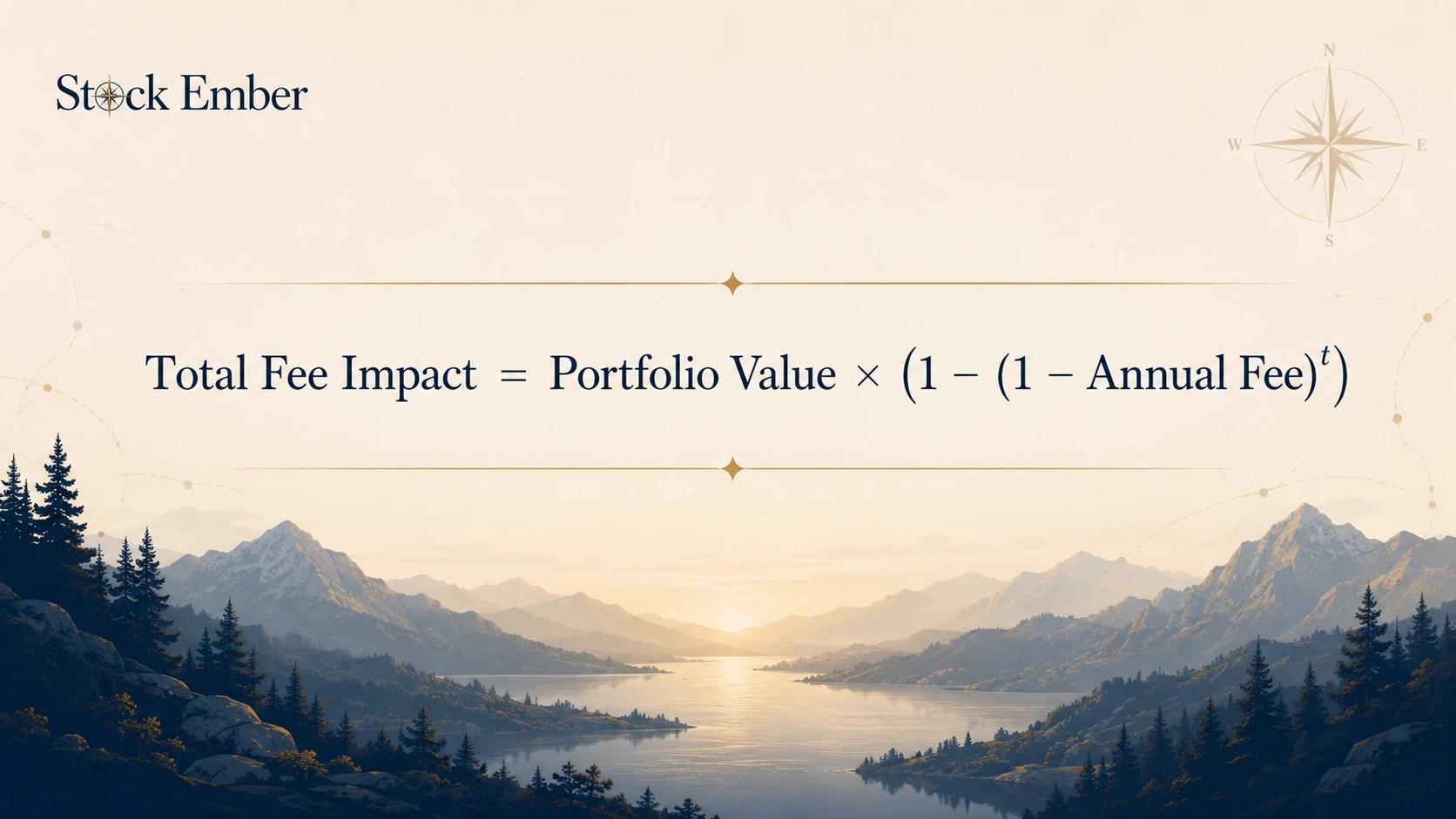
While a fee difference of 0.32% per year appears minor on a factsheet, it operates against your wealth using the exact same mathematical compounding principles that build your returns:
Total fee impact formula
Fund Type
Expense Ratio
Estimated Annual Cost (per $100,000 invested)
Core S&P 500 Index ETF
~0.03%
~$30
Specialized Dividend Aristocrat ETF
~0.35%
~$350
Extra Cost of Dividend Aristocrat ETF
+0.32%
Approximately $320 more each year, before the effects of compounding.
Over a decade, as the table above shows, that elevated annual fee can quietly remove several thousand dollars from the compounding base of a six-figure portfolio. You are paying a premium fee to an investment manager simply to filter out companies that do not meet an arbitrary 25-year timeline, even though broad-market, low-cost index options already naturally contain those exact same market leaders at a fraction of the cost.
Conclusion
Dividend Aristocrats represent an objective benchmark for corporate longevity, showcasing businesses that have demonstrated the operational resilience required to grow their distributions across multiple market cycles. They offer clear visibility for investors who prioritize current cash flow over aggressive capital appreciation.
However, long-term wealth accumulation requires looking past historical badges. Relying blindly on past streaks introduces sector concentration risks and leaves investors vulnerable to corporate value traps. For the vast majority of patient buy-and-hold investors, utilizing broad-market index funds provides a simpler, more diversified path that captures these elite dividend payers naturally without exposing your capital to the eroding effects of inflated specialized management fees. When you are ready to evaluate the investment funds that hold these asset packages, our ETF reviews provide an objective breakdown of fees and structures.
FAQ
5 questions
Can a Dividend Aristocrat stop paying dividends?
Yes. Dividends are completely discretionary corporate distributions. If an economic shock or operational crisis severely impacts a company's balance sheet, the board of directors can cut or entirely suspend the dividend overnight, which immediately removes the company from the Dividend Aristocrats index.
Do Dividend Aristocrats beat the S&P 500?
Historically, the performance varies across market cycles. According to index data published by S&P Dow Jones Indices, because the Dividend Aristocrats index is heavily weighted toward mature industries like industrials and consumer staples, it has often outperformed during bear markets but lagged behind the standard S&P 500 during tech-driven bull markets.
Are Dividend Aristocrats safe investments?
While these companies represent highly mature corporate business models with durable cash flows, they are not risk-free. They remain subject to market volatility, industry disruption, and the structural risk of capital erosion if management prioritizes protecting its dividend streak over reinvesting in growth.
What happens if a Dividend Aristocrat fails to increase its dividend?
If a company fails to increase its total regular dividend per share in any given calendar year—even if it keeps the payout exactly flat—it fails the index's eligibility rules and is removed during the next scheduled rebalancing.
How many Dividend Aristocrats are there?
The exact constituent count changes frequently based on annual index rebalancings. Companies are continuously added as they hit the 25-year milestone or removed due to dividend cuts, flat payouts, corporate mergers, or falling out of the S&P 500 entirely.
Disclaimer
This guide was written with AI assistance and reviewed by the StockEmber editorial team for accuracy. StockEmber provides independent education, not personal financial advice. Some links may support our work at no additional cost to you.
The StockEmber Team is our in-house desk of independent research writers. We test brokerage platforms, read the fine print on fees and custody, and cover ETFs and long-horizon investing for people who plan to hold for decades — not days.