The secondary market is a financial marketplace where investors buy and sell existing securities such as stocks and bonds among themselves. The issuing corporation receives no direct capital or proceeds from secondary market transactions. Stock exchanges and electronic networks facilitate these trades to provide continuous price discovery and asset liquidity.
The secondary market is a financial marketplace where investors buy and sell existing securities such as stocks and bonds among themselves, without direct participation from the issuing corporation.
When you purchase shares of a company through a brokerage account, you might assume your money goes straight to the business. In reality, you are buying those shares from another investor who wishes to sell. Understanding how the secondary market functions helps you evaluate trading liquidity, valuation efficiency, and execution costs over a 10-year horizon.
Quick Takeaways
01The secondary market facilitates security transactions between existing investors without issuing new company equity.
02Issuing corporations receive no direct capital or proceeds when their shares are traded on secondary stock exchanges.
03Stock exchanges provide continuous liquidity, price discovery, and narrow bid-ask spreads for market participants.
04Daily secondary market price fluctuations reflect short-term trading sentiment rather than changes in long-term fundamental business value.
05Long-term passive index investors utilize secondary market liquidity to rebalance portfolios efficiently without engaging in active stock trading.
What Is the Secondary Market?
The secondary market is a financial ecosystem where previously issued financial instruments including equities, corporate bonds, and exchange-traded funds (ETFs) are traded among individual and institutional investors. When you trade on a public stock exchange, you operate entirely within this secondary framework.
Investor-to-Investor Security Transfers
In a secondary market transaction, ownership of existing shares transfers from one investor to another. If Investor A sells 100 shares of a company to Investor B, Investor A receives the sale proceeds, Investor B’s brokerage account is credited with the shares through the securities settlement system, and the underlying corporation receives no direct proceeds from the transaction. The total number of outstanding company shares remains unchanged.
Primary Market vs. Secondary Market
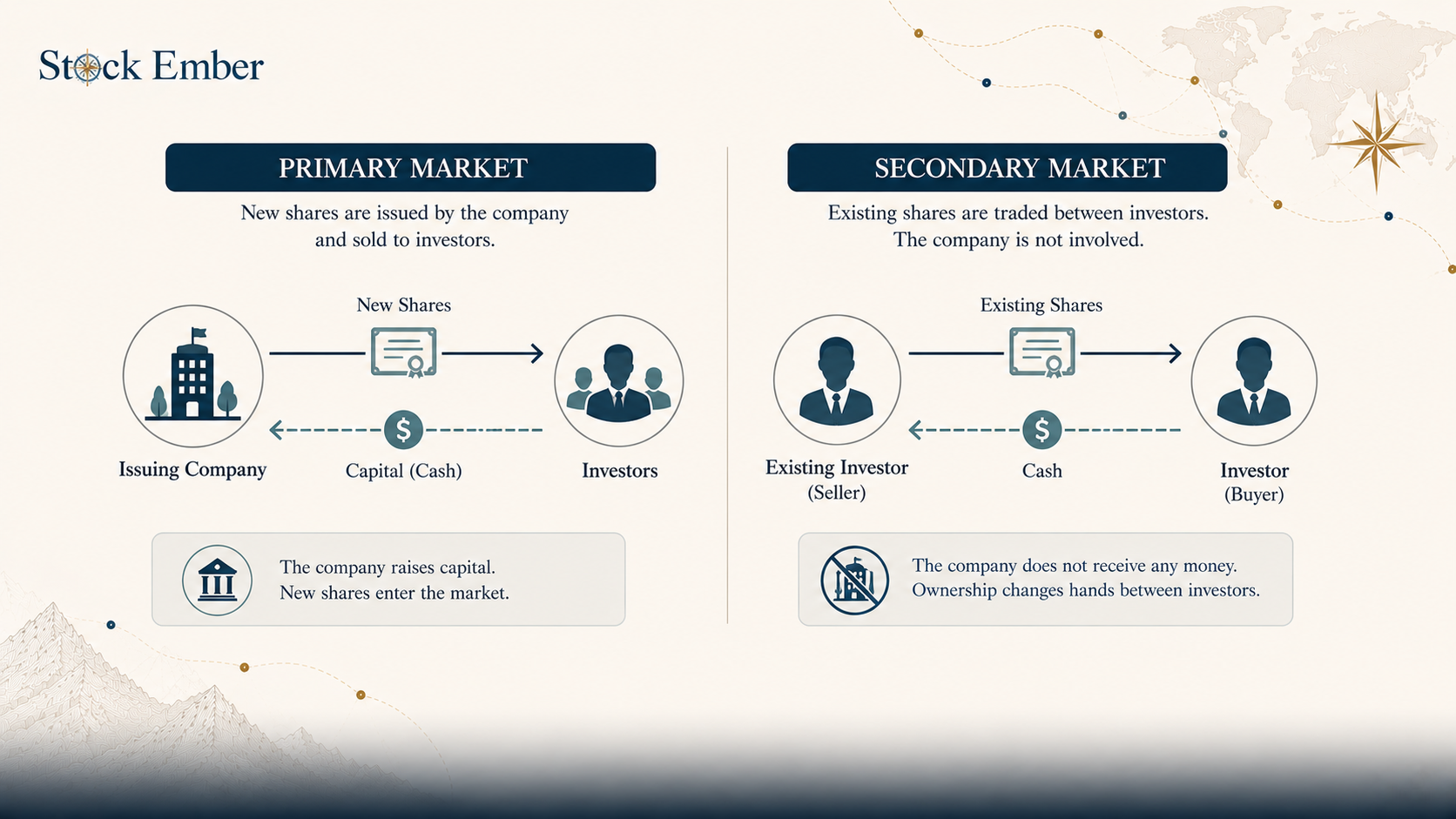
The contrast between primary and secondary markets lies in where transaction capital flows:
Primary Market: The company creates and issues brand-new shares or bonds directly to institutional investors (such as during an Initial Public Offering or rights issue). Capital flows straight onto the company's balance sheet to fund expansion, research, or debt repayment.
Secondary Market: Existing investors trade previously created securities among themselves. Capital flows purely between buyers and sellers; the issuing company acts only as an observer.
Comparison diagram showing capital and share flows in the primary market versus the secondary market.
How Trading Works in the Secondary Market
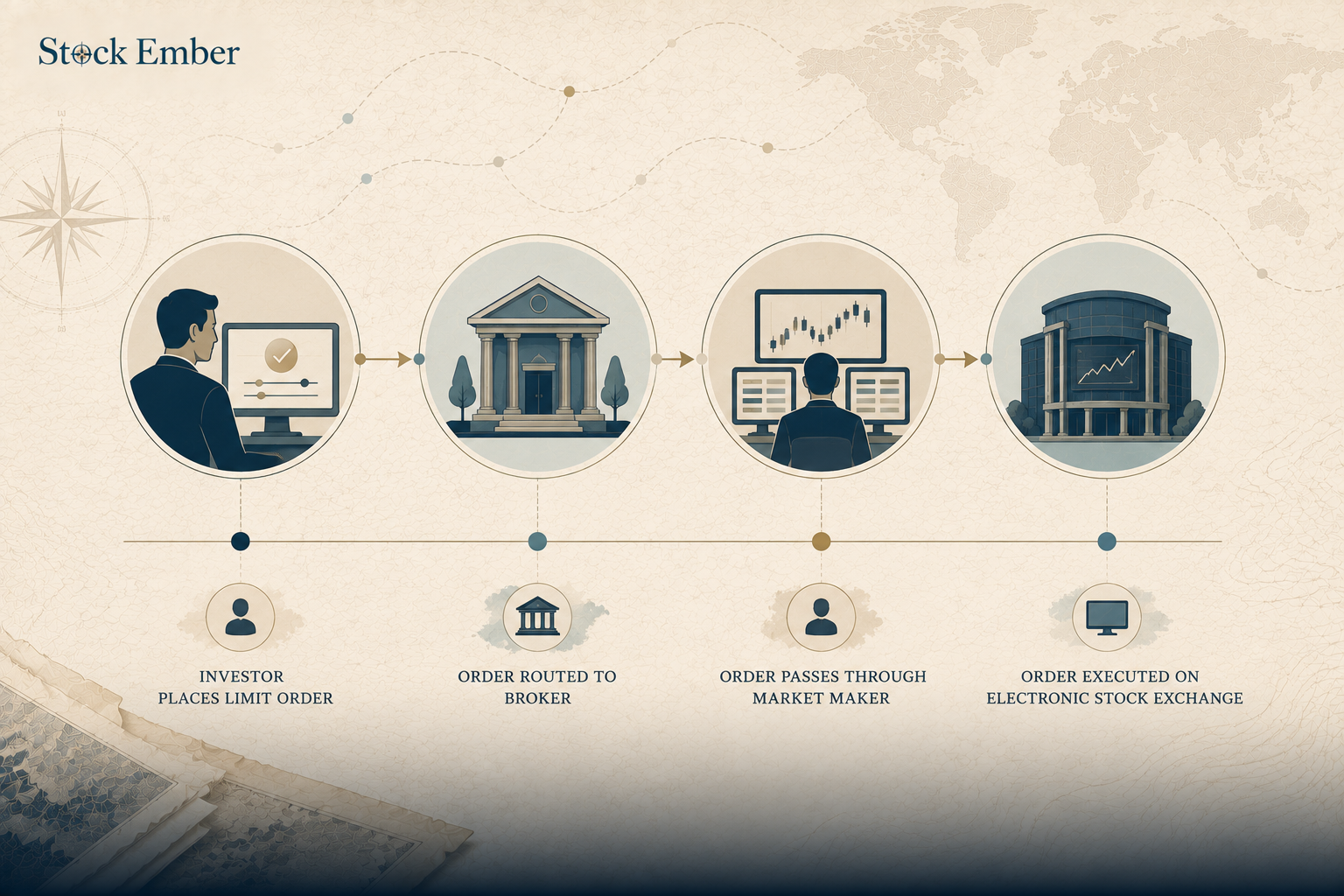
Trading in the secondary market relies on centralized exchanges and decentralized electronic networks that match buy and sell orders from investors around the world.
Flowchart depicting order execution steps between brokers, market makers, and stock exchanges.
Stock Exchanges vs. Over-The-Counter (OTC) Markets
Secondary market transactions take place across two main structural frameworks:
Centralized Exchanges. Regulated venues such as the New York Stock Exchange (NYSE) and the Nasdaq Stock Market, where electronic systems match eligible buy and sell orders.
Over-The-Counter (OTC) Markets. Decentralized dealer networks where securities not listed on formal exchanges are traded directly between parties through electronic trading systems.
The Role of Brokers and Market Intermediaries
Retail investors do not execute trades on stock exchange floors directly. Instead, retail brokers route orders to execution venues such as stock exchanges, alternative trading systems, or market makers. After a trade is executed, clearing and settlement systems help complete the transfer of securities and cash. Market makers maintain order books by standing ready to buy or sell securities continuously, ensuring that trades execute within milliseconds.
Why the Secondary Market Matters for Long-Term Investors
The secondary market matters for long-term investors because it establishes continuous price discovery and provides immediate liquidity, allowing asset owners to convert holdings into cash with minimal transaction friction.
Continuous Price Discovery and Valuation
Because millions of transactions occur daily, the secondary market acts as an ongoing auction that prices securities based on real-time supply and demand. This market price forms the foundation for fundamental valuation metrics, such as comparing market capitalization against balance sheet net assets via the price to book ratio.
Liquidity and Low Transaction Friction
Liquidity describes how quickly an asset can be converted into cash without triggering significant price movement. High secondary market liquidity generally makes it easier to sell an equity position near currently quoted prices, although execution speed and the final sale price depend on market conditions, order size, and the type of order submitted. Without an active secondary market, investors would have to search manually for individual buyers whenever they wished to adjust their holdings.
In practice, many long-term investors come to appreciate secondary market liquidity not as an invitation to trade frequently, but as a safety release valve. Knowing that your assets can be liquidated at fair market value within seconds provides the psychological security required to hold equity portfolios through prolonged economic cycles. Navigating Secondary Market Mechanics: Order Types and Spreads
Navigating secondary market mechanics requires understanding how order execution types and bid-ask spreads impact your total transaction costs when entering or exiting positions.
Understanding Bid-Ask Spreads
The bid price is the highest amount a buyer is willing to pay, while the ask price is the lowest amount a seller is willing to accept. The difference between them is the bid-ask spread, a subtle transaction cost paid to market intermediaries.
Highly Liquid Stocks: Typically have narrower bid-ask spreads because many buyers and sellers are actively competing to trade the shares, although spreads can widen during volatile market conditions.
Illiquid Stocks or Small Caps: Feature wider spreads, meaning investors lose a larger percentage of capital upon entering and exiting positions.
Avoiding Short-Term Market Noise
High secondary market liquidity generally makes it easier to sell an equity position near currently quoted prices, although execution speed and the final sale price depend on market conditions, order size, and the type of order submitted.
Daily price movements may reflect short-term sentiment, changes in liquidity, or new information about a company’s fundamentals. Some movements may have limited relevance to a long-term investment thesis, while others may indicate material changes in the business.
How the Secondary Market Fits into a Long-Term Passive Strategy
In a long-term passive strategy, the secondary market serves as an efficient clearing mechanism that allows you to automate contributions and rebalance index holdings without attempting to time market fluctuations.
When learning how to invest in stocks, beginner investors often fall into the trap of using secondary market liquidity to trade frequently. Continuous buying and selling introduces transaction friction, bid-ask costs, taxable capital gains events, and emotional market-timing errors.
Long-horizon investors often realize that the greatest advantage of the secondary market is its ability to facilitate low-cost, automated indexing. Broad-market index funds use secondary market depth to acquire hundreds of underlying equities seamlessly, letting long-term holders capture broad economic growth while ignoring day-to-day market chatter.
By relying on broad index holdings, you leverage the secondary market's deep liquidity to enter and rebalance your portfolio efficiently, while keeping your primary focus on a 10-year compounding strategy.
Conclusion
The secondary market provides the vital infrastructure where investors trade existing shares among themselves, ensuring continuous price discovery and asset liquidity without channeling proceeds directly to issuing corporations. While secondary exchanges offer instant access and continuous price updates, success for buy-and-hold investors lies in ignoring short-term market noise and focusing on long-term capital growth.
Understanding market mechanics provides essential context for managing a portfolio, but daily trading mechanics do not need to dominate your investment routine. When you are ready to select a trading platform to execute your long-term plan, our broker reviews offer a clear starting point.
FAQ
5 questions
What is the main difference between primary and secondary markets?
The primary market is where new securities are created and sold directly by corporations to raise business capital, such as during an Initial Public Offering (IPO). The secondary market is where existing investors trade those previously issued securities among themselves, with zero capital flowing back to the issuing company.
Does a company get money when I buy its stock on the secondary market?
No. When you purchase stock on a public exchange like the NYSE or NASDAQ, you are buying existing shares from another investor who wishes to sell. The cash you pay goes directly to the selling investor (minus broker fees), and the issuing corporation receives no financial proceeds.
What are examples of secondary markets?
Major public stock exchanges such as the New York Stock Exchange (NYSE), NASDAQ, and the London Stock Exchange (LSE) are prime examples of secondary equity markets. Secondary markets also exist for trading corporate and government bonds, futures, options, and foreign exchange currencies.
Why is liquidity important in the secondary market?
Liquidity allows investors to convert securities into cash quickly and at predictable prices without causing massive price fluctuations. Deep secondary market liquidity ensures that you can adjust your portfolio or exit a position in seconds without having to locate an individual buyer manually.
Is the stock market a primary or secondary market?
The vast majority of day-to-day stock market trading takes place in the secondary market. While companies occasionally use the stock market as a primary market to issue new shares through IPOs or follow-on offerings, continuous daily stock trading consists entirely of secondary market transactions between investors.
Disclaimer
This guide was written with AI assistance and reviewed by the StockEmber editorial team for accuracy. StockEmber provides independent education, not personal financial advice. Some links may support our work at no additional cost to you.
The StockEmber Team is our in-house desk of independent research writers. We test brokerage platforms, read the fine print on fees and custody, and cover ETFs and long-horizon investing for people who plan to hold for decades — not days.