A safe withdrawal rate for a 40 year retirement is the percentage of initial portfolio value an early retiree distributes in year one, adjusted annually for inflation, that sustains capital across four decades. Because extending the timeline past 30 years increases exposure to market volatility and inflation, early retirees typically lower initial withdrawal targets to between 3.25% and 3.5%.
A safe withdrawal rate for a 40 year retirement is the initial percentage of portfolio value an early retiree takes out in year one. This rate is then adjusted for inflation annually, keeping capital from running out over four decades.
While traditional retirees planning for a 30-year timeframe often rely on historical spending rules, early retirees face a much longer timeline. Stretching a portfolio across 40 years increases exposure to market downturns and price inflation. This guide explains how long-term withdrawal rates work, why extended horizons demand lower spending floors, and how to build a flexible distribution plan.
Quick Takeaways
01The traditional 4% rule was designed for a 30-year retirement and carries higher failure risks over a 40-year horizon.
02Early retirees typically lower initial withdrawal rates to between 3.25% and 3.5% to preserve capital over four decades, though actual outcomes depend on market performance and individual circumstances.
03Severe market drawdowns during the first ten years of retirement present the single largest threat to portfolio longevity.
04Adopting flexible spending guardrails rather than rigid fixed distributions improves portfolio survival rates over 40 years.
What Is a Safe Withdrawal Rate?
A safe withdrawal rate is the initial percentage of savings an investor takes from their portfolio in their first year of retirement, then adjusted for inflation each subsequent year, without running out of money.
The concept originated in 1994 when financial planner William Bengen analyzed historical U.S. market data across rolling 30-year periods. His landmark study, along with the 1998 Trinity Study, found that a 4% initial withdrawal rate, combined with a portfolio split between broad stock and bond indexes, survived every 30-year historical window analyzed.
Under this model, an investor with a $1,000,000 portfolio takes $40,000 in year one. If inflation runs at 3% in year two, the withdrawal increases to $41,200. The plain text formula for setting the first-year distribution looks like this:
While the 4% guideline offers a helpful starting benchmark, it assumes a fixed 30-year retirement span. For early retirees leaving the workforce in their 40s or 50s, a 40-year retirement horizon alters the underlying math.
Why a 40-Year Horizon Breaks the 4% Rule
A 40-year horizon breaks the traditional 4% rule because adding ten extra years significantly increases the probability of portfolio depletion under a static spending plan.
When you extend a retirement timeline from 30 to 40 years, two main factors increase risk: cumulative price inflation and exposure to prolonged bear markets. Over four decades, even a moderate 2.5% annual inflation rate cuts the purchasing power of a dollar by more than 60%. Research from Morningstar shows that extending a retirement timeline past 30 years requires lowering initial spending expectations.
To maintain a high probability of portfolio survival over 40 years, Schwab’s research suggests lowering the initial spending rate to a range of 3.25% to 3.5% for a 40-year retirement horizon.
For a $1,000,000 portfolio, choosing a 3.25% rate means taking $32,500 in year one instead of $40,000. Starting with that lower cash drain leaves $7,500 more principal invested in the market, providing a larger foundation to generate future growth and handle rising living costs.
The Impact of Sequence of Returns Risk Over Four Decades
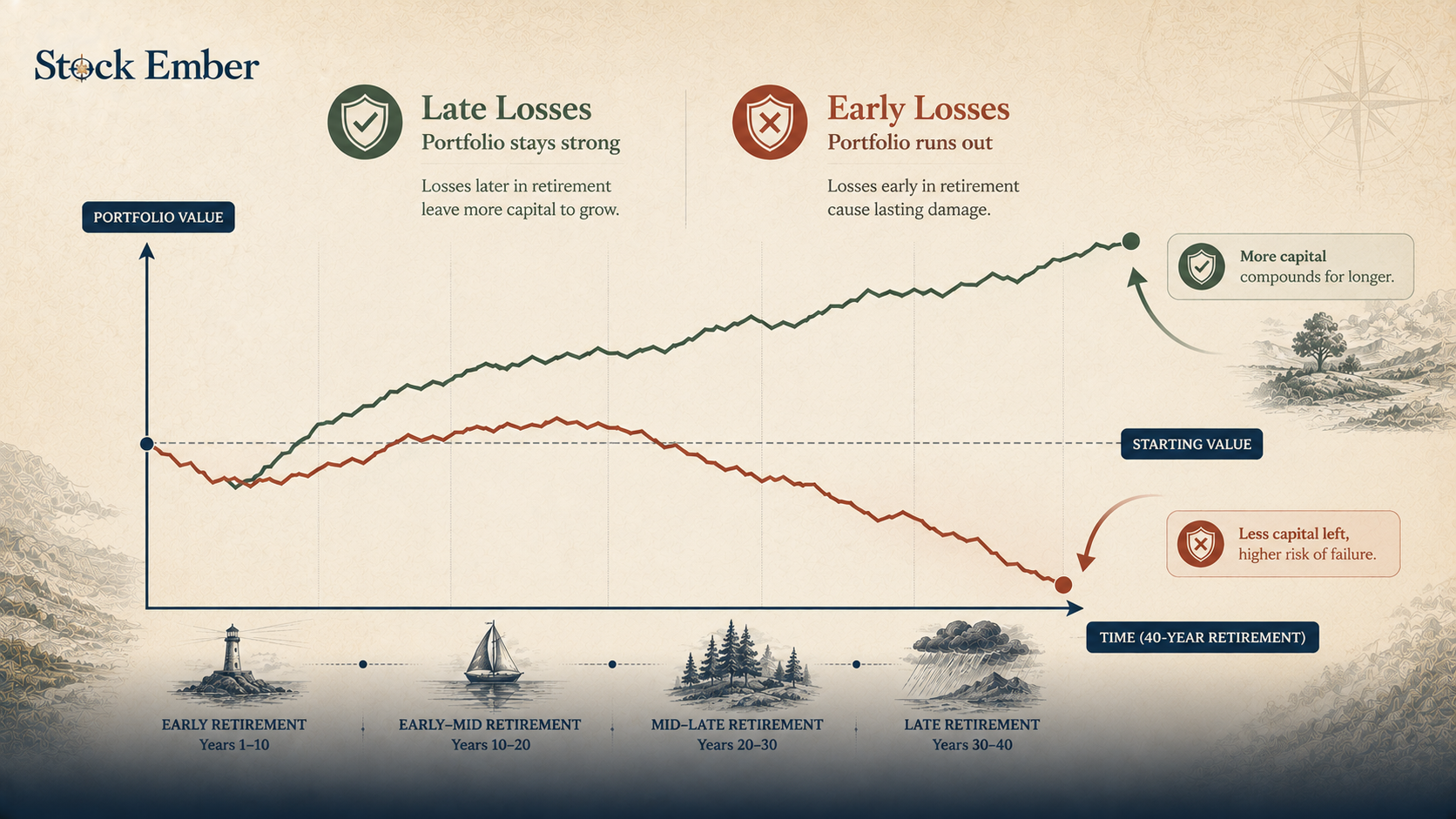
Sequence of returns risk is the hazard that market drawdowns during the early years of retirement permanently destroy a portfolio's ability to recover.
When you withdraw money from a falling portfolio, you sell assets at discounted prices. This locks in paper losses and reduces the number of shares remaining to capture future market rebounds. If severe stock market declines happen in years 1 through 10 of a 40-year retirement, taking fixed, inflation-adjusted distributions can drain capital beyond repair, even if long-term average market returns eventually recover in later decades.
Chart contrasting early market losses versus late market losses on retirement portfolio survival
Conversely, if strong market gains occur during the first decade, your portfolio accumulates a financial buffer that easily supports distributions for the remaining 30 years. Because you cannot control market timing when you retire, managing early withdrawal stress is the primary key to surviving a 40-year horizon.
The Impact of Expense Drag and Index Structure on Long-Term Capital
Over a 40-year timeline, fund management fees and underlying index structures exert a cumulative drag on total wealth that can undermine a safe withdrawal rate for 40 year retirement plans.
A core element of managing costs over four decades is passive investing, which focuses on holding broad market indexes rather than paying high active management fees. An active management fee of 0.75% per year reduces your effective withdrawal rate by nearly three-quarters of a percentage point. Over 40 years, that extra fee drag extracts a significant percentage of a portfolio's total value.
Similarly, market concentration in top-heavy, market-cap-weighted indexes can expose long-term retirees to sector volatility. Investors seeking to avoid heavy weightings in a small handful of mega-cap tech stocks might evaluate options like an S&P 500 equal weight index strategy to diversify market risk across all constituent companies.
The simple math for calculating net distribution capacity after fund fees is:
Net Withdrawal Floor = Target Withdrawal Rate - Annual Expense Ratio
Keeping fund fees as close to zero as possible ensures that more of your portfolio's investment return stays in your pocket to fund living expenses.
Common Early Retirement Withdrawal Pitfalls (and How to Avoid Them)
Early retirees often fall into predictable traps when managing distributions over extended timelines. Here are three common pitfalls and how to avoid them:
Following Unyielding Spending Rules: Blindly increasing your cash withdrawal for inflation during severe market crashes accelerates portfolio decay. Implementing dynamic guardrails such as skipping an inflation adjustment or cutting discretionary spending by 10% after a down year, helps protect your principal balance.
Holding an Overly Conservative Portfolio: Fear of stock market volatility leads some retirees to shift too heavily into bonds or cash. However, a 40-year retirement requires continuous equity growth to combat inflation. Maintaining a 60% to 80% stock allocation helps ensure your capital keeps pace with living costs.
Ignoring Flexibility in Early Retirement: Unlike traditional retirees, early retirees often have options to generate partial income, undertake consulting work, or adjust personal spending. Factoring temporary flexible income into your strategy lowers the required withdrawal rate during down markets.
In practice, many long-term investors find that a variable spending plan provides far greater confidence over a 40-year horizon than a rigid percentage target. Under this approach, distributions decrease slightly following bad market years and rise after strong years.
Conclusion
Establishing a safe withdrawal rate for 40 year retirement plans requires balancing early cash needs with long-term capital growth. Moving from a standard 30-year retirement to a 40-year horizon increases exposure to market volatility and inflation, making a baseline withdrawal rate of 3.25% to 3.5% a safer foundation than the traditional 4% rule. By managing investment fees, controlling early sequence of returns risk, and keeping spending flexible, early retirees can build a portfolio strategy designed to last four decades.
When you are ready to evaluate broad index funds for your long-term strategy, exploring our ETF reviews is a great next step. Investing always involves risk, including the potential loss of principal, and historical market returns do not guarantee future results. Treat this guide as an educational resource to inform your research rather than personalized financial advice.
FAQ
5 questions
Is 4% a Safe Withdrawal Rate for a 40 Year Retirement?
A 4% withdrawal rate carries a higher risk of portfolio failure over 40 years compared to a traditional 30-year horizon. Because four decades increase exposure to severe early market drawdowns and compounding inflation, historical models suggest lowering the initial withdrawal rate to between 3.25% and 3.5% for greater portfolio survival confidence.
What is the sequence of returns risk in a 40 year retirement?
Sequence of returns risk is the hazard that market downturns during the first 5 to 10 years of retirement permanently deplete your capital. Withdrawing fixed amounts from a shrinking portfolio forces you to sell assets at a loss, reducing the remaining principal available to generate compound growth when the market eventually recovers.
How does asset allocation impact a 40 year safe withdrawal rate?
Maintaining an equity allocation of 60% to 80% is essential for a 40-year retirement horizon. While bonds reduce short-term portfolio volatility, stocks provide the capital growth required to outpace long-term inflation over four decades. A balance of growth assets and stability helps preserve purchasing power over extended timelines.
What is a dynamic withdrawal strategy for early retirement?
A dynamic withdrawal strategy adjusts spending annually based on market performance rather than adhering to a rigid inflation-adjusted rule. By reducing distributions slightly after bad market years or capping inflation increases during downturns, early retirees significantly increase their portfolio's long-term survival odds over 40 years.
How do expense ratios affect withdrawal rates over 40 years?
Fund management fees reduce net portfolio returns directly. An annual expense ratio of 0.50% effectively lowers a 3.5% withdrawal rate by half a percentage point, extracting a substantial portion of portfolio wealth over 40 years. Utilizing low-cost passive index funds helps maximize the net cash available for living expenses.
Disclaimer
This guide was written with AI assistance and reviewed by the StockEmber editorial team for accuracy. StockEmber provides independent education, not personal financial advice. Some links may support our work at no additional cost to you.
The StockEmber Team is our in-house desk of independent research writers. We test brokerage platforms, read the fine print on fees and custody, and cover ETFs and long-horizon investing for people who plan to hold for decades — not days.