The S&P 500 Equal Weight Index is an unweighted stock index that assigns an equal ~0.2% portfolio weight to all 500 companies in the benchmark, regardless of market cap. It undergoes mandatory quarterly rebalancing to trim outperforming stocks and buy underperforming ones, reducing mega-cap concentration risk while shifting factor exposure toward mid-cap and value stocks.
The S&P 500 Equal Weight Index is an unweighted stock index that allocates an equal dollar amount, roughly 0.2%, to every company in the S&P 500, regardless of its total market capitalization.
When a handful of mega-cap technology stocks dominate headline returns, many investors worry their index funds are too concentrated. Equal weighting offers an alternative path by giving a small regional bank the exact same footprint as a trillion-dollar tech giant. This guide explains how equal weighting functions, how quarterly rebalancing affects long-term returns, and the hidden costs of holding an equal-weight fund for ten years.
Quick Takeaways
01The S&P 500 Equal Weight Index assigns every constituent stock a fixed ~0.2% allocation, reducing mega-cap concentration risk.
03Equal weighting creates an intentional shift toward mid-cap companies and value stocks within the benchmark.
04Higher expense ratios and portfolio turnover create noticeable fee and tax friction over long holding periods.
What Is the S&P 500 Equal Weight Index?
The S&P 500 Equal Weight Index takes the 500 companies in the standard benchmark and splits portfolio capital evenly across all of them.
In a traditional cap-weighted index fund, larger companies take up a larger share of your money. If a mega-cap tech company grows in market value, its weight in the index expands with it. Equal weighting resets this balance. Out of 500 stocks, each position starts at an identical weight of 0.2% (calculated as 100% divided by 500 constituents).
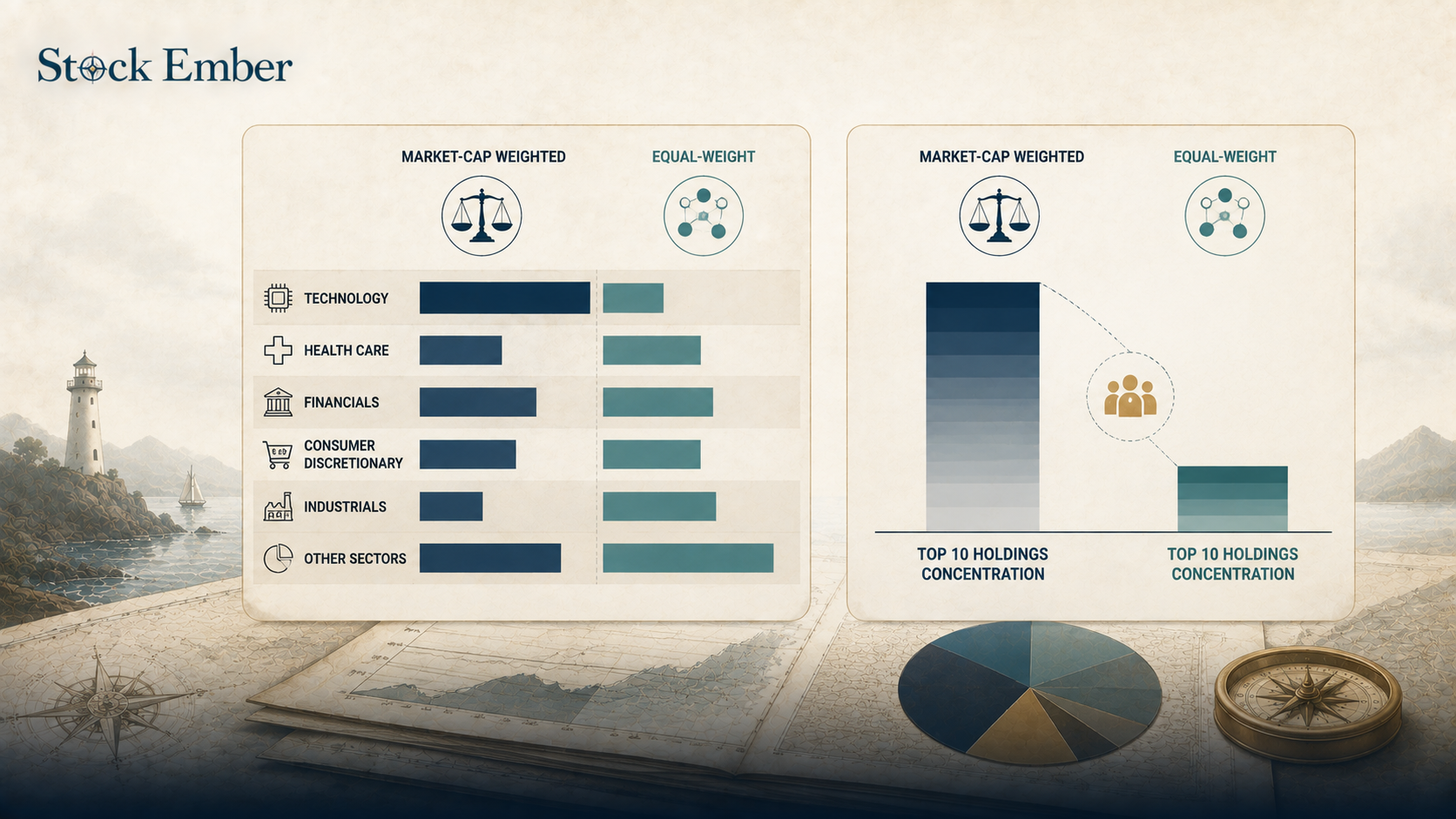
For investors focused on passive investing, index weighting determines how their underlying risk is spread. In a standard market-cap S&P 500 fund, the top ten holdings often account for more than 30% of the total portfolio value. In an equal-weight index, those same top ten companies account for just 2% of the index at each quarterly reset.
How Equal Weighting Works: The Quarterly Rebalance
Equal weighting relies on a disciplined quarterly rebalance to maintain equal allocations across every constituent stock.
Over any three-month period, individual share prices move in different directions. Winning stocks rise and grow to represent 0.3% or 0.4% of the index, while falling stocks shrink to 0.1%. To correct these shifts, the index administrator performs a forced rebalance four times a year, at the end of March, June, September, and December.
During this reset, the index trims back the stocks that gained price and uses the cash proceeds to buy more shares of the stocks that fell. This process builds a systematic "buy low, sell high" rebalancing discipline into the fund structure.
In practice, many long-term investors find that quarterly rebalancing feels counterintuitive because it trims momentum winners to fund underperforming stocks.
Equal Weight vs. Market-Cap Weight: Structural Differences
Equal weighting fundamentally alters your factor exposures by leaning away from mega-cap growth and toward mid-cap and value stocks.
Standard cap-weighting gives maximum weight to companies with the largest market capitalization. This weighting method gives a $10 billion mid-cap company the exact same voting weight as a $3 trillion giant. According to index design specifications from S&P Dow Jones Indices, this structural choice shifts the index toward smaller companies within the S&P 500 universe.
Chart comparing top holding concentration and size tilts between equal weight and market cap indices.
This shift changes how your portfolio behaves during different economic conditions, such as when evaluating strategies for investing during stagflation. When mega-cap tech stocks lead a market rally, cap-weighted funds usually outperform equal-weight funds. When market breadth widens and smaller companies gain momentum, equal-weighted portfolios often pull ahead.
Feature
Standard Market-Cap Weight
Equal Weight
Stock Allocation
Based on market capitalization
Fixed at ~0.2% per stock
Concentration Risk
High (top 10 represent ~30%+)
Low (top 10 represent ~2%)
Company Size Tilt
Mega-Cap and Large-Cap bias
Mid-Cap and Large-Cap blend
Rebalancing Action
Market-driven (minimal trading)
Mandatory quarterly reset
Typical ETF Expense Ratio
~0.03%
~0.20%
The 10-Year Cost of Equal Weighting
Holding an equal-weight fund introduces higher expense ratios, portfolio turnover drag, and potential tax costs over a ten-year timeline.
On a hypothetical $100,000 investment growing at an assumed average of 7% per year over ten years (a projection only, not a guaranteed return):
A 0.03% fee costs roughly $550 in direct fees and lost compounding
A 0.20% fee costs roughly $3,600 over the same 10-year period.
Beyond the higher fee ratio, equal-weight funds experience higher portfolio turnover. Standard cap-weighted funds rarely trade stocks unless a company enters or leaves the index, resulting in relatively low annual turnover. Equal-weight funds must buy and sell shares quarterly to reset weights, causing annual portfolio turnover that industry estimates typically place between 15% and 25%, depending on market volatility during the reset period. In taxable accounts, this trading activity can generate capital gains distributions that create additional tax friction for investors.
Common Pitfalls for Buy-and-Hold Investors
Investors often make key structural errors when deciding between equal-weight and cap-weighted index strategies:
Chasing recent market cycles: Switching back and forth between equal-weight and cap-weight funds based on recent tech performance leads to buying high and selling low.
Ignoring taxable account placement: Holding an equal-weight fund in a taxable brokerage account can create taxable capital gains distributions caused by quarterly rebalancing sales.
Assuming lower total risk: Equal-weight funds carry heavier exposure to mid-cap stocks, which can result in larger drawdowns during broad market panics despite lower single-stock concentration.
Conclusion
The S&P 500 Equal Weight Index provides broad diversification by removing the heavy concentration of mega-cap stocks found in standard cap-weighted benchmarks. However, this balanced structure comes with higher annual expense ratios, increased portfolio turnover, and a tilt toward mid-cap volatility. For long-term buy-and-hold investors, weighing these structural cost trade-offs against portfolio goals is essential before shifting allocations.
When you are ready to evaluate specific index funds, our ETF reviews provide clear comparisons of available options. Investing always puts capital at risk and past performance does not promise future results, so use this breakdown as educational guidance for your own research.
FAQ
5 questions
What is the main difference between equal weight and market-cap weight S&P 500?
Market-cap weighted indices allocate capital based on stock size, giving mega-cap companies a dominant share of the fund. Equal-weighted indices assign roughly 0.2% to every constituent stock, ensuring small and large companies carry identical portfolio influence.
How often does the S&P 500 Equal Weight Index rebalance?
The index rebalances quarterly at the end of March, June, September, and December. During this reset, the fund systematically trims stocks that have grown in value and buys shares of stocks that have fallen to restore every position back to 0.2%.
Does the S&P 500 Equal Weight Index outperform market-cap weighting?
Equal weighting can outperform during periods when market breadth is wide and smaller or mid-cap stocks rally. However, market-cap weighting typically outperforms when a small group of mega-cap technology stocks leads strong market rallies.
What are the main drawbacks of holding an equal-weighted S&P 500 fund?
Equal-weighted funds carry higher annual expense ratios (around 0.20% versus 0.03% for standard cap-weighted funds) and higher portfolio turnover. This increased turnover can generate trading friction and potential capital gains taxes in taxable brokerage accounts.
Is the S&P 500 Equal Weight Index safer than a standard S&P 500 fund?
Equal weighting reduces single-stock concentration risk, meaning severe drops in a single mega-cap tech company impact the portfolio far less. However, it leans more heavily into mid-cap stocks, which can lead to higher overall volatility during broad market panics.
Disclaimer
This guide was written with AI assistance and reviewed by the StockEmber editorial team for accuracy. StockEmber provides independent education, not personal financial advice. Some links may support our work at no additional cost to you.
The StockEmber Team is our in-house desk of independent research writers. We test brokerage platforms, read the fine print on fees and custody, and cover ETFs and long-horizon investing for people who plan to hold for decades — not days.