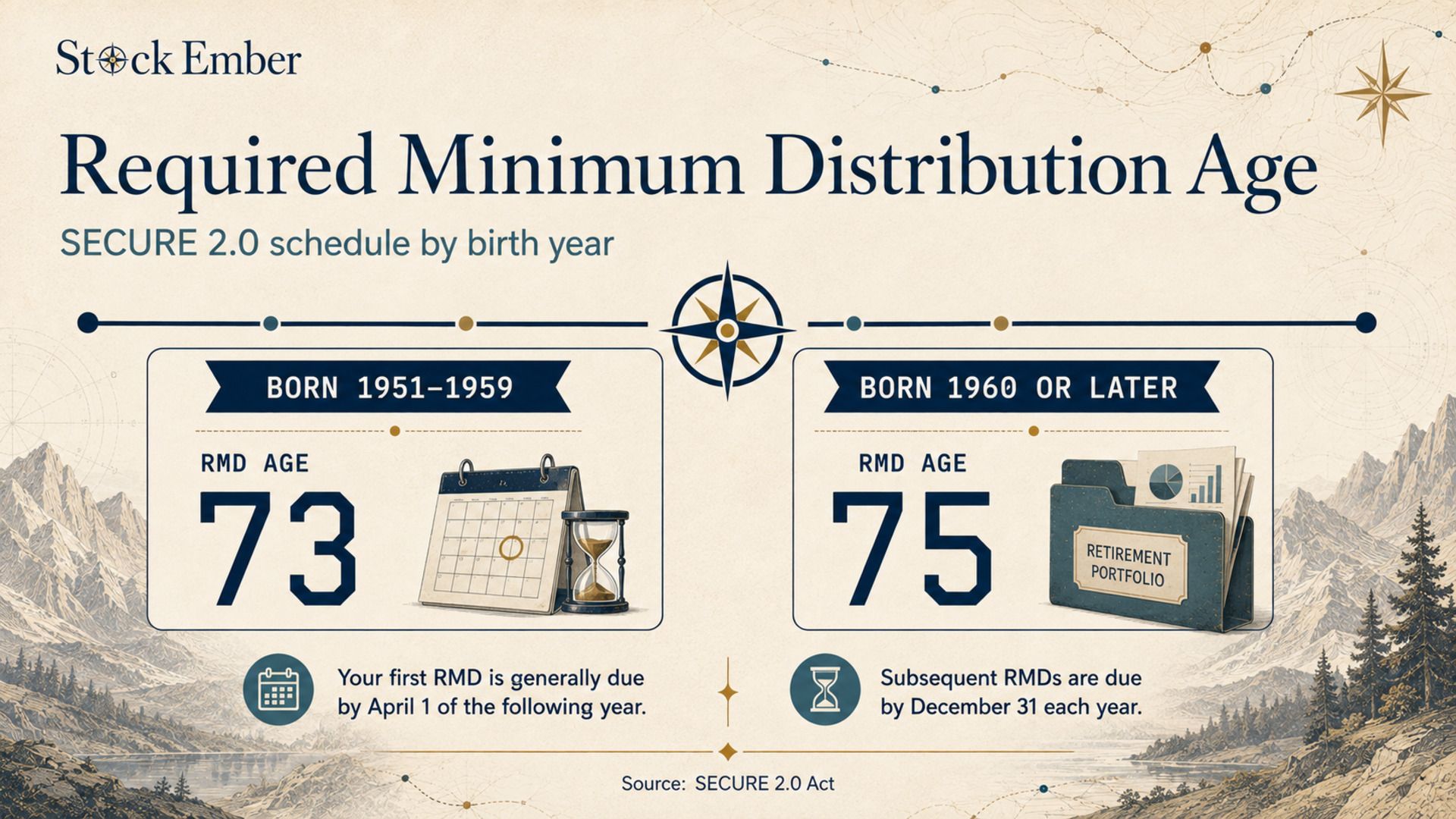
The required minimum distribution age is the statutory starting threshold when the IRS mandates annual withdrawals from tax-deferred retirement accounts. Under the SECURE 2.0 Act, the starting age is 73 for individuals turning 72 after December 31, 2022, and increases to age 75 in 2033 for individuals born in 1960 or later.
The required minimum distribution age is the statutory starting age when the IRS requires individuals to begin withdrawing mandatory minimum amounts annually from tax-deferred retirement accounts.
Saving for retirement in traditional accounts allows your investments to compound tax-deferred for decades. However, that tax deferral does not last forever, as federal tax rules mandate annual withdrawals once you reach a specific age. This guide breaks down the starting timeline, which accounts require withdrawals, key tax deadlines, and how to protect your portfolio from avoidable penalties.
Quick Takeaways
01Under current SECURE 2.0 rules, the required minimum distribution starting age is 73 for individuals turning 72 after December 31, 2022.
02The statutory starting threshold increases to age 75 in 2033 for anyone born in 1960 or later.
03Original Roth IRAs are completely exempt from lifetime distribution requirements, whereas traditional IRAs and traditional 401(k) plans require mandatory withdrawals.
04Missing a mandatory withdrawal deadline triggers an IRS excise tax penalty of 25%, which can be reduced to 10% if corrected promptly.
What Is a Required Minimum Distribution?
A required minimum distribution (RMD) is the mandatory annual amount that federal tax law requires you to withdraw from tax-deferred retirement accounts once you reach a specific age.
Understanding the RMD meaning comes down to tax timing. When you contribute to traditional retirement wrappers, you receive an upfront tax deduction, and your investments grow without facing annual dividend or capital gains taxes. In exchange for this multi-decade tax deferral, the Internal Revenue Service requires you to pull money out so it can finally be taxed as ordinary income.
To explain what is RMD calculation in practice: the IRS determines your yearly distribution by taking your account balance as of December 31 of the previous year and dividing it by a distribution period based on your life expectancy. As you age, that division factor gets smaller, which forces a larger percentage of your remaining portfolio out of the account each year.
Required Minimum Distribution Age Schedule by Birth Year
Your RMD age depends directly on your birth year under rules established by Congress in the SECURE 2.0 Act.
Chart showing RMD starting ages by birth year under SECURE 2.0 Act
For decades, the baseline required minimum distribution age was set at 70½. Legislative updates increased that threshold to age 72, and recent changes expanded the timeline further to give retirement savings more time to compound.
Birth Year
RMD Starting Age
Statutory Rule
1950 or earlier
Age 70½ or 72
Reached starting age under legacy rules
1951 – 1959
Age 73
Current active threshold under SECURE 2.0
1960 or later
Age 75
Effective starting in the year 2033
Knowing your exact RMD start year prevents premature withdrawals or missed deadlines. If you turn 73 this year, you enter your first distribution window.
Accounts Subject to IRA RMD Rules
Understanding general RMD rules requires knowing which accounts mandate withdrawals and which allow your funds to stay untouched.
The standard IRA RMD requirements apply to almost all tax-deferred personal and small-business accounts, including:
Traditional IRAs
SEP IRAs
SIMPLE IRAs
Traditional 401(k), 403(b), and 457(b) plans
Unlike tax-deferred accounts, holding a Roth IRA exempts you from lifetime distribution rules because contributions are made with post-tax dollars. Furthermore, starting in 2024, SECURE 2.0 eliminated lifetime distribution mandates for designated Roth 401(k) accounts as well.
There is also a "still-working" exception for employer-sponsored 401(k) or 403(b) plans. If you continue working past your standard distribution age and do not own 5% or more of the business sponsoring the plan, you can delay taking distributions from that active plan until April 1 of the year after you officially retire.
Key Deadlines and Penalty Risks
The deadline for taking your first required distribution is April 1 of the calendar year following the year you reach your starting age.
For every subsequent year, the annual distribution deadline moves up to December 31. Handling these timelines is an essential part of managing broader IRA withdrawal rules.
Year You Reach RMD Age ──> First RMD Deadline: April 1 of Following Year All Subsequent Years ──> Annual RMD Deadline: December 31
Many account holders fall into the "April 1 trap" by delaying their very first distribution. If you turn 73 and wait until April 1 of the following year to take your first distribution, you must take your second distribution by December 31 of that same year. Taking two full distributions in one tax year can push your income into a higher tax bracket, increasing your overall tax bill.
Failing to take the full required amount on time results in an IRS excise tax penalty equal to 25% of the unwithdrawn amount. If you correct the error in a timely window and submit IRS Form 5329, the penalty can be reduced to 10%.
Common Mistakes to Avoid
Managing required distributions requires attention to portfolio details to prevent tax friction.
Trying to satisfy 401(k) distributions from an IRA: You can total the mandatory distribution amounts for all your traditional IRAs and take the full sum from a single IRA. However, you cannot satisfy a 401(k) or 403(b) distribution using funds from a traditional IRA.
Ignoring tax bracket inflation: Forced taxable distributions count as ordinary income. Over a 10-to-20 year retirement horizon, unmanaged withdrawals can trigger higher Medicare Part B premiums or raise taxes on Social Security benefits.
Missing the correction window: If you miss a deadline, leaving the error uncorrected makes the 25% penalty permanent. Promptly filing a correction helps lower the penalty fee to 10%.
Conclusion: Managing Your Required Minimum Distribution Age
Understanding your required minimum distribution age allows you to build an efficient withdrawal strategy and protect your retirement nest egg from heavy penalties. By tracking key birth-year thresholds, recognizing which account types require distributions, and keeping strict deadline calendars, long-term investors can maintain control over portfolio tax friction.
When you are ready to evaluate platforms for managing your retirement portfolio and automated distributions, our broker reviews & rankings offer a helpful starting point.
Tax laws and personal income circumstances vary over time, so treat this guide as educational grounding rather than formal tax advice.
FAQ
4 questions
What is a Required Minimum Distribution (RMD)?
An RMD is the minimum amount of money the federal government requires you to withdraw each year from certain tax-deferred retirement accounts once you reach a specific age.
At what age must I start taking RMDs?
Under current US tax law, the starting age for RMDs is 73. This age requirement is scheduled to increase to 75 starting in 2033.
Which accounts require RMDs, and which do not?
Traditional IRAs, SEP IRAs, SIMPLE IRAs, and traditional 401(k) plans require RMDs. Original owners of Roth IRAs do not have to take RMDs during their lifetime.
What is the penalty for missing an RMD deadline?
If you fail to take your full RMD by the deadline, the IRS imposes an excise tax penalty of up to 25% on the amount that was not withdrawn.
Disclaimer
This guide was written with AI assistance and reviewed by the StockEmber editorial team for accuracy. StockEmber provides independent education, not personal financial advice. Some links may support our work at no additional cost to you.
The StockEmber Team is our in-house desk of independent research writers. We test brokerage platforms, read the fine print on fees and custody, and cover ETFs and long-horizon investing for people who plan to hold for decades — not days.