Lump sum investing is an investment approach in which an investor puts available capital into the market at once rather than investing it gradually over time. Vanguard's historical research suggests that immediate investment has often outperformed dollar-cost averaging because more capital remains invested for longer.
Lump sum investing can put available capital to work immediately, giving investors full market exposure from the start rather than keeping part of their money in cash.
Receiving a financial windfall such as an inheritance, property sale, or annual bonus raises an immediate question: should you invest the entire amount today or drip feed it gradually? While holding cash may feel psychologically safer, delaying market entry can reduce long-term return potential. This guide explores how the strategy works, what historical data reveals about investment timing, and how to manage drawdown risks.
Quick Takeaways
01Lump sum investing places 100% of available cash into market assets immediately to maximize time-in-the-market compounding.
02Vanguard's historical research shows that lump sum investing has outperformed dollar-cost averaging approximately two-thirds of the time.
03Delaying market entry creates ongoing cash drag, which reduces total portfolio wealth over ten-year holding horizons.
04Investors with low risk tolerance can use structured hybrid plans to balance statistical advantages with psychological comfort.
What Is Lump Sum Investing?
This strategy is the immediate, single-transaction deployment of capital into an asset or portfolio.
Unlike regular contributions made from an ongoing monthly salary, lump sum deployment typically occurs after a sudden cash event. Common sources include legal settlements, business sales, annual bonuses, or inherited wealth.
The main objective of lump sum deployment is to maximize total time in the market. By converting liquid cash into equities or bonds without delay, your capital begins participating in economic growth and generating compounding returns immediately.
Dollar Cost Averaging vs. Lump Sum Investing: What the Data Shows
Comparing dollar cost averaging vs lump sum investing highlights the core trade-off between statistical performance and emotional comfort.
Dollar-cost averaging (DCA) spreads a fixed pool of cash across scheduled equal payments over several months or years. By contrast, lump sum deployment puts all cash to work on day one.
When examining historical market data, lump sum investing has generally outperformed dollar-cost averaging. Vanguard research found that investing a lump sum immediately outperformed a gradual cost-averaging strategy approximately two-thirds of the time, largely because more of the money remains invested in the market for longer.
Because equity markets historically trend upward more often than they fall, keeping money in cash while waiting to average in usually results in buying shares at progressively higher prices.
Why Lump Sum Investing Wins in Rising Markets
This approach wins in rising markets because immediate exposure captures the equity risk premium, the extra return investors earn for holding stocks instead of safer assets as early as possible.
Stock prices reflect the future earnings potential of underlying businesses. Over extended horizons, global markets spend significantly more time advancing than declining. When cash sits on the sidelines, it earns minimal interest while missing out on market growth and dividend payouts.
For buy-and-hold investors, adopting this strategy aligns with the core philosophy of passive investing. Passive strategies rely on continuous market participation rather than market timing to build long-term wealth.
Many disciplined index investors find that overcoming the temptation to time market dips is the hardest part of deploying a windfall, but historical consistency proves that immediate entry remains reliable over decades.
The 10-Year Opportunity Cost: Calculating the Cash Drag Penalty
Calculating total cost of ownership requires measuring the hidden cash drag penalty caused by delaying full market deployment.
While holding cash during a gradual dollar-cost averaging schedule protects against immediate market downturns, it creates ongoing performance drag. Cash yields rarely match long-term equity growth, meaning every month your funds sit uninvested costs you compounding power.
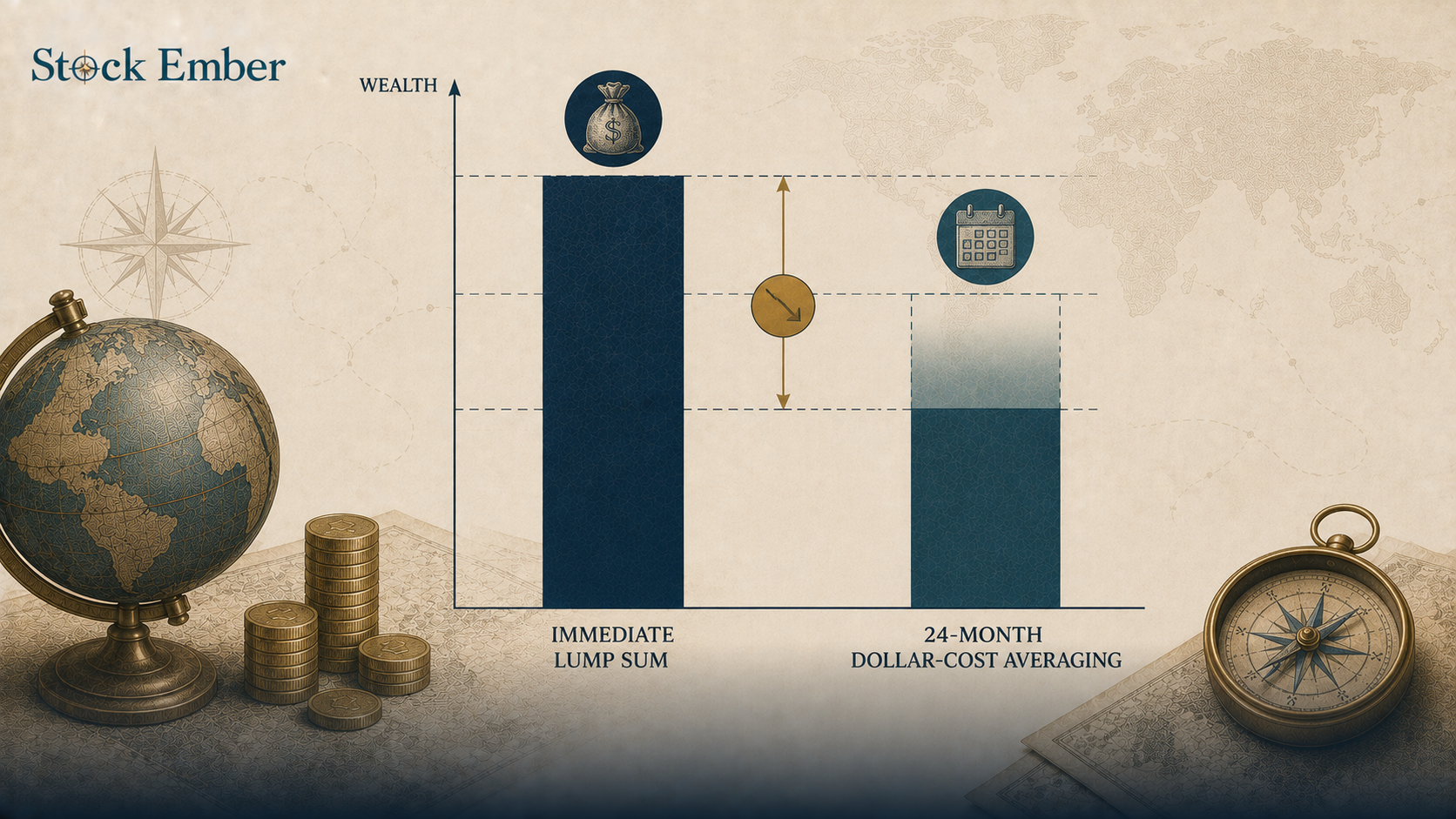
To understand this drag over a decade, consider an illustrative $100,000 windfall growing at a hypothetical 7% annual gross return:
Scenario A (Immediate Lump Sum): Deploying $100,000 on day one allows the full balance to compound at 7% per year. After 10 years, the portfolio grows to approximately $196,700.
Scenario B (24-Month DCA): Spreading the $100,000 in equal monthly tranches over two years results in an estimated 10-year total balance of approximately $184,200.
By delaying full market entry across two years, the resulting cash drag costs over $12,000 in lost compounding growth over ten years. These figures are hypothetical examples based on a constant 7% return; actual investment returns will vary and are never guaranteed.
Chart showing 10-year portfolio wealth difference between lump sum investing and dollar-cost averaging
Managing Pitfalls: Drawdown Anxiety, Regret Risk, and Hybrid Deployment
Managing lump sum pitfalls requires controlling regret aversion, preventing market timing traps, and planning around retirement timing.
The primary risk is immediate timing risk: placing a large sum into the market right before a severe correction. Dropping 15% or 20% shortly after entering can trigger intense emotional stress and tempt unseasoned investors to sell at the bottom.
To mitigate psychological anxiety while preserving statistical benefits, investors often use structured middle-ground options:
The 50/50 Hybrid Split: Deploy 50% immediately as a lump sum, then split the remaining 50% into equal monthly tranches over three to six months.
Rules-Based Rebalancing: Automate transfers so market dips automatically buy shares at lower costs without manual intervention.
For individuals receiving a windfall near or during retirement, deployment timing directly connects to broader income decisions, such as comparing an annuity vs drawdown setup. Securing guaranteed income sources first can reduce the stress of deploying remaining liquid assets into fluctuating equities.
Conclusion
This strategy provides a mathematically grounded approach to wealth accumulation by putting capital to work without delay.
While short-term volatility can cause anxiety, historical data shows that maximizing time in the market consistently beats waiting for the perfect entry point. By recognizing the hidden cost of cash drag and selecting a structure aligned with your emotional tolerance, you can deploy windfall capital effectively.
When you are ready to evaluate broad-market index funds for windfall deployment, our ETF reviews provide clear data to help you build your portfolio. Investing always carries risk of loss and past performance does not guarantee future results, so use this guide as an educational context for your own financial planning.
FAQ
5 questions
Is lump sum investing better than dollar cost averaging?
According to Vanguard's research, lump sum investing has historically outperformed dollar-cost averaging approximately two-thirds of the time. This is largely because investing immediately gives more of the portfolio time in the market rather than leaving part of the capital in cash.
What are the main risks of lump sum investing?
The primary risk here is short-term timing risk, where a market drop occurs immediately after full capital deployment. While broad markets typically recover over long horizons, experiencing a severe drawdown right away can cause significant emotional distress for unprepared investors.
Should retirees invest a windfall as a lump sum?
Retirees should evaluate liquid lump sum deployment in the context of their overall retirement cash flow strategy. Before placing a windfall into volatile equities, retirees often address guaranteed income needs, such as evaluating an annuity versus drawdown approach, to prevent sequence of returns risk from affecting living expenses.
How can risk-averse investors safely deploy a lump sum?
Risk-averse investors can use a hybrid deployment model to reduce emotional regret. For instance, an investor might deploy 50% of the lump sum immediately to capture time-in-the-market gains and divide the remaining 50% into automated monthly installments over three to six months.
What is cash drag in lump sum investing?
Cash drag occurs when uninvested funds sit in cash earning low interest while waiting to be gradually moved into the market. Over a ten-year horizon, holding cash during a prolonged dollar-cost averaging strategy can significantly reduce total portfolio growth compared to immediate deployment.
Disclaimer
This guide was written with AI assistance and reviewed by the StockEmber editorial team for accuracy. StockEmber provides independent education, not personal financial advice. Some links may support our work at no additional cost to you.
The StockEmber Team is our in-house desk of independent research writers. We test brokerage platforms, read the fine print on fees and custody, and cover ETFs and long-horizon investing for people who plan to hold for decades — not days.