An annuity converts pension savings into a guaranteed contractual income stream for life, while flexi-access drawdown keeps pension capital invested in market assets for variable withdrawals. Annuities remove investment risk but expose income to inflation, whereas drawdown offers growth potential and inheritance flexibility alongside market risk.
An annuity converts pension capital into a contractual income stream for life, whereas flexi-access drawdown keeps your pension capital invested in market assets, allowing you to withdraw variable income as needed.
Choosing between an annuity and drawdown is one of the most critical decisions you will make when reaching retirement. One path offers absolute payment certainty, while the other provides capital growth potential and inheritance flexibility. This guide compares how both options work, evaluates their 10-year holding costs, and explains how to balance security with long-term flexibility.
Quick Takeaways
01A pension annuity exchanges your capital for contractual lifetime income, eliminating market volatility risk.
02Flexi-access drawdown keeps your pension invested, offering withdrawal flexibility and growth potential alongside market risk.
03Level annuities suffer from inflation risk over time, while drawdown portfolios face market sequencing of returns risk.
04Many retirees combine both strategies, using an annuity for essential living costs and drawdown for discretionary spending.
What Is a Pension Annuity?
A pension annuity is a financial contract purchased from an insurance company that turns your defined contribution pension pot into a regular income stream for the rest of your life.
When you buy an annuity, you transfer a sum of cash from your pension pot to the insurance provider. In exchange, the provider guarantees to pay you a fixed or index-linked income at set intervals until you die. In the UK, you can usually take up to 25% of your pension pot tax-free before purchasing an annuity with the remaining funds, subject to the applicable lump sum allowance.
Annuities offer several variations to match personal circumstances:
Single Life vs. Joint Life: A single life annuity pays income until you die, after which payments cease. A joint life annuity continues paying a reduced or full income to a surviving spouse or partner.
Level vs. Inflation-Linked: A level annuity pays the exact same cash amount every year. An inflation-linked annuity increases annual payouts in line with price indices, though it starts at a lower initial payout rate.
Guaranteed Periods: You can attach a guarantee period (such as 5 or 10 years) ensuring that if you die shortly after purchase, payments continue to a beneficiary for the remainder of that period.
Once the cancellation period expires, buying an annuity is an irreversible decision. You cannot exchange the contract back for a lump sum later in retirement.
What Is Flexi-Access Pension Drawdown?
Flexi-access pension drawdown allows you to keep your retirement savings invested in market funds while taking income whenever you choose.
Instead of handing your pension pot over to an insurance firm, you move your funds into a drawdown account provided by an investment platform. You can usually take up to 25% of your pension pot as a tax-free lump sum, subject to the applicable lump sum allowance, and leave the remaining funds invested in stocks, bonds, or money market funds.
Because your capital remains invested, flexi-access drawdown offers distinct operational features:
Variable Withdrawals: You decide how much income to take and how often, whether through regular monthly payments or ad-hoc cash withdrawals.
Investment Exposure: Your underlying capital stays exposed to market movements. If your investments perform well, your pot can grow; if markets drop, your pot value falls.
Estate Flexibility: Any unused pension funds remaining in your drawdown account when you die can generally be passed on to beneficiaries. The tax treatment depends on your age at death, the type of benefit received, and applicable pension tax rules.
Flexi-access drawdown requires ongoing management, as you must monitor withdrawal rates to avoid running out of money in old age.
Key Differences: Annuity vs. Drawdown Compared
Comparing an annuity against flexi-access drawdown highlights the balance between income certainty and capital flexibility.
Feature
Pension Annuity
Flexi-Access Drawdown
Income Security
Contractual income guaranteed for life
Variable; depends on market performance
Investment Risk
Transferred entirely to the insurer
Retained by the investor in market assets
Capital Flexibility
None; irreversible purchase
High; adjust or pause withdrawals anytime
Death Benefits
Payments usually stop (unless joint)
Remaining balance passes to heirs
Ongoing Costs
Zero ongoing maintenance fees
Platform fees, fund charges, and adviser fees
The 10-Year Fee and Risk Lens: Inflation vs. Platform Drag
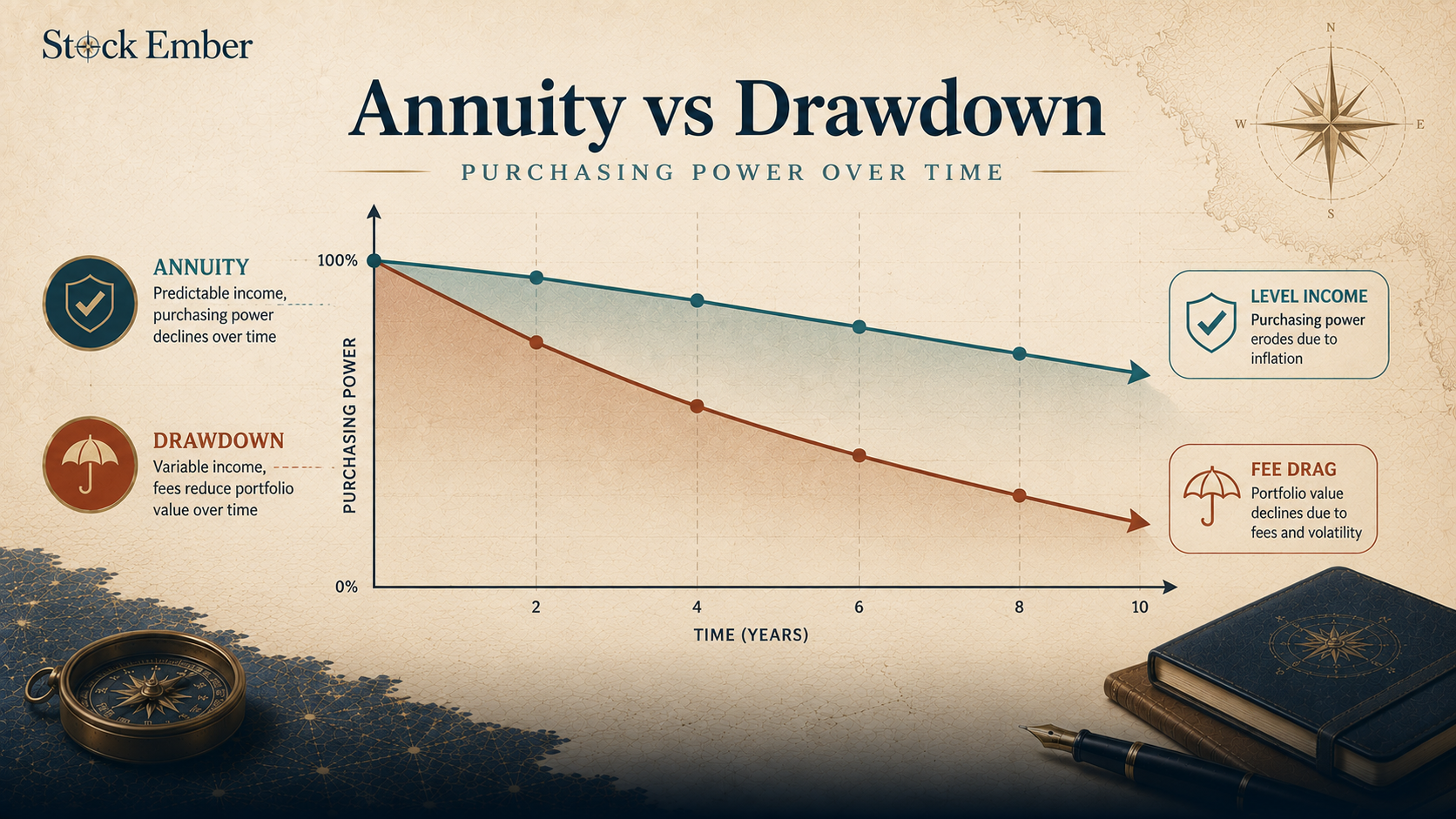
Evaluating retirement options over a 10-year horizon reveals two contrasting long-term risks: platform fee drag versus purchasing power erosion.
With flexi-access drawdown, your money remains invested in market instruments. Over a decade, ongoing annual management charges, platform custody fees, and underlying fund expense ratios compound over time. For instance, a £100,000 drawdown portfolio incurring 0.75% in total annual fees costs roughly £7,500 over ten years in direct fees and lost compounding growth. To limit these ongoing costs without taking unnecessary market risk, many long-term investors rely on a low-cost passive investing framework. Adopting broad index funds keeps fee drag low while maintaining portfolio growth potential.
Conversely, a standard level annuity charges zero ongoing platform fees after purchase, but it exposes your income to purchasing power decay. If inflation averages 3% annually, a fixed £5,000 yearly annuity payout loses approximately 25% of its real buying power over ten years.
When managing an invested drawdown portfolio, evaluating its Sharpe ratio a measure of risk-adjusted return helps determine whether your investment strategy generates sufficient returns relative to the market volatility you take on. Official guidance on decumulation options provided by MoneyHelper emphasizes balancing guaranteed baseline income against market-linked growth.
Graph showing inflation decay versus fee drag in retirement drawdown.
Common Pitfalls: The Safety Illusion and Sequencing Risk
A common mistake in retirement planning is viewing annuities as entirely risk-free while viewing drawdown as inherently superior for growth.
Level annuities create a safety illusion. While the nominal payout never changes, high inflation steadily shrinks what that payout buys. A retiree who buys a level annuity at age 65 may find that by age 80, their fixed income no longer covers essential living costs.
On the other hand, unhedged drawdown portfolios face sequencing of returns risk. If severe market downturns occur during the first few years of retirement while you are actively withdrawing cash, your capital drops rapidly. Withdrawing money from a declining portfolio locks in capital losses, making it difficult for the remaining pot to recover even when markets rebound.
In practice, many retirees protect against early market downturns by maintaining a two-year cash buffer alongside their drawdown portfolio to avoid selling equities during market declines.
Conclusion
Choosing between an annuity vs drawdown depends on your health, risk tolerance, and baseline income needs. Many long-term investors choose a hybrid approach: purchasing a smaller annuity to cover non-negotiable living expenses, while leaving the rest in flexi-access drawdown for growth and flexibility. When you are ready to evaluate broad-market funds to support a sustainable drawdown strategy, our ETF reviews provide a clear breakdown of low-cost options. Investing involves risk including potential capital loss, and annuity rates fluctuate based on interest rates, so treat this guide as educational material rather than personal financial advice.
FAQ
5 questions
What is the main difference between an annuity and pension drawdown?
An annuity converts your pension into a guaranteed lifetime income stream paid by an insurance provider. Flexi-access drawdown keeps your pension capital invested in market assets, allowing you to withdraw variable amounts of cash while exposing remaining funds to market growth and downturns.
Can you combine an annuity and flexi-access drawdown in retirement?
Yes, many retirees use a hybrid approach. You can use a portion of your pension pot to purchase an annuity that covers essential, non-negotiable living expenses while keeping the remaining balance in flexi-access drawdown for discretionary spending and potential capital growth.
Are annuity payments and drawdown withdrawals taxed in the UK?
Under both options, you can usually take up to 25% of your pension pot tax-free. Any subsequent income received from an annuity or drawn down from an invested pension is treated as taxable income and subject to UK Income Tax under PAYE rules.
What happens to my money when I die under an annuity versus drawdown?
Standard single-life annuities typically stop paying income upon death unless you purchased a joint-life annuity or a guarantee period. In flexi-access drawdown, any unspent capital remaining in your pension account passes to your designated beneficiaries.
Can you switch from drawdown to an annuity later in retirement?
Yes, flexi-access drawdown is flexible, allowing you to purchase an annuity with some or all of your remaining drawdown pot at a later age. However, buying an annuity is an irreversible decision that cannot be undone once the cancellation period expires.
Disclaimer
This guide was written with AI assistance and reviewed by the StockEmber editorial team for accuracy. StockEmber provides independent education, not personal financial advice. Some links may support our work at no additional cost to you.
The StockEmber Team is our in-house desk of independent research writers. We test brokerage platforms, read the fine print on fees and custody, and cover ETFs and long-horizon investing for people who plan to hold for decades — not days.