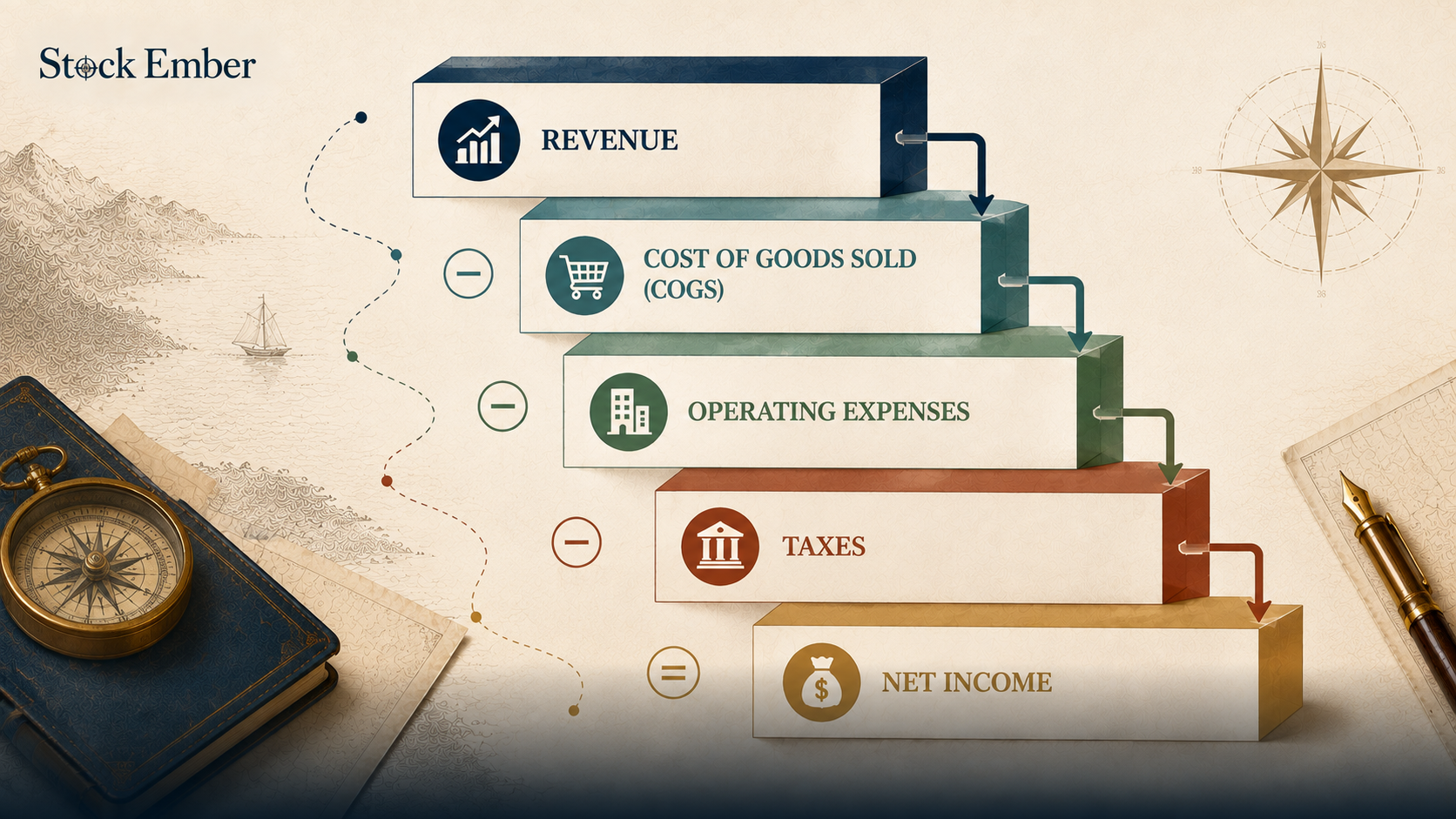
An income statement is a primary financial report that summarizes a company's revenues, expenses, and net profit or loss over a specific reporting period. Using accrual accounting, it tracks how top-line sales flow down through operating costs and taxes to reach bottom-line earnings.
An income statement is a primary financial report that details a company's revenues, expenses, and net profit or loss over a specific reporting period, such as a quarter or year.
Investors often look at earnings headlines to judge a company's financial success, but top-line sales numbers do not tell the full story. Understanding how revenue flows down through operating costs, taxes, and non-operating items reveals whether profits reflect true operational health. This guide covers how a basic income statement works, its core components, and how to evaluate earnings quality.
Quick Takeaways
01It shows a company's financial performance by subtracting expenses from revenues to calculate net income over a set period.
02Accrual accounting rules record revenue when earned and expenses when incurred, meaning net profit does not equal liquid cash flow.
03Preferred stock dividends are subtracted from net income to determine residual earnings available to common shareholders.
04Relying solely on headline earnings growth can be misleading if profits stem from one-time asset sales or aggressive revenue timing.
What Is an Income Statement? Definition & Core Structure
In financial accounting, an income statement definition refers to the financial report that measures a company's profitability over a set timeframe. Also known as a statement of income or profit and loss (P&L) statement, it summarizes gross revenues, operating costs, tax obligations, and bottom-line profit.
When learning about what is income statement structure, investors can think of it as a stair-step calculation. The report starts at the very top with gross sales (top-line revenue) and systematically subtracts production costs, overhead expenses, interest, and taxes until reaching net income (bottom-line earnings).
For anyone building fundamental skills when investing in stocks, reading this basic financial report reveals whether a business model generates repeatable profits or suffers from shrinking profit margins.
Key Components of a Simple Income Statement
It organizes financial activity into distinct line items, allowing investors to evaluate operating performance step by step:
Revenue (Gross Sales): Total money generated from selling goods or services before deducting any costs.
Cost of Goods Sold (COGS): Direct expenses required to produce goods or deliver services, such as raw materials and direct labor.
Gross Profit: Revenue minus COGS, showing core production efficiency.
Operating Expenses (OpEx): Indirect expenses necessary to run the business, including selling, general, and administrative (SG&A) costs, marketing, research and development (R&D), and depreciation.
Operating Income (EBIT): Gross profit minus operating expenses, measuring profit generated strictly from core business operations.
Non-Operating Items & Taxes: Interest expenses on debt, interest income, one-time gains or losses, and corporate income taxes.
Net Income: The final bottom-line profit remaining after all expenses, interest, and tax obligations are deducted.
The basic math follows a linear structure:
Operating Income = Revenue − Cost of Goods Sold − Operating Expenses
According to financial disclosure guidelines provided by the SEC, evaluating each expense tier helps investors identify whether rising costs or falling sales are eroding overall profitability.
Stair-step diagram detailing revenue, operating expenses, and net income components.
Accrual Accounting: Revenue vs. Actual Cash
Understanding what is an income statement requires recognizing the difference between accrual accounting and cash accounting. Public companies report earnings using accrual accounting rules, which recognize revenue when performance obligations are met and goods are delivered not when cash enters the bank account.
Similarly, expenses are matched to the period in which the corresponding revenue is generated. For instance, if a company purchases manufacturing machinery, it does not deduct the entire equipment cost at once. Instead, it spreads the cost over several years through depreciation expense on the report.
Because of accrual accounting, a company can report strong net income while experiencing cash flow shortages if customers delay paying their bills. Long-term investors must compare net profit against actual cash flows to ensure reported earnings represent real money.
How Preferred Stock Dividends Impact Net Income
When analyzing net profit, common equity investors must pay close attention to how capital structure affects bottom-line distributions. Companies that issue preferred stock must pay fixed dividends to preferred shareholders before distributing earnings to common stock owners.
Net income listed at the bottom of the statement of income reflects total corporate profit, but it does not account for preferred dividend obligations. To calculate earnings available to common shareholders, preferred stock dividend payments must be subtracted from net income:
Net Income Available to Common Shareholders = Net Income − Preferred Stock Dividends
If a business earns $10 million in net income but must pay $2 million in preferred dividends, only $8 million remains for common equity holders. This distinction is essential when calculating net income per share (EPS) for common stock.
Why the Statement of Income Matters for Buy-and-Hold Investors
For long-term buy-and-hold investors, evaluating multi-year income statements shows whether a company possesses a sustainable competitive advantage and operational resilience.
Over a ten-year holding period, a healthy business should demonstrate consistent top-line sales growth alongside stable or expanding operating margins. If revenue grows by 10% annually while operating expenses grow by 15%, profit margins will shrink, reducing the capital available for reinvestment or dividend payouts.
In practice, many long-term investors find that tracking multi-year operating margin trends reveals competitive shifts far earlier than quarterly net income headline numbers.
Common Earnings Quality Red Flags
Analyzing this report helps highlight artificial profit boosts and operational weaknesses before they lead to unexpected earnings drops:
One-Time Asset Sales Masking Weak Sales: A company selling real estate or subsidiaries can boost net income temporarily, even if core operational sales are falling.
Operating Costs Growing Faster Than Revenue: Persistent expense inflation narrows profit margins, making the company vulnerable during economic downturns.
Aggressive Revenue Recognition: Recording sales prematurely before products are delivered can force future earnings restatements or write-downs.
Conclusion
An income statement provides a clear view of a company's revenue performance, cost structure, and net profitability over time. By tracking operating income, deducting preferred stock obligations, and comparing net profit against actual cash flows, you can separate genuine operational growth from short-term accounting gains.
When you are ready to choose an investment platform to build your equity portfolio, our broker reviews offer an objective analysis of trading platforms and account features. Remember that fundamental analysis represents one part of sound portfolio management, and all stock investments carry the risk of financial loss.
FAQ
5 questions
What is an income statement?
An income statement is a financial document that tracks a company's revenues, costs, and net profitability over a specific period, such as a quarter or a year. It shows whether a business generated a profit or a loss during that timeframe.
What is the main difference between revenue and net income?
Revenue represents the total top-line sales generated from selling goods or services before deducting any expenses. Net income is the bottom-line profit remaining after all operating costs, taxes, interest, and depreciation are subtracted.
Why doesn't net income match actual cash flow on an income statement?
Income statements use accrual accounting, which records revenue when earned and expenses when incurred, rather than when cash actually enters or leaves the bank account. Uncollected bills or non-cash depreciation can cause net income to differ from cash balances.
How do preferred stock dividends affect net income?
Preferred stock dividends must be paid out to preferred shareholders before residual profits reach common stock owners. Subtracting preferred dividends from net income gives the net income available to common shareholders.
What are the main components of a simple income statement?
The primary line items include gross revenue, Cost of Goods Sold (COGS), gross profit, operating expenses (SG&A, R&D, depreciation), operating income (EBIT), interest and tax expenses, and bottom-line net income.
Disclaimer
This guide was written with AI assistance and reviewed by the StockEmber editorial team for accuracy. StockEmber provides independent education, not personal financial advice. Some links may support our work at no additional cost to you.
The StockEmber Team is our in-house desk of independent research writers. We test brokerage platforms, read the fine print on fees and custody, and cover ETFs and long-horizon investing for people who plan to hold for decades — not days.